
Travelling together: the pros and cons of multi-generational policies

In the face of changing preferences and evolving family dynamics, how can insurers tailor their policies to meet the travel needs of large family groups?
The trend of larger family groups going on holiday, frequently encompassing multiple generations, has been increasingly prevalent due to a range of factors – economic and social. Such groups will necessarily require greater flexibility in the coverage they seek – but what is there to consider when creating policies tailored to them?
What is behind the rise in multi-generational travel?
According to Stephen Samataro, Chief Revenue Officer at AXA Partners US, many families are “increasingly choosing shared experiences over material gifts”. Additionally, higher life expectancies and more active older people mean that grandparents are now frequently “eager travel companions”. Beyond this, Samataro said, “economic factors play a huge role. Many families find it more financially practical to pool resources for travel,” he said. “Shared accommodation, group discounts, and the ability to split costs make these trips more accessible.”
Despite this, Samataro reported that these trends were not reflected in AXA’s sales figures, with no significant demand for bespoke family policies as of yet. This, he stated, could be due to the dissonance between fantasy and reality: “The idea of multi-generational travel sounds appealing, but the practical execution remains challenging. Most families are more likely to have shorter, more focused gatherings rather than extended multi-generational trips.”
Garry Nelson, Head of Corporate Affairs at AllClear and InsureandGo, agreed that the desire for shared experiences was a significant factor. He reported that, according to his company’s own data, there had been a “gradual shift towards people wanting fewer, better holidays – and this does sometimes involve taking the full or extended family on a memorable holiday.
“Our summer 2025 research asked a nationally representative sample of 2,000 adults what they regarded to be the main purpose and benefits of a summer holiday and, specifically, which factors were more important to them than in previous years,” he explained. “Nationally 36% said they valued the opportunity to have quality time with their family members and children – quality time to reconnect – and 43% also said they needed time to mentally switch off with loved ones.”
Many families find it more financially practical to pool resources for travel
Samataro also noted that the desire for a shared experience was reflected in the kind of destinations typically visited by multi-generational familial groups. Such parties tend to favour locations that “offer something for everyone – relaxation, educational experiences, and activities that can accommodate different energy levels and interests”. This can include trips to historic cities, beach and cruise holidays, and various forms of domestic travel.
Greg Lawson, Head of Travel Insurance at Collinson, argued that “evolving family dynamics” were a key driver of the rise of multi-generational travel – including a shift away from the traditional, nuclear family setup.
“For example, both parents working and longer-living grandparents with more disposable income may mean more children spending school holidays with other family members, or grandparents travelling with families to act as guardians,” he said.
Creating bespoke policies
For large travel groups such as this, with many moving parts, the benefits of a single, shared policy are clear – they allow for a streamlined experience both when purchasing and when seeking assistance.
However, delivering such products can be a challenge in itself, requiring a much more flexible approach, due to the differing needs of different demographics.
For Nelson, the main considerations when tailoring a policy to a multi-generational travel group is “baggage and activity cover.
In many instances, younger travellers are more likely to be taking higher-value tech and take part in higher-risk sports and activities.
“It is also important to ensure pre-existing medical conditions are covered for all travellers included on the policy,” he added – something older travellers are more likely to need.
Samataro agreed, adding that among younger people, the popularity of extreme sports was something worth considering.
Flexibility is critical – but tricky to deliver
Furthermore, Samataro said, creating coverage that is flexible enough to meet everyone’s needs requires taking into account “different health needs, different risk tolerances, different financial constraints, [and] different residences”.
This flexibility is especially important, as the number of people covered also adds a greater likelihood of the need for changes. “Maybe Grandpa needs to modify his coverage, or the teenagers want to add an unexpected excursion,” Samataro said. “Traditional insurance just can’t keep up with that level of complexity.”
Jess Strange, Chief Customer Officer at Southern Cross Travel Insurance, noted that large family groups might be travelling to a “special family event, like a wedding or reunion” where expensive items such as special clothing or jewellery might be worn – necessitating optional coverage for such items.
Additionally, Strange noted that large groups might include travellers from outside the family unit, such as friends or
romantic partners.
“We all know of that teen who can’t bear to be separated from their first love or their absolute best mate,” she said, adding that multi-generational policies should offer the option of coverage for these occurrences as well.
“As ever with optimisation”, Lawson said, the key was not creating complexity in understanding or execution, and ensuring that policies designed around a “typical family” still worked when faced with the diversity of real ones.
He noted that the situation faced by a family with younger children would not be the same as sisters or cousins travelling together, or uncles and aunts with nieces or nephews.
Meeting the needs of different generations
Nelson noted that when it came to addressing the specific needs of different generations, it was important to recognise different priorities in terms of cost, safety, and the kind of trips being made.
He said: “Younger people tend to be more price conscious when planning a holiday, and many also look for cheaper, or last-minute breaks. They are also more likely to be interested in more adventurous trips, or participate in extreme sports.” This was is in contrast with many older travellers, “particularly over-55s”, for whom “safety is a more important consideration.
“They are also … more likely to focus on the quality of travel cover, rather than a lower headline price for a policy,” he concluded.
Samataro agreed, noting that grandparents and older travellers prioritise “comfort and security”, preferring to look for comprehensive medical coverage and protection for pre-existing conditions, alongside other health-related offerings.
By contrast: “Parents are primarily focused on logistics and safety. Their concerns revolve around trip cancellation coverage, protection for unexpected disruptions, and policies that can accommodate changing family dynamics.”
Finally, Samataro noted that for children and younger travellers, the priority was “robust medical coverage and protection against travel disruption”, especially in support of the popularity of potentially risky activities such as water sports or bungee jumping.
Lawson speculated that, as technology improves, “it may be that products can allow for different generations or relationships to travel with younger related children whilst treating them as a family”.
However, he argued that “the bigger question is whether distributors even want to ask that level of detail within the user experience, and can such personalisation be achieved cost-effectively without overcomplicating the user experience?”
Is a single family policy better?
One might assume that bundling everyone under a single policy is the easiest and most cost-effective option. But the picture is a little more nuanced.
In many instances, younger travellers are more likely to be taking higher-value tech and take part in higher-risk sports and activities
“Policies tailored to older generations are likely to have a higher base premium to reflect the higher risk of the overall traveller pool,” explained Nelson. “Even younger travellers with no medical conditions are likely to pay more than they would with someone who doesn’t offer the same specialist cover.”
Consequently, he said, they may be better off seeking insurance with a separate provider, rather than being on the same policy.
However, he warned that opting for separate policies wasn’t without its risks. One of the most significant concerns is cancellation cover, as most travel insurance policies will not provide cover for cancellation due to the health issues of an individual insured elsewhere.

Lawson added that another unique challenge of multi-generational policies, like many types of group policy, was that while they “can drive bigger income opportunities”, cancellations are also more high impact because “when one person cancels, often the whole group cancels”.
The main benefit of a multi-generational policy, from the travelling party’s perspective, is simplification, said Samataro. “Instead of managing multiple individual policies with different terms, expiration dates, and contact numbers, families get one comprehensive solution. One policy number, one assistance line, one set of documentation.”
The bigger question is whether distributors even want to ask that level of detail within the user experience
Beyond this, he added, there is a sizeable benefit to shared policies from the perspective of providing insurance. “When something goes wrong – and something always goes wrong on family trips – having a unified approach means less confusion, [with] one point of contact who understands the entire family’s travel context.”
Strange agreed: “Having every member on the same policy will save time and effort, and makes it much easier to claim if something goes wrong.”
Additionally, she noted that modern, digital solutions had made the personalisation of individual needs on one policy much easier.

Conclusion
The popularity of multi-generational travel continues to grow, due to longer lifespans, a desire for shared experiences, non-traditional family structures, and a need to pool resources. Despite the clear benefits of creating bespoke travel policies for such travel groups, the challenges of catering to the diverse needs of the individual travellers remain a logistical hurdle.
Shared policies may raise premiums for younger travellers, as well as complicating the response if things go wrong. Despite this, there is potential in the concept for insurers willing to put in the work, balancing flexibility, personalisation, and ease of use, with modern technology offering possible opportunities to deliver results.
October 2025
Issue
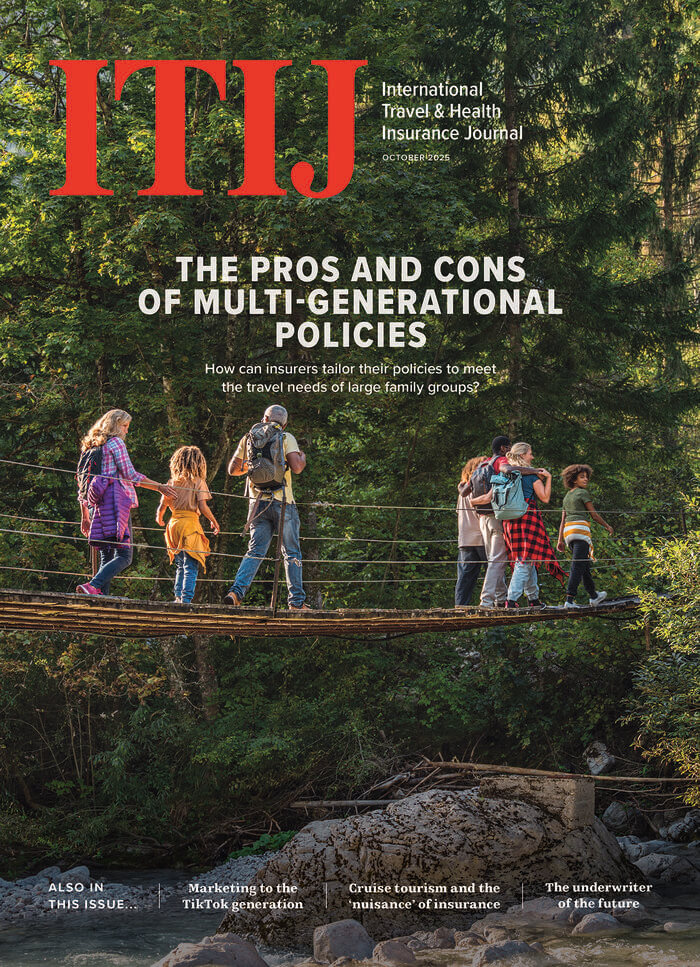
This month we examine whether insurers are making the best use of social media to target a new audience. We look at what’s been done, and what more could be done to educate a new generation. We also look at the rise in multi-generational holidays – are insurers able to tailor policies to fit this trend?