
Industry Voice: Wildfires – an escalating medical and operational risk

Dr Katherine O’Reilly, Regional Medical Director at International SOS, explores why wildfires are becoming a growing workplace risk and what organisations can do to better protect their people and operations
Parts of Europe have been experiencing one of the most severe wildfire seasons on record, and the full extent of the impact is yet to be seen. Combined with record-breaking temperatures in Western Europe and widespread drought conditions, the scale of wildfires underscores a broader shift in the risk landscape from extreme weather events.
This volatility is further complicated by the increase in concurrent health, security, and operational risks. In our Risk Outlook 2026 report, almost half (49%) of organisations say that the convergence of health, security, and operational risks has increased over the past year.
As a result, many are re-evaluating wildfire events as a persistent occupational hazard rather than a rare anomaly. To respond effectively, organisations must move beyond reacting to the immediate security and health risks, acknowledge the far-reaching consequences caused by wildfires, and take decisive steps to mitigate them.
Evolving risks of wildfires
While the immediate danger of proximity to active flames is palpable, the harms that can be caused by wildfire smoke, poor air quality, heat, and the impact on mental health are often overlooked.
The inhalation of smoke can cause obvious and immediate irritation to the eyes, nose, and throat. However, since many modern wildfires often include the burning of homes, vehicles, and commercial and industrial buildings, the smoke can carry a toxic mix of heavy metals and carcinogens in the form of fine particulate matter. Due to their microscopic size, these fine particles can penetrate deep into lung tissue and cross directly into the bloodstream.
Many organisations are re-evaluating wildfire events as a persistent occupational hazard rather than a rare anomaly
Smoke inhalation can lead to a range of health problems for individuals, such as asthma attacks, heart attacks, and strokes, and can worsen pre-existing or underlying health conditions such as chronic obstructive pulmonary disease (COPD). Additionally, exposure to extreme heat can cause dehydration, heat exhaustion, and heatstroke, and further exacerbate health issues.
The psychological toll of wildfire incidents is equally significant. The sudden nature of evacuation orders, combined with the potential loss of homes, businesses, communities, alongside prolonged exposure to smoke can lead to anxiety, depression, and post-traumatic stress disorder (PTSD).
Compounding these personal health risks is the strain wildfires can place on local infrastructure. The demand for public healthcare surges during wildfire events, while hospitals and clinics may also be experiencing operational disruption due to damage or power outages. As a result, many people may struggle to access the care they need.

Building resilience and duty of care
With wildfires presenting a range of security and health risks, the wildfire season can expose critical gaps in an organisation’s risk management that leave them underprepared to best protect their workforce and operations.
To fulfil duty of care, understanding the exposure to risk and preparing ahead is critical. This need for preparedness also extends to mitigation planning for potential concurrent risks.
Since wildfires often spread quickly and unpredictably, it is essential for every business to map out their people, assets, operations, and supply chains to gain a full picture of risk exposure and develop robust contingency plans.
Advancements in predictive modelling, threat monitoring, and risk assessments now enable organisations to better prepare for and test different scenarios
Advancements in predictive modelling, threat monitoring, and risk assessments now enable organisations to better prepare for and test different scenarios. As information volumes continue to increase, so access to timely, verified, decision-ready intelligence has become even more essential.
Organisations should also integrate heat-specific risk assessments as part of their health and safety framework, including regularly evaluating work environments and tasks for heat exposure risks. Risk assessments should pay special attention to outdoor roles and indoor spaces that lack ventilation or cooling systems and include modifications where necessary.
Equipping the workforce with essential supplies and the appropriate respiratory protection is also essential – for example, providing properly fitted N95 masks for every employee when evacuation orders are issued or the air quality index (AQI) drops below safe thresholds.
Organisations should also take into consideration any workers who are considered high-risk, and tailor support or offer alternative working arrangements to meet their specific health needs.
Breaking down silos
According to International SOS’ Risk Outlook 2026, internal decision-making is another major barrier to effective risk management. Our research exposed uncertainty within risk governance structures, with 25% of organisations unclear on escalation triggers, and 17% of organisations unclear about what happens when new risks emerge.
The findings highlight broader structural challenges in organisational risk response, with clarity around lines of responsibility and bureaucracy of decision-making emerging as significant concerns. These gaps can contribute to duplicated effort, inconsistent action, and increased pressure on teams, and ultimately delay action when speed is of the essence.
The organisations that respond most effectively are those with an integrated approach to safeguarding employee health and safety. Effective response depends not only on having plans but on sharing information rapidly across teams. According to our Risk Outlook 2026 research, organisations identify rapid verification of information (38%), cross-functional collaboration (37%), and internal information sharing (34%) as the three most important enablers of effective crisis response. Wildfires demand exactly this type of coordinated decision-making and response, bringing together medical, security, HR, travel, and operational functions. This cross-functional approach allows clear, pre-defined thresholds to be established. As risks converge and evolve, decision-makers maintain a holistic view and know who they need to inform to act decisively.
As extreme weather events evolve in intensity, frequency, and geography, having structured plans that cross organisational silos, inform and educate workforces, and empower teams to anticipate the risks and act decisively and with agility, will best position organisations to navigate the complex threats posed by modern wildfires – protecting their people and operations.
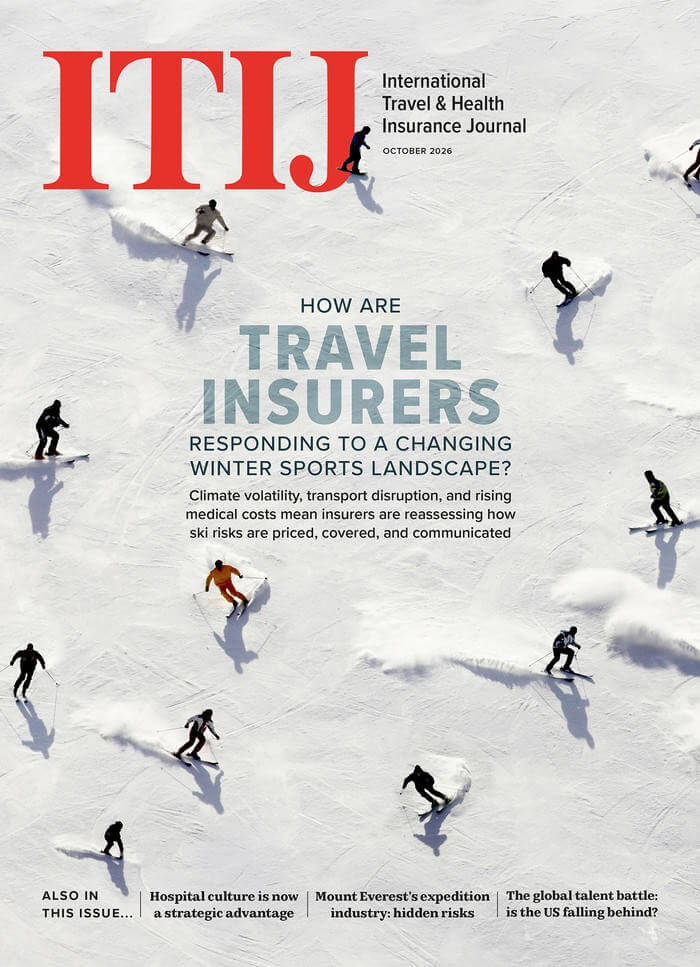
October 2026
Issue
This month in ITIJ we take a close look at how travel insurers are responding to the changes in winter sports risk, and we ask how risk is priced, covered and communicated to policy holders.
How do international hospitals stand out from the crowd, and become the number one choice for insurers and assistance companies? Clinical excellence alone is no longer enough. We look at why hospital culture has become a strategic advantage, and how dedicated international departments are strengthening relationships between hospitals, insurers, and assistance companies.
Dr Katheine O’Reilly
Dr Katherine O’Reilly is Regional Medical Director, Medical Information and Analysis for the
UK, Europe, and the Americas at International SOS. She is an experienced and enthusiastic doctor with over 10 years of expertise in medical assistance, health intelligence, and risk assessment.