
Industry Voice: Responding to an employee kidnapping: how business leaders can prepare for the unthinkable

Sue Williams QPM, Strategic Adviser – Special Risks and Crisis Management, Healix Risk and Security Advisory Board, shares her insights and experience in hostage negotiations and kidnap scenarios
Hostages. Kidnappings. We might associate these words with the plot of an exciting action film, or, under more serious circumstances, with some of the distressing stories we have all seen reported in the news in recent years. Thankfully, for most of us, the threat of being kidnapped is an incredibly unlikely prospect.
On the other hand, depending on the nature of our job, or the place where we live or work, the risk of being taken hostage ourselves, or of it happening to an employee or loved one, can be all too real. And although rare, when it happens, the impact can be huge. Preparation is essential. Both corporately and individually, we need to be ready.
As the Officer in Charge of both the Kidnap and the Hostage Crisis Negotiation Units at Scotland Yard, London’s police headquarters, and in my work since then, I have contributed to the successful resolution of hundreds of kidnaps and hostage situations, on land and sea.
In my role as a Strategic Adviser – Crisis Management on the Healix Risk and Security Advisory Board, I often meet organisations whose employees regularly face the very real threat of kidnap. As a result, I am often asked how a company should respond if the unthinkable happens, and what they should do to be as prepared as possible. The suggestions that follow scratch the surface of how to prepare for the most complex of scenarios.
Who is most at risk?
The first step for organisations is to identify which employees may be most vulnerable. Contrary to what the media might have us believe, high-net-worth individuals are not the most frequently targeted victims of kidnapping. Field operatives, expatriates, and even entry-level staff in high-risk areas can be, and have been, targeted. This is often due to their accessibility as a potential victim, rather than their wealth. Gender, too, plays a role. Women may face higher risks in certain regions due to cultural perceptions or a lack of visibility in security planning. Recognising these dynamics is essential for proactive business leaders aiming to protect their entire workforce.
Just as the types of victim can vary, so can the circumstances. Kidnapping can range from an opportunistic attack, such as being temporarily held under duress (for example, being forced to withdraw money at an ATM), to carefully premeditated abductions where ransom or political motivation is the primary motivation.
Understanding the nuances of a kidnapping situation can be just as critical as the actions taken in response. For example, male and female hostages are often treated differently. Female hostages may be more likely to be subjected to sexual violence, although of course this can happen to male hostages too. Likewise, male hostages may be seen as more expendable or viewed as more of a threat to their captors and treated accordingly.
National and locally employed staff are more likely to be taken hostage. The response must be tailored accordingly by keeping a local crisis just that: a local crisis. Fortunately, national cases do not usually have the duration or political implications of an international hostage case. Media intrusion is also easier to manage.

The golden hour
The term ‘golden hour’ has been borrowed from the medical profession. It typically refers to the time immediately after a trauma victim’s arrival at a hospital, when the medical team’s early assessment and interventions offer
an opportunity to have a positive impact on the patient’s chances of survival and subsequent recovery.
In the case of a kidnap, the first essential in the golden hour is to assemble a crisis management team (CMT) immediately. The initial assessment and choice of early actions will set the tone and professionalism of the response, and there should be an early risk assessment. This must cover the remaining staff at the crisis site, the organisational footprint, and the location of the response team. This early evaluation should seek to identify motivation, victim support, stakeholder mapping, and the credibility of the threat. Early actions will also include the most appropriate mitigation measures, notifications, and the overall strategy tailored to bring the hostages home safely and as quickly as possible. Engaging law enforcement (if appropriate), professional support, and experienced negotiators can stabilise the situation, allowing for calm, clear communication with the captors.
Contrary to what the media might have us believe, high-net-worth individuals are not the most frequently targeted victims of kidnapping
Should you pay a ransom?
Handling ransom demands introduces a financial and ethical dilemma. With insurance options and, in some cases, government provisions that allow the recovery of paid ransoms, companies would ideally focus on the safety of their employee as their priority. However, the payment of a ransom is often illegal, contravening local or international laws. Therefore, it is prudent that a legal adviser join the CMT if paying a ransom is being considered as an option.
Prevention: preparation, proactivity, and protocols
Unsurprisingly, kidnaps don’t always happen during normal working hours, when organisations are most likely to be fully resourced. When someone is taken hostage, preserving life becomes the immediate and urgent priority. Therefore, planning and procedures, prepared and ready to be implemented, can go a long way to ensure that when a crisis hits, the appropriate response can be easily set in motion.
Emergency preparedness
A well-prepared crisis response plan begins with an informed, trained CMT, with clearly defined roles. Pre-formulated templates for communication, reports, and media statements streamline rapid responses and ensure clarity in any high-pressure situation. A pre-prepared agenda for the first crisis meeting can help to establish focus and support quick, coordinated decisions. Regularly scheduled drills and simulations refine the response strategy, preparing the team for real-life events. After each incident, a thorough post-incident review should capture lessons learned to improve future responses.

Proactive security measures
Proactive security begins with an ongoing risk assessment framework. This framework identifies potential vulnerabilities, which can be addressed through routine updates
to response plans. Familiarity with standards like ISO 31030, which provides guidelines
for travel risk management, can help companies align their safety practices with international benchmarks, ensuring consistency and robustness.
Insurance policies play a key role in mitigating financial and medical risks, covering ransom demands or medical evacuations. Memorandums of understanding (MoUs) with local authorities and partners can help to reinforce the support structure if a kidnapping occurs. Proof-of-life documents and hostile environment awareness training (HEAT) are particularly important for employees working in high-risk areas, empowering them with survival strategies and a tool to help authorities identify them if necessary. Tailored training modules based on individual risk factors such as gender should also be factored in.
Employee safety protocols
Employee safety protocols are fundamental to a company’s crisis response framework. A well-developed crisis response plan that covers evacuation procedures, data security, and communication strategy ensures a structured approach to high-risk scenarios. Clear decision-making authority (DMA) assignments avoid confusion and allow swift, informed decisions.
The initial assessment and choice of early actions will set the tone and professionalism of the response, and there should be an early risk assessment
A thoughtful family support strategy, led by trained staff, is essential to provide regular updates and emotional support to family, friends, and co-workers. Social media guidelines help manage public communications, specifying approved messaging to control information flow and reduce misinformation. Additionally, access to psychological support services for employees, the CMT, and affected families is crucial, offering mental health resources to help manage the emotional impact of such an event.
If the unthinkable happens: what to do if you are taken hostage
During training for employees who are at risk of kidnap (for example aid workers in war-torn countries or areas where terrorist groups are known to operate), it is imperative to advise them that in the event of a kidnap they should:
- Try to stay calm: follow the instructions given by your captors, be cooperative, and do not argue. Try to build rapport and find common ground
- Be ready to surrender and lose belongings/have them taken. Offering them up freely without resistance can potentially de-escalate the situation
- Keep a low profile and avoid being seen to study your captors or listen too closely to their voices
- Ask for anything you need or want, such as medicines, and appear to be grateful. Explain any injuries or medical issues, and your requirements
- Eat, drink, and maintain personal hygiene and fitness routines as much as you can. It can be instrumental in captivity, as physical resilience can impact mental fortitude
- Building rapport with captors can help humanise the victim in the captors’ eyes, possibly leading to better treatment. Even subtle connections can help facilitate compassion and understanding
- If possible, captives should gently encourage their captors to notify authorities of their condition, subtly reminding captors of the captive’s value as a person and the potential consequences of harm
Humanise yourself – showing vulnerability and asking captors to update authorities on your condition can sometimes evoke sympathy and compassion from captors - Finally, never underestimate the work that is going on to secure your release. Many people will be working around the clock.
Conclusion
By implementing forward planning and comprehensive crisis management protocols, companies can significantly improve the chances of a safe outcome in the event of a kidnapping. Many real-life cases have shown beyond any doubt the stark contrast between preparedness and vulnerability. While it is impossible to eliminate every risk, those organisations that embrace strategic foresight, respond swiftly, and have built expert partnerships are in a much better position than those that have not. They are far better placed to navigate these dark situations along a clear path towards safety and survival, and with their reputation intact.
November 2025
Issue
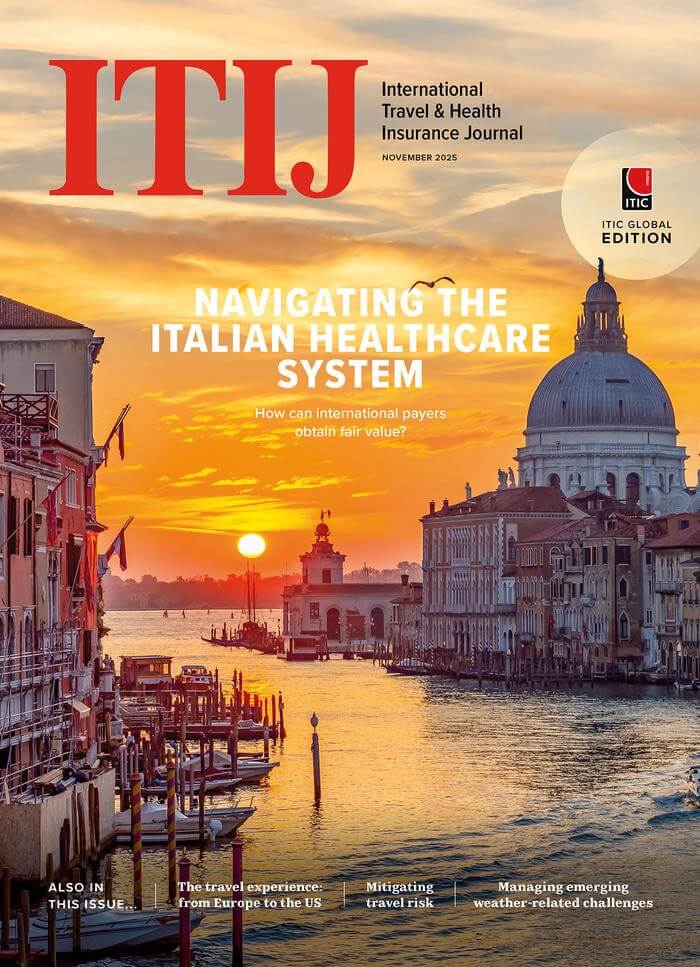
In this issue of ITIJ we look at current travel patterns to and from the US and Europe, take a close look at the Italian healthcare system, and examine how insurers are adapting policies and coverage to manage weather-related challenges.