
Industry Voice: Political problems affecting flight routes

Tom Hienckes, Business Development Manager at European Air Ambulance, describes the challenges facing air ambulance companies as a result of geopolitical issues
In today’s hyper-connected world, aviation stands as a pillar of globalisation. Yet all of those in aviation navigate a far more complex terrain: the invisible borders of geopolitics. Flight routes, the air highways that crisscross our globe, are not just designed for efficiency and fuel economy. They are often disrupted by political tensions, conflicts, and diplomatic disputes.
From sanctions and airspace bans to ongoing wars and diplomatic rifts, political problems continue to cast long shadows over commercial aviation. Air ambulance operators are not exempt; however, political tensions and international disputes continue to challenge the very essence of what we do: flying across borders to repatriate patients.
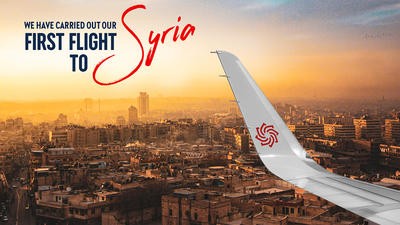

In recent years, the growing number of airspace closures, restrictions, and overflight bans has complicated … intercontinental air ambulance flights
Route reshaping
As a globally operating air ambulance service provider, European Air Ambulance (EAA), we see firsthand how political instability, diplomatic breakdowns, and evolving airspace restrictions reshape our routing, leading to costly delays, and sometimes even preventing lifesaving missions altogether.
While commercial aviation can absorb disruptions with rescheduling, medical evacuations often cannot. The impact of geopolitical issues on flight routes has risen over the last few years and continues to disrupt international air ambulance operations.
When governments issue flight restrictions for political reasons, they often take the form of:
- No-fly zones: specific areas where aircraft are not permitted to enter
due to military operations or diplomatic sanctions - Overflight bans: countries denying access to their airspace for operators from certain nations (or types of flights)
- NOTAMs (Notices to Airmen): temporary or permanent changes to airspace usage, often due to political or security issues
- Diplomatic clearance delays: bureaucratic slowdowns in granting overflight or landing permissions, which can be politically motivated.
Air ambulance flights are, despite their lifesaving purpose, often caught in the crossfire of international politics. Even when exemptions exist for medical aircraft, securing them requires significant lead time, sometimes diplomatic interventions and often local knowledge – resources that are scarce in an emergency.
It is also important to note that, depending on the conflict zone, not all air ambulance providers operate on a level playing field. Applicable restrictions vary from country to country, and risk assessments differ between operators. Additionally, the willingness to take risks or to circumvent restrictions may be higher for some operators than for others.
In recent years, the growing number of airspace closures, restrictions, and overflight bans has increasingly complicated the planning of intercontinental air ambulance flights. To address this challenge, EAA operates a 24/7 Operational Control Centre at its headquarters in Luxembourg, ensuring continuous monitoring and proactive management of global developments. This capability is further supported by dedicated resources, including a Security Manager who assesses the global security situation daily to anticipate and respond to potential disruptions.
When required, decisions must be made within minutes, with critical information promptly communicated to all relevant stakeholders, including the Accountable Manager and other responsible nominated postholders.
Given the constantly evolving global landscape, it is nearly impossible to provide a fully up-to-date overview. By the time this article is published, the situation may have already changed significantly. Nevertheless, here are a few illustrative examples that have significantly impacted the planning of global air ambulance missions in recent years.
The Russian invasion of Ukraine
Perhaps the most prominent example of political problems affecting flight routes in recent years is the aftermath of the Russian invasion of Ukraine in February 2022. The conflict prompted the European Union, the UK, the US, and several allies to close their airspace to Russian carriers. In retaliation, Russia banned most Western airlines from entering its airspace.
For us, operating global medical flights, this has had cascading consequences. For example, routes between Europe and Asia, which traditionally passed over Russian airspace, have had to be significantly rerouted, leading to longer flight times with more fuel stops, which of course has a direct impact on the costs.
Even though long-range aircraft, such as EAA’s Challenger 605, have been introduced to the air ambulance market in recent years, extensive airspace bans – such as those over Russia – continue to pose significant challenges for flight planning.
The Middle East conflict
Another area impacting flight routes is the recurring escalation of tensions in the Middle East. Unlike the closure of Russian airspace, where conditions have remained largely unchanged since the onset of the conflict, the situation in the Middle East keeps evolving daily, often affecting multiple countries simultaneously. Israel, Jordan or Lebanon, for example, have suspended flight operations multiple times, sometimes at very short notice; this volatility has meant sudden rerouting or mission cancellations – sometimes while patients were already en route to the airport.
The political challenges affecting flight routes have numerous consequences for air ambulance operators
Due to the confrontations between Israel and Iran, the difficult situation in the Middle East peaked in June 2025, when other Gulf countries, including the United Arab Emirates, Qatar, Bahrain, Kuwait, and Saudi Arabia, also issued temporary airspace restrictions or partial closures, causing major disruptions.

Violence in Sudan
Maybe less known in the public and less covered in the media but nevertheless having a big impact on the planning of flights is the resurgence of violence in Sudan since 2023, which led to the closure of its airspace, a crucial corridor for flights between Sub-Saharan Africa and the Middle East. Adding to this challenge are the ongoing conflict zones in nearby countries such as Yemen, Libya, and Somalia. As a result, thorough and well-advanced planning of air ambulance flights is essential. Staying on the African continent, other airspace closures causing disruptions were in Niger, Gabon and lately also between Algeria and Mali.
The political challenges affecting flight routes have numerous consequences for air ambulance operators. Of course, delayed patient evacuations or, in the worst-case scenario, cancellations, are highly detrimental for everyone involved: primarily the patient, but also the assistance company and the operator itself.
Time, costs, and crew wellbeing
In critical care scenarios, time is a crucial factor. Political restrictions that require longer flight routes can delay the transfer of patients to definitive care facilities by several hours. Extended flight durations also increase the time patients spend on board, which may not always be in their best medical interest.
Detours and additional technical stops significantly increase fuel consumption and airport expenses, such as landing or handling fees. These rising operational costs cannot be absorbed by the operators alone and, unfortunately, must often be passed on to clients. Depending on the routing, these additional costs can be substantial.
Rising operational costs cannot be absorbed by the operators alone
Longer flight routes result in extended duty times not only for flight crews but also for medical teams. At EAA, we must frequently exchange both flight and medical crews to remain within legal duty limits and ensure the highest standards of patient care. Supervising a patient, especially an intensive care unit (ICU) case, on a journey lasting 18 hours or more without crew relief would be medically irresponsible. While these crew changes do lead to additional costs, patient safety has always been at the core of EAA’s identity and operational philosophy.
As the geopolitical landscape continues to evolve, European Air Ambulance, as a globally operating provider, remains agile: by implementing proactive and intelligent route planning, supported by continuous monitoring of operational restrictions, real-time updates, and geopolitical alerts, our dispatch team can plan the safest and most reliable flight routes at any given moment and adapt it if required.
With the addition of two long-range Challenger 605 aircraft to the EAA fleet, we have significantly diversified our capabilities and extended our operational reach beyond that of the existing Learjet 45XR fleet. Operating aircraft with greater range and fewer operational restrictions provides enhanced flexibility in routing and mission planning.
We can only hope that the geopolitical tensions we are currently facing will eventually subside – not only for the sake of air ambulance operations, but for the wellbeing of humanity and the world as a whole.
September 2025
Issue
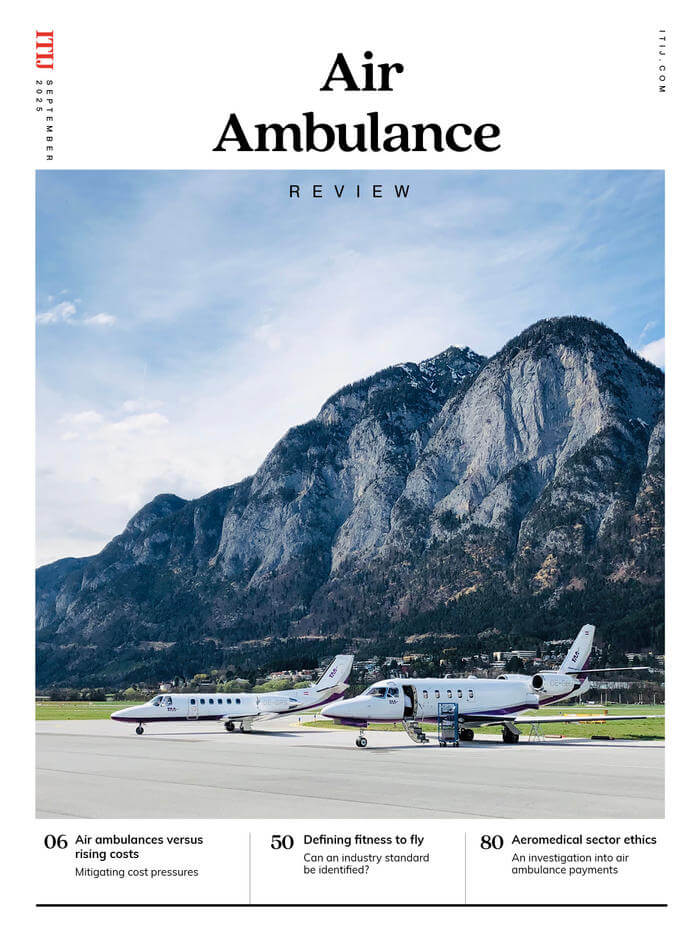
We include an examination on defining ‘fitness to fly’, and ask if an industry standard can be identified, and what that would involve. We also look at capacity in the aeromedical market and experts share their insights. Ethics and transparency in the aeromedical sector is a big issue, and we include an investigation into air ambulance payments.
Tom Hienckes
Born and raised in Luxembourg, Tom Hienckes was fascinated by aviation since early childhood. After his studies in aviation management, he joined a business jet operator, working in the charter sales and in aircraft management departments in Luxembourg and London. In 10 years, he received a significant knowledge of the commercial and operational aspects in aviation. Fluent in English, French, German and Luxembourgish, he dealt with B2B clients as well as with direct clients. He accepted a new challenge in the air ambulance industry by joining the European Air Ambulance as Business Development Manager in February 2022. Off the job, Tom enjoys cycling, hiking, spending time with family and friends, while keeping his own sheep and chicken.