
Industry Voice: Known unknowns: navigating political volatility in aeromedical transport

Eva Kluge, Managing Director of EURAMI, explains why the ability to prepare for every eventuality is what sets air ambulance operators apart
In aeromedical transport, meticulous planning and tight operational windows are not luxuries – they are imperatives. Every mission is a carefully choreographed sequence of clinical precision, logistical expertise, and regulatory compliance. But what happens when the geopolitical landscape introduces sudden volatility – when airspace corridors close overnight, landing rights are revoked with little warning, or new tariffs are imposed mid-flight-plan?
These are the known unknowns of aeromedical aviation. Providers understand that the global political climate is volatile – but they can rarely predict when or how that volatility will manifest. And as the tempo of geopolitical shifts accelerates, the ability to prepare for every eventuality becomes a critical operational differentiator.
Long-term planning meets short-term disruption
Commercial aviation typically plans in multi-year cycles. Fleet renewals, infrastructure investments, and route strategies often unfold over five, 10, or even 20 years. Air ambulance operators, though nimble and mission-oriented, are deeply embedded in this ecosystem. The aircraft they use, the airports they rely on, and the regulatory permissions they require all flow from the broader aviation framework.
Yet aeromedical missions do not benefit from the same margin for delay. A patient in critical condition cannot wait for a new bilateral air agreement to be negotiated. As such, short-term disruptions – tariff hikes, sanctions, denied landing permits, airspace restrictions – can have immediate and profound operational impacts.

Recent events in the Middle East have underscored how quickly a region can become inaccessible. Operators have had to reroute flights, sometimes adding hours of travel time or forcing expensive diversions. The cost implications are not trivial. Fuel burn, crew duty time, and the need for additional medical staff or aircraft swaps all compound under pressure.
Recent events in the Middle East have underscored how quickly a region can become inaccessible
Rising costs, squeezed margins
Beyond direct delays, operators are facing sharp cost increases from less visible sources. Overflight charges can spike due to airspace closures. Insurance premiums may rise in regions deemed high-risk. Emergency permitting – once a rare exception – is now a more common and costly reality in certain jurisdictions.
Moreover, medical inflation and staffing shortages mean that any delay in repatriation or transport not only adds logistical complexity, but also increases clinical risk. Providers must carry the burden of redundancy: extra permits, alternate routing plans, diplomatic channels on standby – all of which cost time and money, and may never be needed until they suddenly are.

Accreditation as a strategic advantage
In this landscape of shifting variables, aeromedical accreditation has become more than a clinical quality benchmark – it’s a strategic asset. Accreditation by recognised bodies such as the European Aero-Medical Institute (EURAMI) provides access to a global network of trusted partners and peer operators.
Accredited providers benefit from shared intelligence, peer benchmarking, and collaboration opportunities that can prove crucial during times of disruption. Whether it’s coordinating patient transfers across politically sensitive regions or accessing reliable ground support in unfamiliar countries, the strength of the accredited network helps operators navigate challenges that no single company could manage alone.
Moreover, the regular audits and compliance updates associated with accreditation help organisations remain agile, proactive, and current with best practices – ensuring they are always prepared, even when faced with the unknown.
Mitigation through agility and partnerships
So how else can aeromedical operators mitigate these uncertainties?
First, strategic redundancy is essential. This means maintaining multiple route maps for high-risk regions, securing pre-approved landing rights in friendly jurisdictions, and cultivating relationships with a broad network of ground handlers, fixers, and government liaisons.
Second, alliances with local providers have become more valuable than ever. In regions where international air ambulance flights may be blocked or delayed, local teams can offer critical stopgap support – from ground ambulances and hospital coordination to temporary patient stabilisation.


By embedding flexibility, cultivating relationships and investing in real-time intelligence, they can navigate a world where political volatility is no longer the exception, but the norm.
Third, technology and real-time intelligence are powerful tools. Dynamic flight-planning systems that incorporate NOTAMs, airspace restrictions, and geopolitical risk indicators allow operations teams to make informed decisions quickly. Integrated tracking and communication platforms also ensure that stakeholders remain in lockstep, even as plans change mid-flight.
Finally, some providers are rethinking aircraft fleet composition. Smaller, more fuel-efficient jets capable of short-field operations offer greater flexibility during political unrest. Helicopter partnerships or hybrid air–ground solutions are also being explored for intra-regional evacuations where international fixed-wing operations face obstacles.
Preparing for the unpredictable
In the words of former US Secretary of Defence Donald Rumsfeld, “there are known knowns... known unknowns... [and] unknown unknowns”. Aeromedical operators live primarily in the realm of the second. They know airspace closures are possible, that geopolitical instability can disrupt flights – but not precisely when or where.
What sets resilient providers apart is their readiness for the unpredictable. By embedding flexibility, cultivating relationships and investing in real-time intelligence, they can navigate a world where political volatility is no longer the exception, but the norm.
In aeromedical transport, patient outcomes are shaped not only by clinical care but by the operator’s ability to land where others can’t – or to find a new path when the old one is suddenly closed. That is the true meaning of preparing for every eventuality.
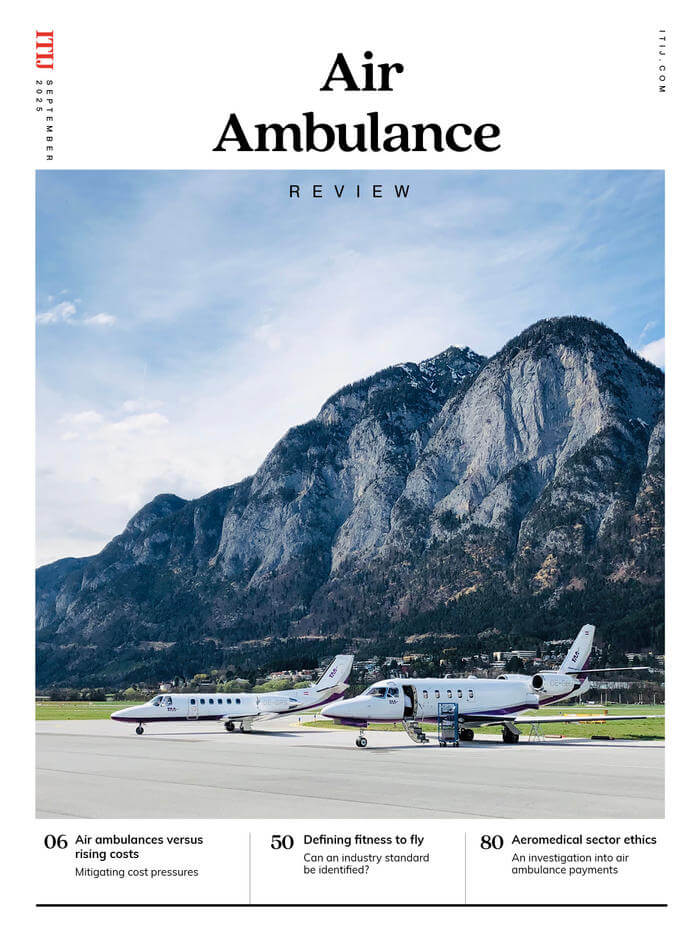
September 2025
Issue
We include an examination on defining ‘fitness to fly’, and ask if an industry standard can be identified, and what that would involve. We also look at capacity in the aeromedical market and experts share their insights. Ethics and transparency in the aeromedical sector is a big issue, and we include an investigation into air ambulance payments.
Eva Kluge
Eva is the Managing Director of the European Aero-Medical Institute (EURAMI). She brings over 25 years of leadership experience in strategic and operational roles within the aeromedical, medical assistance and travel insurance sectors. Eva played a key role in business growth and marketing for more than a decade at leading air ambulance companies in Germany and Austria, earning multiple awards for her pioneering contributions to the industry. She holds a bachelor’s degree in Healthcare Social Management and an MBA in Digital Transformation. A multilingual professional fluent in five languages, including Arabic, Eva spent seven years living and working across the Middle East. She is an esteemed board member of several industry organisations and currently serves on the ITIC MEA Committee.