
Industry Voice: Hotspot Cover’s George Dagnall on risk reality

In our regular column on security and travel risk, George Dagnall, COO of Hotspot Cover, shares his insights with ITIJ. This month he asks if converging crises have turned this into an uninsurable decade
In today’s world, geopolitical risk is no longer sequential. It’s simultaneous. From open war in the Middle East to economic brinkmanship in the Taiwan Strait, we’re now operating in an era of converging crises, compounded by a global rise in authoritarianism. For insurers, the question isn’t where the next crisis will start, but how systems will absorb the next shock when everything is already under pressure.
A world in overlap: the risk landscape
The global order isn’t fraying; it’s already reforming into something sharper, harder, and more dangerous. We are witnessing open war between Israel and Iran, the potential for a US$10 trillion global GDP shock from a Taiwan-China escalation (Bloomberg Economics estimate), and an accelerating breakdown of the post-Cold War international system and rules-based order, once assumed to be permanent. But perhaps the most worrying trend is what isn’t discussed in actuarial models: the global rise of authoritarian governance and political fragmentation.
From Beijing to Moscow, Ankara to Tehran, and increasingly from Tel Aviv to Washington, we’re witnessing a shift away from multilateral cooperation and liberal governance norms. Populism, nationalism, and strategic unilateralism are challenging the frameworks that once underpinned international insurance, law, and diplomacy. The erosion of judicial independence, press freedom, and cross-border cooperation doesn’t just change how nations operate, it changes how risk behaves.
What matters now is the chain, how one crisis cascades across regions, sectors, and policies
This shift is upending assumptions that insurance has long relied on: that legal systems will enforce contracts, that regulators act impartially, and that borders function in emergencies. As these expectations weaken, so does the reliability of everything from emergency medical access to the ability to settle claims across jurisdictions. The result isn’t outright collapse, but fragmentation, a breakdown in the connective tissue that global insurance depends on. And that makes risk not just harder to price, but harder to respond to.
And as history, especially from the 1930s, reminds us, when powerful states abandon liberal constraints, what follows is not balance, but ambition, secrecy, and strategic surprise. This, more than any one hotspot, may be the defining risk of the next decade.
The insurance response: beyond location-based risk
Traditional underwriting starts with a location: where is the crisis? But in 2025, that logic is outdated. What matters now is the chain, how one crisis cascades across regions, sectors, and policies. A missile strike in the Gulf can reroute energy markets in Asia. A blockade near Taiwan can choke electronics supply in Europe. Political repression in one country can cut off access to emergency services in another.
This requires a shift in how we model and structure cover:
• Systemic scenarios must replace single-point assumptions
• War and terrorism extensions must consider adjacent escalation, not just
declared zones
• Intelligence must feed underwriting real-time data, early-warning indicators, and adaptive clauses.
Most importantly, insurers must build capacity for uncertainty.
Not every risk can be modelled. But the inability to model authoritarianism or state collapse does not mean it can be ignored. This is a moment for strategic courage, to build products and partnerships that move with the world as it is, not as it was.
July 2025
Issue
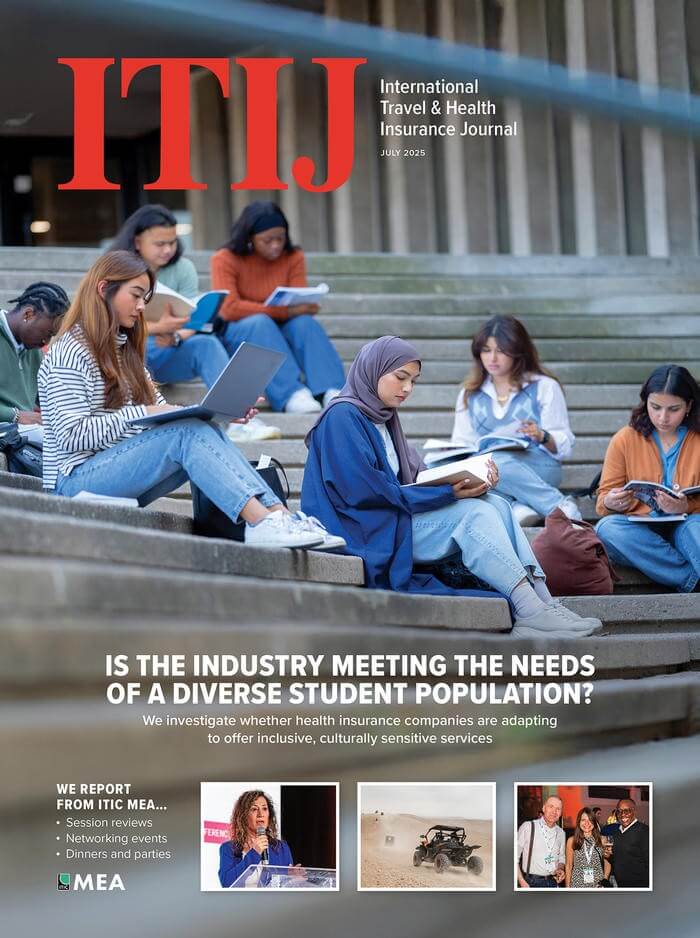
In this issue we look at health insurance for international students, and ask if the industry is adapting to offer inclusive, culturally sensitive policies. We also examine the potentially lucrative world of bancassurance, plus we investigate wait times in the American hospital system.
George Dagnall
George is a risk management expert specialising in conflict zones. With a background in security strategy, a decade of military service, and senior consultancy experience, he ensures comprehensive protection in high-risk environments.