
Industry Voice: Instability in Gaza

In our column on security and travel risk, George Dagnall, COO of Hotspot Cover, shares his insights with ITIJ. This month he assesses the instability in Gaza, along with insurance limits and operational realities
Since the escalation in Gaza began in October 2023, the operational environment has shifted beyond recognition. What initially appeared to be a targeted military response has become a prolonged campaign marked by mass displacement, sustained bombardment, and widespread infrastructure collapse. The humanitarian cost is overwhelming and for those tasked with maintaining safety, continuity, or crisis response in the region, the scope of the challenge is sobering.
For insurers, assistance providers, and organisations with personnel on the ground, the situation now presents not only moral and logistical complexity, but significant limitations in what can be realistically covered, delivered, or executed.

Security conditions: a multi-theatre crisis
Gaza remains the most extreme theatre of this conflict. Current figures estimate over 50,000 Palestinian deaths, including 173 journalists and media workers, and over 70% of Gaza’s infrastructure damaged or destroyed. Humanitarian corridors remain inconsistent or unsafe, and most forms of evacuation are functionally impossible without diplomatic or military coordination.
The ripple effects extend far beyond Gaza. Rocket fire and drone attacks continue across Israel’s northern border with Lebanon, while violence and unrest in the West Bank, including settler activity and Israel Defense Forces (IDF) operations, contribute to a highly fragmented security picture. Since October 2023, over 1,860 attacks on Palestinians in the West Bank have resulted in roughly 800 deaths.
Inside Israel, public pressure on the Netanyahu government is mounting. Military fatigue, political polarisation, and a lack of diplomatic progress further complicate response planning for both local authorities and international partners.

Insurance and assistance: what’s feasible now?
This environment has pushed insurance frameworks to the edge. Most traditional travel insurers have excluded Israel and the Occupied Palestinian Territories from coverage entirely. Even specialist providers face enormous constraints, especially in Gaza, where standard assistance models often break down in the face of access barriers, communications blackouts, and real-world danger.
What’s emerging is a market divided by readiness. Policies linked to strong pre-deployment planning, reliable local networks, and defined evacuation strategies are still being written, but on tight terms. One-off, reactive cover is increasingly difficult to place, especially for Gaza, though policies for the West Bank and Israel remain possible.
Kidnap and ransom (K&R) coverage is evolving too. The threat profile now extends beyond abduction to include politically motivated detentions, arbitrary interference, and non-state-actor involvement in checkpoints and civil infrastructure. Assistance providers are calling for a more nuanced approach and some insurers are responding with packages that integrate real-time intelligence, crisis management, and tailored advisory.
This environment has pushed insurance frameworks to the edge
Looking ahead: the role of insurance in prolonged conflict
This war has made something clear: insurance can no longer be siloed from response planning. It has to work as part of a broader risk framework, one that understands movement, access, intelligence, and local context.
For organisations operating in Gaza, or observing closely from across the region, this is not just about insurance cover; it’s about forward planning with the right capabilities in place. Now, more than ever, those two things need to go hand in hand.
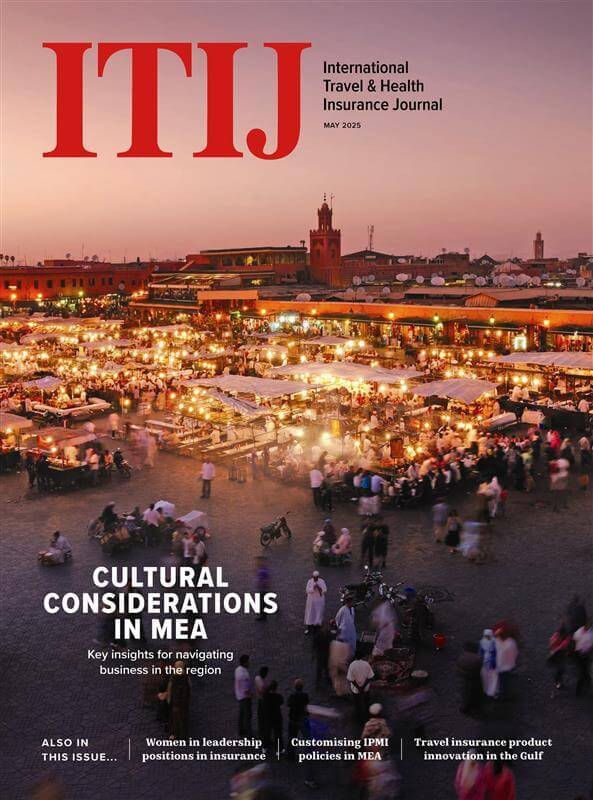
May 2025
Issue
In this issue of ITIJ we consider cultural considerations and understanding in the Middle East and Africa; look at IPMI in the MEA region and the customisation of policies; and gain insights from woman in leadership positions who share the obstacles and opportunities they have encountered.
George Dagnall
George is a risk management expert specialising in conflict zones. With a background in security strategy, a decade of military service, and senior consultancy experience, he ensures comprehensive protection in high-risk environments.