
Humanity amid complexity

Insurers and medical transport providers share with Lauren Haigh protocols, clinical considerations, and best practices for safely transporting patients with psychosis
Psychotic experiences impact millions worldwide. Research from 2021 shows that psychoses affect more than 20 million people on a global scale, while a 2023 study found that incidence of psychotic episodes in the general population was two in every 100 people and, in terms of persistence, episodes continued each year in 31% of cases. Psychotic conditions are incredibly complex and when psychosis intersects with international travel, situations can quickly become even more complicated.
Research has found that 11.3% of travellers experience symptoms of mental illness during travel and 0.3% of travellers experience an acute psychotic episode. Approximately 2.4–3.1% of all in-flight emergencies can be categorised as psychiatric, and psychiatric illness is among the most frequent causes of medical evacuations, with psychotic disorders representing an estimated 10–20% of cases. Timely repatriation can be essential in these scenarios but the safe repatriation of patients experiencing psychosis is one of the most sensitive and complex challenges faced by air ambulance providers, assistance companies, and insurers.
“Transporting a patient who is in the middle of a psychiatric episode is one of the most delicate situations in aeromedical care,” confirmed Dr Miguel Cortés, Senior Flight Physician at AirLink Ambulance. “These missions require precision, compassion, and clear coordination between aviation, medical teams, and insurance companies.” Due to the complex nature of these transfers, including clinical, operational, and legal risks, coordinated decision-making across all stakeholders is crucial, along with significant expertise and rigorous safety protocols that prioritise both safety and dignity.
Is this the right decision?
For insurance and assistance companies, the process begins with deciding whether a transfer should go ahead at all and, if so, how it should be executed. The decision hinges on considerations that span patient safety, aviation constraints, and legal responsibility.
“The key is assessing stability and risk, including agitation, self-harm potential, and medical comorbidities, while ensuring legal compliance, consent, and safeguarding,” underlined Ricus Groenewald, Director of Operations at International SOS. “Operationally, it is critical to choose routes that minimise stress and have contingency plans for delays or escalation. Exploring direct routes reduces exposure to changing environments of different airports, aircraft, and other passengers.”
There are also aviation realities that shape the decision. Dr Cai Glushak, Medical Director and Chief Medical Officer at AXA Partners North America, highlighted that psychotic patients might be disconnected from their surroundings and prone to paranoia or emotional volatility. “The most important thing to assure is that they will be cooperative and not demonstrate physical resistance or volatile behaviour in the airport or on an aircraft,” he stated. “Additionally, they must not be prone to loud or disturbing outbursts that would dismay other passengers. Psychosis must generally be treated with medication and we must be assured they have been adequately medicated to control their behaviour in transit.”
In order to ensure a safe transfer, wherever possible it’s advised to wait until clinical stability is achieved. Dr Finn Morgan, Chief Medical Officer at Healix, confirmed that a commercial transfer was often only possible once a patient had demonstrated sustained stability. “Clinical stability is the primary consideration. If the patient is being transferred commercially, a thorough psychiatric assessment should confirm that the patient is not in an acute crisis, as uncontrolled agitation or aggression can compromise in-flight safety,” he stated. “Awareness of their medication compliance and recent treatment history are essential, ensuring the patient has received appropriate antipsychotic therapy and sedation if indicated.”

Assessment and stabilisation
Once approved, air transport providers take responsibility for ensuring that patients experiencing psychosis are fit to fly. “Our first priority is to help the patient reach both medical and emotional stability before they ever step onto the aircraft,” explained Dr Cortés. “Each mission begins with a thorough pre-flight assessment designed to understand what triggered the episode, whether it is psychiatric, substance-related, metabolic, infectious, or due to dehydration or electrolyte imbalance.”
Transporting a patient who is in the middle of a psychiatric episode is one of the most delicate situations in aeromedical care
Environmental preparation is also key, with providers working hard to establish a calm and trusting environment. “[Being] inside an aircraft where space is tight and movement is limited can feel overwhelming for the patient,” said Dr Cortés. “Because of that, our team focuses on creating the calmest and most predictable environment possible, shaping the patient’s environment to reduce overstimulation. This means softer lighting, fewer distractions, and minimal unfamiliar interactions, as well as using simple, steady communication that reassures the patient and helps build trust. The quieter and more predictable the cabin feels, the safer it is for everyone on board.”
ITIJ also spoke to the medical team at Airlec, who emphasised the importance of establishing trust from the first encounter: “It’s important to create a trustworthy environment as soon as possible,” they said. “This starts when we first visit the patient, introducing ourselves, explaining the steps for the repatriation, and showing pictures of the aircraft.”

Medication and monitoring in the air
Once on board the aircraft, the patient is continuously monitored and gently sedated as appropriate. Continuous monitoring is key for early intervention while deep sedation is not the goal.
Dr Glushak emphasised that medication was used to ease distress and agitation, not to fully sedate. “Medical supervision must be stringent, but humane. Minimum restraint should always be applied, but teams must be prepared to escalate if behaviour threatens safety,” he highlighted.
Protocols and safety
Clarity and consistency are essential when it comes to protocols, restraint, and safety. By ensuring strict frameworks are adhered to and staff are equipped to deal with the unexpected, the best chances of a safe and efficient transport are secured. “Providers should follow recognised safety frameworks and have written protocols for psychiatric emergencies during transportation,” Groenewald clarified. “These must emphasise de-escalation, ethical restraint only when necessary, and continuous monitoring. Staff must be trained in crisis management and sedation, with clear documentation and incident reporting.”
Frameworks are translated into detailed operational practice by providers. For example, at AirLink Ambulance, every psychiatric mission follows a written transport plan, with at least two clinicians trained in mental health transport on board. Patients are positioned away from cockpit controls and exits, equipment is secured, and crew roles are clearly defined.
“The pilot in command is always informed if behaviour changes,” Dr Cortés asserted. “Aviation safety protocols guide whether a flight continues, diverts, or stops. It’s the protocols and guidelines that enable us to manage even the most challenging psychiatric transports with structure, compassion, and confidence.”
Airlec’s medical team highlighted the importance of aligning psychiatric care with aviation safety and local law. “This includes complying with jurisdictional rules on restraint and involuntary treatment, maintaining close communication with pilots, and ensuring sufficient staffing ratios to prevent access to aircraft doors if agitation escalates,” the team outlined.

The right match
Insurers and providers share the responsibility of matching the right aircraft and crew to the level of risk. “Escort levels must match acuity,” said Groenewald. “Providers need monitoring devices, sedation kits, and soft restraints if clinically indicated. Operational readiness includes secure seating, calm environments, and coordination with the receiving facility for immediate care. It is important to know the capability and experience of your provider network so that the selection of the most appropriate provider for a patient movement can be ensured.”
Dr Cortés highlighted that fixed-wing aircraft were generally preferred for psychiatric transfers. “They provide smoother flight characteristics, more space, and greater control over lighting and noise,” he stated. “Long-haul missions require advance planning, including medication strategies that remain safe over many hours, hydration monitoring, and staff rotations to maintain uninterrupted supervision.”
The medical team at Airlec highlighted that fewer stops, larger cabins, and medication availability in oral, intramuscular, and intravenous forms reduced the risk of agitation during long-haul missions.
Wellbeing for all
Families play a key role in the transfer of psychiatric patients due to their influence on patient stability, and it’s important to also ensure the safety and wellbeing of family members. “Families should receive clear pre-transfer guidance on what to expect,” said Groenewald. “If the patient lacks capacity, next of kin must be engaged promptly. Even when families can’t travel, structured updates provide reassurance.”
Dr Morgan explained that familiar faces could be calming for patients, but consent and safety must guide involvement. “Sedation or restraint can be distressing for family members to witness so their wellbeing must also be considered,” he noted.
Providers rely heavily on family insight. “Relatives often tell us what calms the patient, what triggers distress or how best to communicate; information that doesn’t appear in medical records,” said Dr Cortés.
Dr Glushak agreed: “Families are often familiar with the behaviour of psychotic patients with an established history and known diagnosis. They can be very therapeutic in dealing with a patient who finds comfort in a familiar person’s presence. They may also be needed to ‘babysit’ the patient and ensure they take their medications while awaiting the arrival of the escort team in cases in which the patient is no longer hospitalised. We often rely on their observations to validate the patient is truly cooperative before embarking on an escorted trip.”
The quieter and more predictable the cabin feels, the safer it is for everyone on board
Where appropriate, Airlec aims to include an accompanying person to help the patient feel safe and confident. When that isn’t possible, clear communication around timing, medication, and risks remains essential.
Even when families are not on board, keeping them informed throughout the transfer reinforces trust and compassion at a highly distressing time.

Continuity of care
In order to be seamless and successful, psychiatric transfers require continuous collaboration from the outset, with insurers and assistance companies often acting as the central coordinators between providers, families, and ground teams. “It’s important to assign a main point of contact for updates and use a structured communication plan with scheduled milestones,” said Groenewald. “This one key point of contact is for escalation or critical decision-making. Regular and accurate information sharing is important for reassurance and trust between all parties.”
Dr Morgan agreed that within assistance companies a single point of contact was crucial. “This provides reassurance to patients and their families, who can be frustrated at having to repeatedly explain their situation if staff are unfamiliar with their case,” he said.
Planning and prevention
Preparation and technology are key pillars that underpin psychiatric transfers. From the insurer perspective, telepsychiatry, predictive risk tools, and structured behavioural assessments are invaluable. “Telepsychiatry during transfers could improve decision-making and reduce sedation reliance,” Groenewald reported. “Predictive risk tools would refine escort planning. Digital platforms for family updates and education, plus low-stimulation environments and standardised outcome metrics, can enhance safety
and experience.”
A 2023 study compared telepsychiatry and face-to-face treatment and found no significant difference between the two, highlighting the credibility of the tool and its potential for use in risk assessment and planning.
We know that prevention is better than cure, and Dr Morgan highlighted the potential impact of enhanced screening. “Better pre-travel screening could reduce the need for emergency transfers altogether,” he stated.
Dr Glushak agreed: “From a planning perspective, we now use a structured behavioural pre-repat assessment tool that screens for any red flags regarding a patient’s anticipated behaviour en route. This check has enabled us to avoid most unexpected disturbances.”

Achieving the balance
In addition to the obvious need for clinical skill, transporting patients experiencing psychosis also requires judgement, empathy, and collaboration across disciplines and borders. “Planning must balance clinical stability, operational safety, and dignity,” underlined Groenewald. While some element of risk is unavoidable, how it is managed through thorough assessment, coordinated action, and compassionate care has a direct impact on outcomes and trust. Ultimately, by treating psychosis as not just a medical diagnosis, but a complex operation and fundamentally human challenge, providers and insurers are ensuring humanity amid complexity.
March 2026
Issue
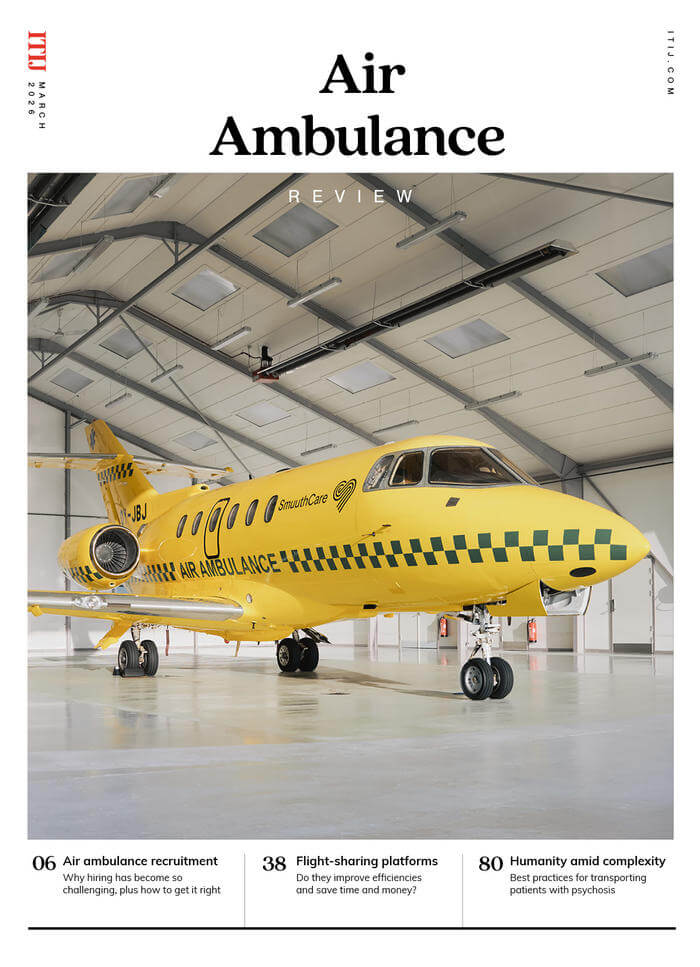
In this issue of Air Ambulance Review we examine the challenges facing air ambulance providers when it comes to recruitment; look at flight-sharing platforms and ask if they can improve efficiencies; and we delve into the latest medications, protocols and best practices for transferring vulnerable patients with psychosis.
Lauren Haigh
Lauren Haigh is a freelance writer for ITIJ.