
Flight-sharing platforms – what are they, and are they worth it?

Oliver Cuenca explores the potential and limitations of flight-sharing platforms as a means to improving aeromedical efficiency and quality
As the aeromedical transport sector continues to evolve, assistance companies are increasingly turning to digital coordination tools in the hope of streamlining complex global operations. Flight‑sharing platforms, in particular, have emerged as a promising – yet still contested – solution, offering enhanced visibility of aircraft availability, mission requests, and empty‑leg opportunities.
But while advocates argue that these systems can unlock new efficiencies and reduce costs, other industry experts caution that their true value depends on data quality, governance, and the realities of a highly specialised, clinically driven market. In this feature, we explore the potential, limitations, and considerations shaping the future of flight‑sharing technology in aeromedical transport.
What are flight-sharing platforms and how do they work?
Claudia Schmiedhuber, Founder and CEO of C3 Advisory Solutions, began by explaining how flight-sharing platforms work, and what data they consolidate.
“Flight-sharing platforms act as a centralised visibility and coordination layer for aeromedical transports,” she said. “For assistance companies, it can be very appealing to have a single go-to portal where missions can be sorted, reviewed, and selected based on predefined inputs.”
Schmiedhuber added that such platforms “typically consolidate mission requests, aircraft availability, empty-leg opportunities, pricing, aircraft type and configuration, location of the aircraft, and – when obtaining a quote – routing and patient transport requirements.”
However, she added that while higher visibility could reduce inefficiencies in itself, it was also important to recognise that using flight-sharing platforms could create additional work and costs for both providers and assistance companies, “due to a pre-determined fee schedule per mission”.
Alongside this, “data needs to be entered … and updated, and not all operators are willing to share their operational data with third-party platforms, due to the sensitive nature of the same. As a result, no platform ever reflects the full market, which is an important limitation to understand.”
Dr Liron Beltzer, Chief Medical Officer, and Jessica Peltz, Head of Customer Success, both at Aero-plan, added that by aggregating critical data – such as flight schedules, aircraft suitability, and real-time location – such platforms could create a transparent marketplace “that drives value for both parties”.
“This centralised visibility allows for the identification of mutually beneficial opportunities … that would otherwise remain hidden in a fragmented market,” they said.
Dr Beltzer and Peltz noted the ability of such systems to “cross-reference multiple requests from different clients with global provider availability”. This “ensures requestors gain access to the most geographically and clinically relevant options, while providers can maximise fleet utilisation and revenue, ultimately improving efficiency across the entire air medical ecosystem.”

What inefficiencies currently exist in aeromedical transport coordination?
Eva Kluge, Managing Director of the European Aero-Medical Institute (EURAMI), began by stating that “fixed-wing air medical coordination is often more efficient than generally assumed”, usually contributing only a “small portion of overall insurer expenditure – typically 1–2% of all medical assistance activity, and 4–5% of total costs”.
However, Kluge added that when it came to air ambulance operations, “the primary inefficiency lies in the management of empty-leg capacity”.
She explained: “Providers distribute large volumes of empty-leg notifications, which often overwhelm assistance teams and do not integrate well with standard workflows. Although empty legs can theoretically reduce costs by utilising repositioning flights, matching is difficult in practice. It is possible – though not always straightforward – to find a patient whose medical needs, location, and timing precisely align with an available empty leg. As a result, empty-leg utility remains limited by geographic, clinical, and scheduling constraints.”
However, Kluge noted that “superior clinical management and early repatriation … usually generate far greater savings than any optimisation achieved through empty-leg utilisation”.
She continued: “A similar challenge occurs when assistance companies attempt to coordinate double or even triple transports from busy destinations. Such combinations often require significant logistical adjustments by the operators, and, due to duty time restrictions, not all patients may receive a true bed-to-bed transfer. While this can reduce costs and may be suitable in selected cases, it is not always the safest or most patient-centric option.”
Dr Beltzer and Peltz noted that inefficiencies typically stemmed from “fragmented communication between international branches, and an absence of a centralised system to share active case data”.
While higher visibility could reduce inefficiencies, using flight-sharing platforms could create additional work and costs
Additionally, they noted that manual processes for gathering quotes had a tendency to create data silos, restricting efforts to coordinate.
“Data flow is often restricted by air ambulance provider internal protocols designed to protect privacy or operational security, such as blocking tail numbers on tracking platforms,” they added. “This lack of transparency impedes the real-time sharing of aircraft availability and location data with the broader network.”
Beyond this challenge, other challenges include inefficient “empty leg utilisation”, due to assistance firms’ limited view of global aircraft positioning, leading to aircraft flying empty on some stretches; “total care cost management”, where clients’ focus on initial quoted figures “obscures the broader financial picture … ultimately increasing the total cost of care”; and the administrative burden of “manually sourcing quotes … [distracting] from patient care and follow-up”.
Amy C Arndt, Operations Director at the National Accreditation Alliance of Medical Transport Applications (NAAMTA Global), added that while the focus, from an accreditation perspective, was not to endorse specific technologies, coordination platforms, when used as decision-making tools, could “assist experienced dispatch and medical leadership in identifying appropriate opportunities to align missions, or utilise return legs, without compromising safety and clinical readiness”.
However, she said, “accreditation experience shows that efficiency gains are meaningful only when achieved through strong governance and professional judgement, with improved utilisation viewed as a byproduct of better coordination”.
Schmiedhuber noted that, “in theory”, maintaining digital platforms for tasks such as flight-sharing could significantly shorten administrative time by reducing the need for multiple phone calls and email exchanges. Additionally, case managers can review options in one place to compare feasibility more efficiently.
“In practice, however, this efficiency depends heavily on data quality, input frequency, and governance,” she warned. “Assistance companies must fully understand who receives their requests, who is allowed to quote, and how those providers are vetted before collaborating with a platform. Ensuring that operator insurance, aircraft registration, medical and quality standards are current and sufficient is essential – and is ultimately the responsibility of the assistance company using such a platform.”

How can flight-sharing platforms prevent duplicate missions, increase aircraft utilisation, and reduce empty mileage?
Schmiedhuber also said that, despite limitations, such platforms could offer better visibility and reduced inefficiencies to assistance companies, by facilitating the use of existing “empty legs”.
“When capacity is visible, aircraft already positioned in a region can be matched with live cases more effectively,” she said.
However, she warned that while ideal in theory, empty-leg utilisation could be “operationally complex” due to rapid changes in flight operations – for example, delays, changes in patient readiness, permit issues, or crew duty and rest limitations.
This rapid change highlights the importance of maintaining accurate data on flight-sharing platforms – something that Schmiedhuber said “might not be feasible in daily operations”.
Kluge explained that while platform-based models often dominate in many parts of the modern economy, “they perform best in high-volume, repeatable environments”.
By contrast, air ambulance missions are “highly specialised and relatively infrequent”, meaning that the potential of flight-sharing platforms is, in her opinion, limited.
This situation is worsened by the provider commissions charged by some platforms, which Kluge said “raise ethical concerns in a sector centred on acutely ill patients”.
She concluded: “To deliver real added value, platforms must provide reliable anonymised operational insights, not only to the payers but also to the providers, rather than functioning merely as digital bidding tools. They require structured data, neutrality, transparent governance, and broad adoption across the industry. Without trust and clarity on both sides, the promised efficiencies remain largely theoretical.”

What quantifiable cost savings can payers expect?
When it comes to cost-saving opportunities, Schmiedhuber said that as well as allowing air ambulances to fill empty mileage more effectively, flight-sharing software can create earlier transport opportunities, shortening hospital stays for patients.
However, she reiterated that the platforms themselves introduce new cost structures: “Many operate on percentage-based fees or per-mission charges applied to one or both sides. Over the course of a year, these fees can accumulate to many thousands of dollars for assistance companies and providers alike. Thus, companies need to consider not just potential savings on missions, but also platform fees and internal resource costs to determine whether such a collaboration is a good fit.”
In practice, efficiency depends heavily on data quality, input frequency, and governance
Dr Beltzer and Peltz argued that flight-sharing platforms offered a range of cost savings for payers in the air medical sector, including reduced time on “manual sourcing – allowing them to allocate more time to high-value activities like direct patient care and essential follow-ups”.
Other benefits, they added, could include a wider range of air ambulance providers, “driving down flight costs and ensuring assistance companies are paying a competitive, market-driven price”, as well as faster sourcing – and shorter hospital stays for patients as a result.
What concerns or regulatory considerations exist?
Arndt said that key considerations for utilising flight-sharing platforms included ensuring the “integrity of clinical information used for acceptance decisions, the preservation of dispatch authority and medical oversight, clarity on accountability, and the protection of patient and operational data”.
Beyond this, she warned: “Platforms that oversimplify clinical complexity or introduce cost-driven incentives can unintentionally increase risk rather than reduce it. Technology may enhance coordination, but only when embedded within strong governance and professional judgement. Efficiency gains are meaningful
only when achieved without compromising patient care or transport safety.”
When implementing flight-sharing platforms and similar tools, Schmiedhuber warned that firms must be “fully aware of what data they’re sharing, where it is stored, how it is used, and who has access to it”.
She highlighted that there was a range of legislation that needed to be complied with in many regions, such as the European Union’s (EU) General Data Protection Regulation (GDPR), and the US Health Insurance Portability and Accountability Act (HIPAA).
Alongside this, assistance companies need clarity on who can see their requests, who is permitted to respond, and how providers are vetted. “Flight-sharing platforms can be a valuable tool, but they must support – rather than dilute – established industry standards, regulatory compliance, and overall governance,” she said.
Kluge warned that when it came to digital bidding and coordination platforms, a great deal of thought must be given to data privacy and confidentiality.
“When used solely for requesting quotes, risk remains limited because the data shared by assistance companies is anonymous,” she explained. “However, if a bidding platform were to evolve into a handling platform, the complexity would rise sharply.
Air medical transport involves highly sensitive patient data, and many platforms lack transparent IT architectures, robust encryption, or clearly defined access controls. Within GDPR and national health-information frameworks, this introduces real compliance risks.”
Beyond this, she warned: “Market neutrality is another concern. Platforms controlled or influenced by a single provider could unintentionally limit visibility or skew the mix of available quotes. Until neutrality, transparent governance, and strong data controls are ensured, caution remains warranted.”

Conclusion
While flight‑sharing platforms promise a new layer of visibility and coordination in the aeromedical sector, the technology alone cannot resolve the structural complexities of global patient transport. The potential benefits – from improved empty‑leg utilisation to faster sourcing and reduced administrative burden – remain closely tied to data quality, operational transparency, and the willingness of providers and payers to engage within a framework of strong governance. At the same time, concerns around neutrality, clinical oversight, and regulatory compliance underscore that digital tools must complement, not replace, professional judgement.
For now, flight‑sharing platforms offer meaningful opportunities, but their long‑term value will depend on trust, adoption, and the industry’s ability to integrate them responsibly into established aeromedical practice.
March 2026
Issue
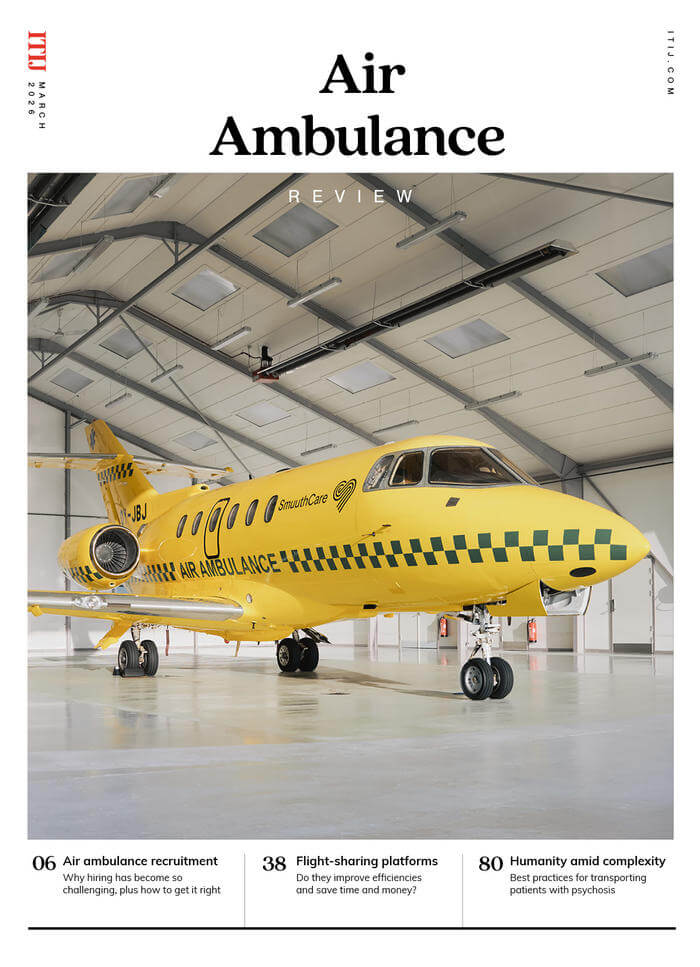
In this issue of Air Ambulance Review we examine the challenges facing air ambulance providers when it comes to recruitment; look at flight-sharing platforms and ask if they can improve efficiencies; and we delve into the latest medications, protocols and best practices for transferring vulnerable patients with psychosis.