From first call to safe homecoming

Anthony Kinsella, Director of Clinical Operations and Lead Flight Paramedic with AD Medical Air Assist, explains how patients are transported safely from bedside to bedside during complex medical repatriations
When the first call comes in requesting a repatriation, what are the key pieces of information you need to gather, and how do those early decisions shape the entire operation?
The first call is really about building a clear clinical and logistical picture. We need to know where the patient is, where they need to go, their diagnosis, current condition, mobility, oxygen requirements, medication, recent procedures and whether there are any time-critical concerns. We also establish what medical information is available and whether a receiving hospital or consultant has already accepted the patient.
Those early details are really important because they help us decide the safest and most appropriate way to manage the repatriation. A patient who initially appears suitable for a commercial flight may require a stretcher, additional oxygen or alternatively an air ambulance once we review the clinical information. Getting that assessment right at the beginning helps us build the safest and most appropriate plan and prevents avoidable delays later.
How do you assess whether a patient is fit to travel, and what clinical factors determine the most appropriate mode of transport?
Fitness to travel is much more than whether somebody is simply ‘fit to fly’. We review the diagnosis, observations, mobility, oxygen requirement, neurological and cardiovascular status, recent surgery or trauma, medication, and the likelihood of deterioration during the journey.
We also consider the entire journey rather than just the flight. A patient may tolerate two hours in the air but have several hours of ground transfers, airport procedures and waiting either side.
For a stable patient, a commercial flight with a medical escort may be appropriate. Others may require a commercial stretcher and one or more clinicians. If the patient requires intensive monitoring, ventilatory support, multiple infusions or interventions that cannot safely be managed commercially, an air ambulance may be the appropriate option. In some European cases, a specialist intensive care ground transfer can also provide an effective alternative.
Can you walk us through the planning process once a repatriation has been approved?
Once approved, there are multiple workstreams happening simultaneously. We liaise with the treating hospital for current medical information and discharge planning, while confirming acceptance, bed availability and handover arrangements with the receiving team.
At the same time, our operations team coordinates flights, airline medical clearance, MEDIF requirements, medical equipment, oxygen, ground ambulances and the clinical crew. Timing is crucial because all of those elements have to connect.
Before departure, the escort receives a detailed clinical and operational handover so they understand the patient's condition, journey plan, equipment requirements and potential risks. Good communication between every provider is probably one of the most important elements of a successful repatriation.
What measures do you put in place to manage clinical risks and ensure continuity of care throughout the journey?
Risk management begins from the initial call. We review the latest clinical information, identify any potential complications and make sure the escort has the appropriate equipment, medication and contingency plans in place.
Our clinician will usually see the patient the day before travel to complete a pre-flight assessment, review their medical information and make sure everything is in place for the journey. We then reassess the patient again on the day of travel to make sure nothing has changed and they’re still fit to fly. From there, we continuously monitor the patient throughout the journey according to their clinical needs.
Ultimately, we work on the principle that care is continuous from bedside to bedside. The responsibility does not end when the aircraft lands. We ensure an appropriate clinical handover takes place at the destination so the receiving team understands the patient's condition, treatment during transport and any ongoing concerns.
About AD Medical Air Assist
AD Medical Air Assist specialises in complex medical repatriation, delivering seamless, clinically led patient transfers worldwide. From commercial medical escorts and stretcher repatriations to specialist ground transfers and air ambulances, our experienced clinical and operations teams coordinate every detail, providing safe, responsive and compassionate care from bedside to bedside.
Anthony Kinsella
Director of Clinical Operations and Lead Flight Paramedic, AD Medical Air Assist
Anthony is a HCPC-registered paramedic with extensive frontline and international retrieval experience. He combines hands-on clinical practice with the operational planning and coordination of complex medical repatriations, working closely with hospitals, airlines, ambulance providers and medical teams worldwide.
November 2026
Issue
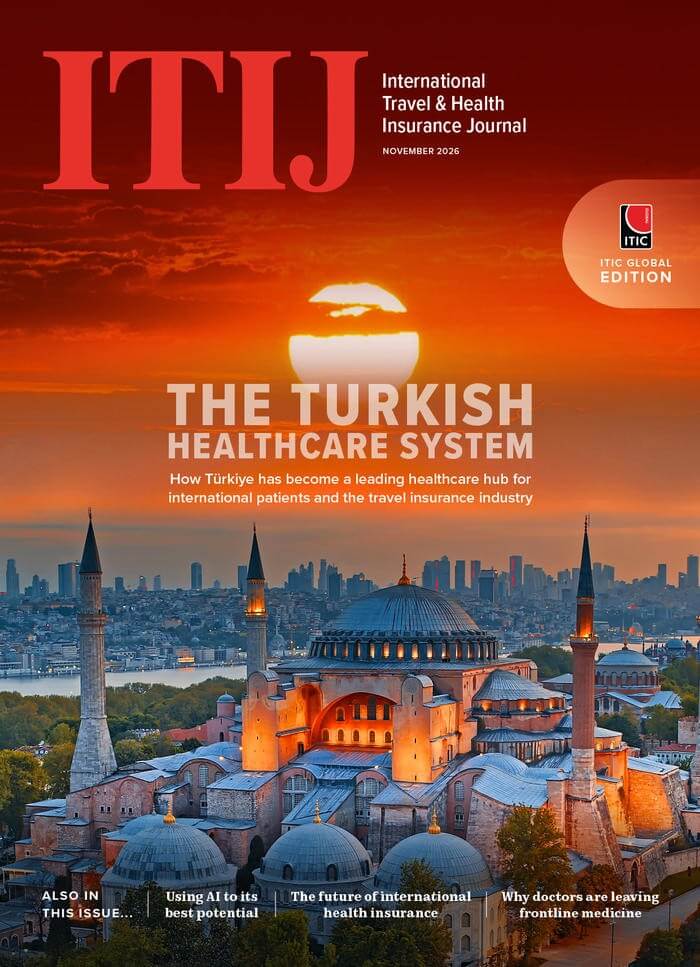
In this, our biggest issue ever, our main focus is on artificial intelligence. After recent threats and warnings about the potential dangers of AI and calls for coordinated action to slow the technology's development, we speak to experts about the technology in a three-part special. We look at data-driven risk assessment, underwriting, and portfolio optimisation, which are all being transformed by AI, and ask what insurers and underwriters are doing to get the most out of the technology.
Editorial Team
The Editorial Team updates the ITIJ website daily, and works on features for the print edition. With expert industry knowledge and years of experience in writing about complex travel insurance issues, the Editorial Team is ready to investigate and report on the topics that matter most to ITIJ's readers.