
Defining fitness to fly

Alfie Jake Thomson speaks to experts about the nuanced term and what they think should happen when it comes to standardisation
The UK Civil Aviation Authority estimates that over a billion people travel by air every year, a figure expected to double over the next two decades. While air travel remains a form of transport praised for its comfort and accessibility to the global population, questions have arisen recently around an increase both in older passengers and in those travelling with new, and pre-existing, illnesses. Health professionals have found themselves increasingly asked to assess a patient’s fitness to fly, both for nationals planning to travel abroad and for those who find themselves needing repatriation overseas due to accident or illness.
While patients suffering from illness can be transported via air ambulance transport, it is not always in their best interests to do so immediately, with every call for assistance requiring a complex analysis of the risks and benefits of such a transfer.
For health professionals, air ambulance teams, insurers and physicians, before moving a patient, they must take into consideration a multitude of factors. Responsibilities must be clearly understood, communication channels flawless and key decision-makers possessing significant medical-legal expertise consulted beforehand.
For most commercial airlines, fitness to fly (FTF) assessments have been subject for years to regulatory bodies
However, in defining a patient’s fitness to fly, such professionals, healthcare experts, assistance companies and insurers find themselves attempting to define, and work within, a term that, as Jan Eichel, Executive Director of the Commission on Accreditation of Medical Transport Systems (CAMTS), put it, is “somewhat subjective”.

Differing definitions, and nuanced concepts
For most commercial airlines, fitness to fly (FTF) assessments have for years been subject to regulatory bodies like the International Air Transport Association (IATA), which have established internationally recognised guidelines and criteria for passengers such as pregnant women and those recovering from surgery. In the context of aeromedical patient transport, however, as Dr Bettina Vadera, Chief Medical Adviser at AMREF Flying Doctors, argued, fitness to fly becomes a highly individualised risk-benefit assessment, no longer just a clinical judgement but a “complex and multidisciplinary collaboration” between the patient or their next of kin, assistance and insurance companies, and receiving facilities.
Defining fitness to fly is therefore no easy task for the air ambulance industry, said Regent Air’s Chief Medical Officer, Dr Chad Regehr, and Chief Operating Officer, Dr Ripenjot Rai. Speaking to ITIJ, both pointed out how the concept was “nuanced” and lacking a singular, robust definition, but was, “at its core”, about the physiological and clinical stability of a patient, and their ability to endure aircraft transportation without compromising their safety. Both were keen to point out how defining fitness to fly requires not just satisfying patient medical criteria but a “comprehensive evaluation” of equipment, crew capability, flight duration and altitude physiology.
Claudia Schmiedhuber of the Global Assistance & Medical Transport Institute (GAMTI) noted that issues had been prevalent as fitness to fly can “vary greatly with factors like the role of medical decision-makers”, from local treating doctors to flight physicians, and the differences between guidelines set at a local, regional and organisational level meaning one physician may deem a patient fit to fly, only for another to “contradict the same”. All of which can lead to a costly outcome: delayed or even full cancellation of air transportation.
Whilst recognised bodies like the IATA may provide a general set of standards, they may be interpreted differently by national aviation authorities
Such issues often come about through what Heather Petrie, Director of Quality Safety and Project Management at Airmedic, calls a “lack of understanding” from discharging providers in certain countries of the capabilities of the air ambulance provider, of in-flight physiology, and of how both will affect the patient. Petrie was keen to emphasise, however, that this was often not the case, that there was only “one definition” when both teams “are on the same page”. When there is an understanding between the air ambulance provider and the assistance company/insurer, the patient is defined as fit to fly based on their medical status and through an application of flight physiology to their specific illness.
With “no universally recognised definition” for fitness to fly, organisations like the European Aero-Medical Institute (EURAMI) have been praised for their decades-refined and internationally recognised standards for repatriation and aeromedical transfer. Speaking to ITIJ, President Dr Cai Glushak and Managing Director Eva Kluge said their process in defining fitness to fly was one guided by three pillars: clinical, operational and regulatory.
Firstly, by using “specific diagnostic tests and evaluations”, a patient’s ability to withstand the stresses of flight can be gauged, with onboard flight physicians helping to assess more acute or complex cases against the equipment and skill set available.
Secondly, all necessary arrangements – from trained escort personnel to airline clearance – are put in place, and this step is seen as the most crucial, with Kluge and Dr Glushak arguing how “it’s not just the flight itself that matters – every link in the logistics chain must be professionally managed to ensure patient safety”.
Finally, full legal compliance with aviation authority rules and airline medical policies, like patient consent and liability coverage, is established.
Through these pillars, organisations like EURAMI offer a “comprehensive framework”, and a respected accreditation, in the face of a term that is often subjective, helping strengthen both patient safety and medical quality in the process.


Complexities, complications and cultural differences
While the concept of fitness to fly may be considered universal, the interpretation and implementation of such assessments are subject to considerable variations, especially in global transfers. Recognised bodies like IATA may provide a general set of standards, but they may be interpreted differently by national aviation authorities like the European Union Aviation Safety Agency (EASA). Similarly, different airlines will utilise different medical information forms (MEDIFs), with “some more formal and more risk-adverse due to liability concerns, whilst others are much more lenient”, noted Dr Vadera. Additionally, some airlines are simply better equipped than others, possessing onboard medical kits, more highly trained staff and the ability to accept more medically complex passengers, particularly if they work in close cooperation with medical escort providers.
Cultural differences can also play a part, with a patient’s family insisting on the transfer of critically ill individuals even when it is directly against the advice of medical teams
Such differences are seen as merely the beginning of complications. Elena Korsak from emergency air transport operator SmuuthCare told ITIJ how the lack of a universal definition, coupled with the decision to deem a patient fit to fly being put sometimes in the hands of “doctors without the necessary qualifications”, only increased the risk of “medico-legal complications” and the need for a ‘better safe than sorry’ policy.
Dr Rowan Hardy, Deputy Medical Director at Gama Aviation, said “many use [these policies] to question the rationale for patient transfer, especially in situations where patients will remain in private facilities that make money for as long as the patient is in-house”.
These issues were ones shared by Petrie, who mentioned how, in her 20-plus years of experience with air ambulance transports globally, many situations have arisen where “the hospital simply does not promptly provide fitness for transport documentation or discharge clearance”, only further inviting costly escalation processes through broader channels like governmental or embassy representatives.
To Kluge and Dr Glushak, such challenges are because of “miscommunications” between international providers, insurers and airlines. When these occur, there is the possibility of both incorrect assumptions being made about a patient’s condition and gaps in their subsequent care. Both argued this was exacerbated by the presence of language barriers and differences in medical documentation standards. Cultural differences can also play a part, with a patient’s family insisting on the transfer of critically ill individuals, even when it is directly against the advice of medical teams. Kluge and Dr Glushak put emphasis therefore on global stakeholders to adopt “interdisciplinary collaboration whenever, and wherever, possible”.
Local healthcare providers
When it comes to who makes the decision to declare a patient fit to fly, “local healthcare providers almost always” play a part, said Korsak. For as long as patients remain in hospital, it is the local provider who will have the final say on discharging. As a result, doctors from repatriation providers who sit thousands of kilometres away find themselves in a difficult spot attempting to challenge the decisions of local treating doctors.
For as long as patients remain in hospital, it is the local provider who will have the final say on discharging


While both the air ambulance provider and insurance client always strive for collaboration with local healthcare providers, “opinions [can] occasionally conflict” with what can benefit the patient most, said Petrie. She highlighted the Airmedic procedures followed when this occurs, including a series of questions put to the local provider and air ambulance to ensure a positive patient outcome, such as ‘What is medically ideal?’, ‘What can be operationally possible?’ and ‘What will be ethically defensible?’ Discharging physicians have often raised concerns over their liability in discharging patients who may later deteriorate in-flight.
The significant role of local healthcare was one similarly highlighted by Schmiedhuber and Drs Regehr and Rai, who discussed how in many cases the “local context” influenced the decision of treating doctors, going on to make judgements based on in-hospital care capabilities and ground-level clinical standards that simply “do not always align with conditions encountered during air transport”.
Differences in training, lack of familiarity with aviation medicine, and the availability of local resources cause common challenges for air ambulance providers, who find themselves encountering a series of negative outcomes, from more conservative patient assessments, to delays in declaring patients fit for travel, and requests for information that are either not wholly necessary inflight or simply unfeasible.
Schmiedhuber argued this can cause a “disconnect between local providers and air ambulance teams that leads to additional costs and stress for patients, their families and logistical complications for insurance-assistance providers”.
Drs Regehr and Rai similarly raised the challenges Regent Air faces across nations and the negative impact to patient safety and mission planning these result in – disparities in healthcare infrastructure, language barriers and cultural differences in medical decision-making. Such hurdles have led companies like the Global Assistance & Medical Transport Institute (GAMTI) to insist that educating not only staff directly involved with aeromedical transports, but also those at local healthcare facilities, will become of upmost importance and a chief focus for the years ahead.
Standard operating procedures
Every air ambulance company follows a detailed pre-flight assessment, with parameters set to help define both the scope of care and the patients they are transferring. Discussing standard operating procedures (SOPs), Petrie raised how Airmedic would obtain a detailed report looking at, for example, medication reviews, full head-to-toe assessments, and any specialised equipment required for transport.
Unfortunately, despite this, Petrie mentioned how, at one point or another, every air ambulance company had been “burned”: being told a patient is fit to fly, only to find upon arrival a very different, more unstable patient that does not match the report given.
While SOPs can provide a framework for ideal transfer, every case must still be tackled individually

Dr Hardy therefore argued that while SOPs can provide a “framework for ideal transfer, every case must still be tackled individually, with such procedures not applying rigidly”. Clinical teams must use their skills and judgement to weigh up the factors involved for each patient, while dealing with challenges like inaccurate patient representation and miscommunications from discharging hospitals abroad.
Creating the industry standard
Guidelines from bodies like CAMTS have been credited with helping align air ambulance SOPs, but such guidelines have similarly been criticised for lacking universal enforcement and, coupled with the wide range of factors that influence each case, have made the establishment of a unified standard for ‘fitness to fly’ incredibly difficult, with such a process requiring global collaboration, broad-based education in aviation medicine, and models that are context sensitive. All requirements which, in an era of global uncertainty, make for an objective that Schmiedhuber described as “not an immediate possibility”.
Standardisation is double-sided – highly desirable, but very complex
The benefits of standardisation are clear, stated Kluge and Dr Glushak – improved safety, efficiency and patient accommodation – yet standardisation is double-sided: “highly desirable, but very complex”. Challenges remain in aligning globally regulated aviation with nationally governed healthcare. Aeromedical practices remain ungoverned across borders, with any standards being developed on a purely voluntary basis as aviation authorities will “never take responsibility for medical components”. EURAMI therefore argues for the creation of a global network of medical advisers who will interpret local rules and resolve cross-border challenges. Similarly highlighted was the development of internal assessment protocols that would reflect international medical aviation guidelines, like those established by the IATA. Drs Regehr and Rai stated that such processes would require a “navigation of complexities”, requiring cultural sensitivity and a commitment to standardised clinical protocols.
Despite this, Dr Vadera (as both an auditor and member of the board at EURAMI), was keen to emphasise the active development of global standards in the aeromedical industry, with EURAMI’s standards achieving global reach, contributing to a better understanding of the quality and safety expected within aeromedical transport.
Petrie believes the air ambulance community would do well to collaborate on best practices for confirming fitness to fly. Discussing the great successes of the industry, she raised how providers were now able to transport patients whose conditions 20 years ago would have made their transfer unthinkable. Standardisation will require stakeholder collaboration, a learning and sharing of ideas, research and education – all with the aim of making patient outcomes safer – which Petrie concluded was, after all, at the very core of “what this is all about”.
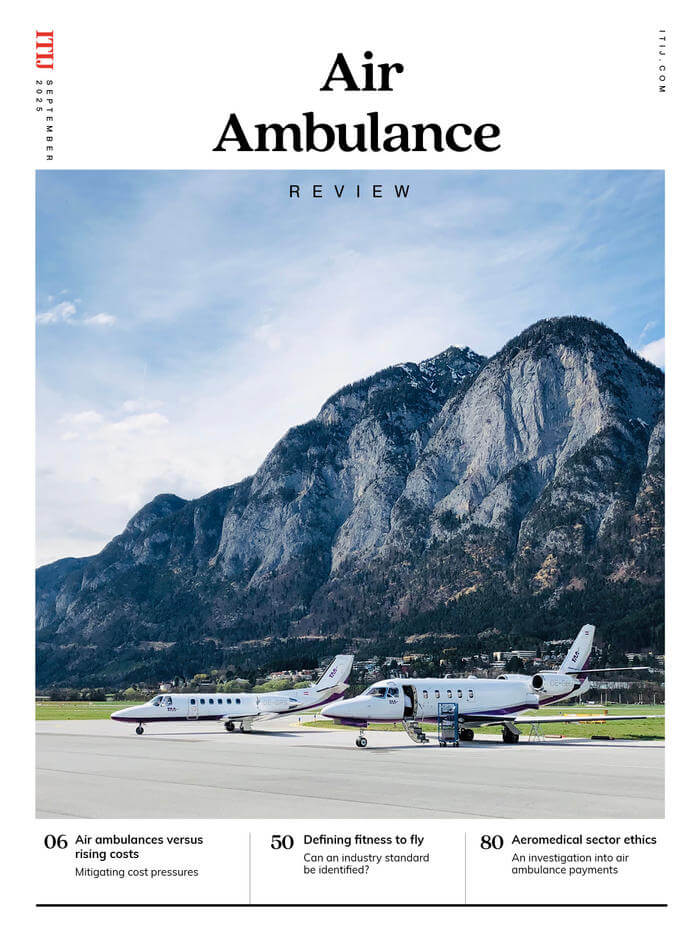
September 2025
Issue
We include an examination on defining ‘fitness to fly’, and ask if an industry standard can be identified, and what that would involve. We also look at capacity in the aeromedical market and experts share their insights. Ethics and transparency in the aeromedical sector is a big issue, and we include an investigation into air ambulance payments.