Closing the gap: how Doctor Emergency and Ambulances is transforming foreign patient care in Albania

A new hospital partnership model is giving international travellers – and their insurers – safer, faster, and betterdocumented access to care in one of Europe’s fastest-growing tourist destinations, says Dr Ervin Kostakis, Chief Medical Officer, Doctor Emergency and Ambulances
Albania has become one of the fastest-growing tourism markets in Southern and Eastern Europe, drawing millions of foreign visitors every year to its coastline, mountains, and historic cities. But rapid tourism growth has outpaced the development of healthcare infrastructure suited to international travellers – until now.
Doctor Emergency and Ambulances, based in Tirana, has spent this year building a solution: formal partnership agreements with public hospitals, concentrated near the country’s major touristic areas, designed specifically to improve how foreign patients are treated, documented, and supported when they need medical care abroad.
The problem
Until recently, foreign travellers who required treatment in Albania’s public hospital system occupied an uncertain position. They were not part of the local healthcare framework in the way residents are, and hospitals had few structured processes for managing their cases – from documentation to communication with insurers back home.
This year, Doctor Emergency and Ambulances signed formal agreements with public hospitals located mainly near Albania’s key tourist destinations
This left gaps: slower information exchange, inconsistent case management, and limited visibility for the travel insurers ultimately responsible for the patient’s care and costs.
As a company providing primary healthcare services, medical transport, and on-the-spot medical visits across the Western Balkans, Southeastern Europe, and Greece, we saw this gap daily. Insurers were often working with incomplete information about their members’ cases. Hospitals, meanwhile, had limited incentives or structure to prioritise the specific needs of international patients – despite growing patient volumes.
A new model of cooperation
This year, Doctor Emergency and Ambulances signed formal agreements with public hospitals located mainly near Albania’s key tourist destinations. These agreements create a structured channel between the hospital, our case management team, and the patient’s insurer – ensuring that when a traveller is admitted, the right information reaches the right people quickly.
A growing tourism economy places an obligation on the healthcare system to treat visitors with the same hospitality Albania is known for elsewhere
For insurers, this means access to more complete and timely information about their members’ treatment, at a modest additional cost. For hospitals, it means a clearer framework – and a financial contribution – for treating patients who were previously outside the formal system. For travellers, it means faster, better documented, and more closely monitored care during what is often a frightening and vulnerable moment abroad.
Why do documentation and coordination matter?
Medical information exchange is not a bureaucratic detail – it is a safety issue. When a hospital’s documentation and communication processes are properly managed, treatment decisions are better informed, continuity of care improves, and the risk of miscommunication between hospital, patient, and insurer drops significantly. In a healthcare system that is still developing the infrastructure to match its tourism growth, this kind of case management support plays a critical role.
Changing how care is delivered
One of the most significant effects of this project has been cultural rather than administrative. As foreign patients become a recognised, structured part of hospital caseloads – rather than an occasional, undocumented exception – medical professionals are adapting. Doctors and hospital staff who previously had little structured experience treating travellers with different languages, expectations, and support networks are now engaging with this patient group more consistently.
This shift matters. A growing tourism economy places an obligation on the healthcare system to treat visitors with the same hospitality Albania is known for elsewhere. As hospitals begin receiving structured contributions for treating international patients, they gain both the incentive and the resources to keep improving standards of service, documentation, and communication – a virtuous cycle that benefits every traveller who falls ill or is injured far from home.
The company has been shortlisted among the top three healthcare providers at this year’s ITIJ Awards in Istanbul
Recognition on the international stage
This year’s project builds on Doctor Emergency and Ambulances’ broader mission: to make medical care safer and more accessible for travellers across a region where healthcare infrastructure varies widely.
That work has not gone unnoticed – the company has been shortlisted among the top three healthcare providers at this year’s ITIJ Awards in Istanbul, a recognition that reflects the growing importance of structured medical case management in emerging tourist destinations.
Looking ahead
As Albania’s visitor numbers continue to climb, the need for reliable, well-documented medical care for foreign travellers will only grow. Doctor Emergency and Ambulances is committed to expanding its hospital network, deepening its partnerships, and continuing to serve as the bridge between international insurers, local healthcare providers, and the travellers who need care the most.
About Doctor Emergency and Ambulances (DEA)
Founded in 2021 and headquartered in Tirana, Albania, Doctor Emergency and Ambulances manages a network of primary healthcare professionals, medical facilities and ground ambulances across six countries of the West Balkans and Greece. By working more closely with public healthcare facilities, DEA has become a trusted partner for international insurers and assistance companies in Southeastern Europe. Its procedures focus on standardisation, closing the gap between local facilities and international patient care standards. Operating 24/7, the company ensures travellers receive timely, well-coordinated care wherever they are in the region.
Dr Ervin Kostakis
Chief Medical Officer, Doctor Emergency and Ambulances
Dr Kostakis is Chief Medical Officer of Doctor Emergency and Ambulances, bringing nearly 20 years of experience in travel insurance and travel medicine to a developing region like the West Balkans. He began working with foreign travellers in Greece in 2005, and in recent years has worked closely with international partners across the West Balkans and Southeastern Europe. He takes an active part in international forums, conferences and committees, contributing articles and guidelines on repatriation and every aspect of medical services for international patients. He is also committed to training medical professionals across the region.
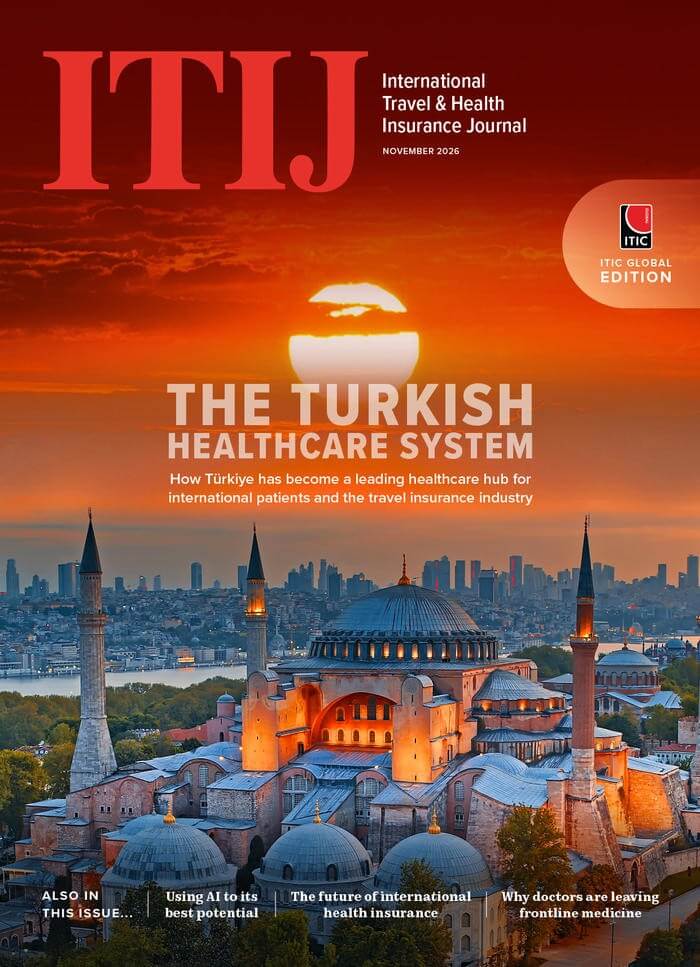
November 2026
Issue
In this, our biggest issue ever, our main focus is on artificial intelligence. After recent threats and warnings about the potential dangers of AI and calls for coordinated action to slow the technology's development, we speak to experts about the technology in a three-part special. We look at data-driven risk assessment, underwriting, and portfolio optimisation, which are all being transformed by AI, and ask what insurers and underwriters are doing to get the most out of the technology.
Editorial Team
The Editorial Team updates the ITIJ website daily, and works on features for the print edition. With expert industry knowledge and years of experience in writing about complex travel insurance issues, the Editorial Team is ready to investigate and report on the topics that matter most to ITIJ's readers.