
Building transfusion capability in international aeromedical retrieval

When pre-departure assessment of two high-acuity international retrievals revealed a potential need for in-flight transfusion, MEDCAIR turned that recurring operational challenge into a repeatable blood-access capability, says Dr Tim Parker, Chief Medical Officer and Medical Director of MEDCAIR
In international aeromedical retrieval, the difference between a transfer that is technically possible and one that is clinically defensible often comes down to what happens before the aircraft leaves the ground.
The case
Both patients required transfer from overseas centres to tertiary care in Australia, and in each case the retrieval team identified a foreseeable potential requirement for blood products during the mission. For a tertiary hospital, blood may be only minutes away. For a fixed-wing retrieval team, access is considerably more complex.
Critical care aeromedical retrieval systems do not simply respond to deterioration; they anticipate foreseeable risks and mitigate them wherever possible
Specific blood products may not always be available at the referring facility, and locally held stock may represent a limited resource required to meet the needs of the local population. Transfusion is also a tightly governed clinical intervention, requiring appropriate processes for product selection, release, traceability, transport and storage.
Where clinically indicated and operationally appropriate, sourcing blood products through an established Australian blood-bank pathway allows those requirements to be incorporated into mission planning. This approach also supports responsible stewardship of a finite healthcare resource, particularly when retrieval teams are operating in settings where blood-product availability may be constrained.
The challenge was not simply to ‘carry blood’. It was to create a system capable of making suitable products available rapidly when clinical risk justified it.
The pathway
MEDCAIR’s Chief Flight Nurse responded by developing a dedicated pathway with an Australian private hospital blood bank.
The pathway enables suitable blood products to be made available at short notice when clinically indicated, with an operational turnaround of approximately three hours achievable in appropriate circumstances. It was designed to integrate with MEDCAIR’s broader target of wheels-up within four hours of activation, where clinically safe and operationally achievable, allowing blood access to form part of mission preparation rather than a separate source of delay. Product selection and release remain subject to blood-bank requirements, availability, patient factors, and appropriate transport and storage arrangements.
Where suitable, the pathway may also allow the blood bank to allocate products that might otherwise go unused locally, potentially reducing avoidable wastage.
For the retrieval team, this provides an additional option for mitigating foreseeable haemorrhagic risk during transfer. For the referring healthcare service, it may also reduce reliance on locally available bloodbank resources.
Critical care aeromedical retrieval systems do not simply respond to deterioration; they anticipate foreseeable risks and mitigate them wherever possible.
Identify risks
The experience reflects a broader principle behind MEDCAIR’s approach to high-acuity retrieval: identifying foreseeable risks early and ensuring the right people, equipment and contingencies are in place before departure. On an individual mission, that may require creativity, adaptability and decisive clinical judgement.
The broader capability comes from experienced clinicians being empowered to identify operational gaps, develop practical solutions, and convert those solutions into reliable, appropriately governed systems.
What began as a response to two demanding retrievals has now become a repeatable capability for future missions. In critical care aeromedical retrieval, innovation is not always a new device or technology.
Often, it is simply a better system.
Dr Tim Parker
Chief Medical Officer and Medical Director, MEDCAIR
Dr Parker, BA (Hons) Oxon, BM BCh, FACEM, MAICD is an Oxford-educated specialist emergency physician with extensive retrieval experience across domestic and international operations. He developed MEDCAIR’s consultant-led clinical governance model and leads mission oversight, clinical standards and capability development.
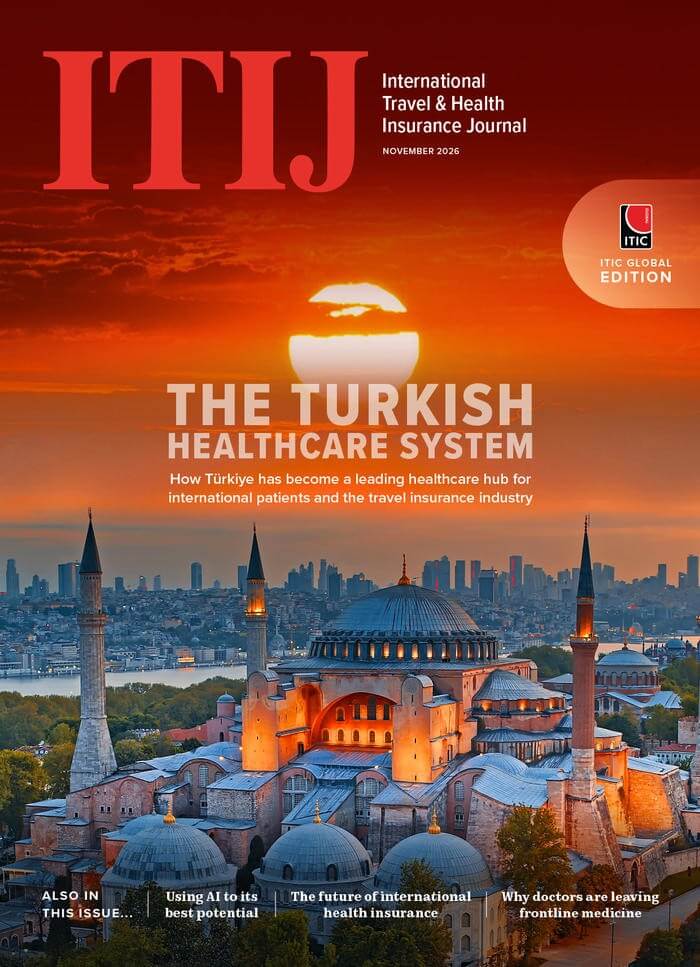
November 2026
Issue
In this, our biggest issue ever, our main focus is on artificial intelligence. After recent threats and warnings about the potential dangers of AI and calls for coordinated action to slow the technology's development, we speak to experts about the technology in a three-part special. We look at data-driven risk assessment, underwriting, and portfolio optimisation, which are all being transformed by AI, and ask what insurers and underwriters are doing to get the most out of the technology.
Editorial Team
The Editorial Team updates the ITIJ website daily, and works on features for the print edition. With expert industry knowledge and years of experience in writing about complex travel insurance issues, the Editorial Team is ready to investigate and report on the topics that matter most to ITIJ's readers.
