Bringing transparency to every air ambulance mission

As demand grows for greater accountability in medical transport, Andy Lee, Founder of Connect Care Air Network, explains how they are helping insurers, assistance companies, and providers gain a clearer view of mission performance through comprehensive governance and reporting
There is currently a gap in how air ambulance missions are assessed and reported. What are the shortcomings of existing systems, and what inspired you to create Connect Care Air Network (CCAN) to address them?
For many years, the air ambulance sector has relied on a combination of accreditation, internal quality programmes, and operator reporting to measure performance. While these all have value, they tend to focus on organisational standards rather than providing a complete, mission-specific record of what actually happened during an individual transport.
The result is a gap between mission activation and mission completion where information is often fragmented across multiple parties, systems, and documents. Clients, insurers, and assistance companies may receive a clinical summary or operational report, but rarely a consolidated governance record that explains how decisions were made, how risks were managed, and how standards were applied throughout the mission.
CCAN was created to close that gap. The objective was to develop a governance platform that documents and measures each mission individually, providing greater transparency, accountability, and consistency for all stakeholders involved in medical transport.
Accreditation programmes provide important quality assurance, but do not provide detailed reporting on each flight. How does CCAN’s approach to monitoring and measuring every mission differ, and why do you believe that ongoing oversight is necessary?
Accreditation remains one of the most important mechanisms available to improve quality and safety in medical transport.
Accreditation evaluates an organisation against recognised standards at the organisational level and at defined intervals.
CCAN takes a different approach by focusing on mission-level governance. Using the RANES platform, information is captured at defined milestones throughout the mission life cycle, from activation through to completion. This creates a documented record of significant events, handovers, relevant clinical and operational information, key decisions, and mission completion.
Ongoing oversight is important because every mission is unique. Even highly capable accredited providers encounter complex operational and clinical challenges. Continuous governance allows organisations to understand not only whether standards exist, but how they were applied in practice during a specific transport.
From your conversations with insurers and assistance companies, what information are they most keen to receive following an air ambulance mission, and how does CCAN help deliver that transparency?
The consistent message from insurers and assistance companies is that they want visibility, not simply a summary.
They want to understand how the mission evolved, whether there were delays, changes in patient condition, operational constraints, unexpected events, or decisions that impacted cost, care, or outcome. They also want confidence that the service they funded was delivered safely and in accordance with recognised standards.
CCAN addresses this by producing a consolidated Governance Report that connects information from across the mission. Rather than relying on isolated reports from different parties, the organisation funding the transport receives a structured record that documents key milestones, decision points, compliance indicators, findings, and performance measures.
This enables a level of transparency that has historically been difficult to achieve.
One of the promises of better data is the opportunity for continuous improvement. How can the insights gathered through CCAN help air ambulance providers, insurers, and assistance companies improve outcomes, efficiency, and patient care in future missions?
Data becomes valuable when it can be converted into meaningful insight.
By consistently capturing governance information across missions, CCAN creates a foundation for trends, recurring issues, and opportunities for improvement to be identified over time. Over time, this information can provide greater insight into operational performance, documentation quality, handover effectiveness, and potential opportunities for improvement.
Insurers and assistance companies gain greater visibility into service delivery and the documented mission experience.
Over time, this creates an evidence-based environment where decisions are informed by real operational experience rather than assumptions. The ultimate objective is not simply better reporting; it is safer missions, improved efficiency, stronger collaboration between stakeholders, and better outcomes for the patients entrusted to our care.
Andy Lee
Founder, Connect Care Air Network (CCAN)
For more than 35 years, Andy has worked in humanitarian and medical assistance, supporting people during crisis and adversity. Today, he is exploring new ownership and investment models that encourage transparency, shared responsibility, and long-term sustainability while preserving the independence, integrity, and purpose of the organisations involved.
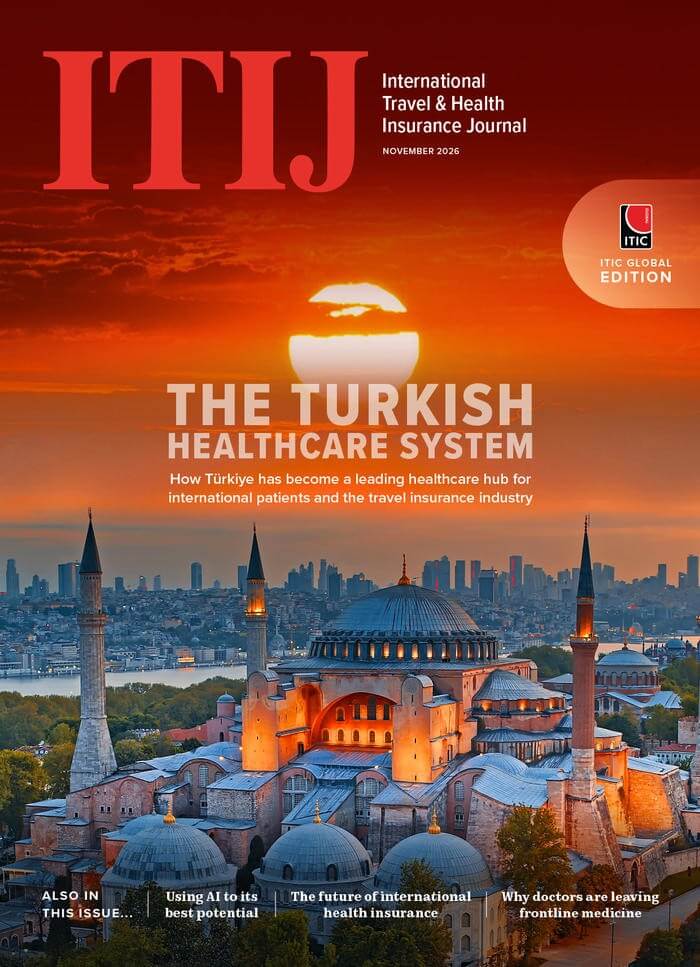
November 2026
Issue
In this, our biggest issue ever, our main focus is on artificial intelligence. After recent threats and warnings about the potential dangers of AI and calls for coordinated action to slow the technology's development, we speak to experts about the technology in a three-part special. We look at data-driven risk assessment, underwriting, and portfolio optimisation, which are all being transformed by AI, and ask what insurers and underwriters are doing to get the most out of the technology.
Editorial Team
The Editorial Team updates the ITIJ website daily, and works on features for the print edition. With expert industry knowledge and years of experience in writing about complex travel insurance issues, the Editorial Team is ready to investigate and report on the topics that matter most to ITIJ's readers.