
Accreditation highlights of 2025

The biggest accreditation companies speak to Michelle Royle about the past year and what’s coming up in 2026
CAMTS
Jan Eichel, Executive Director of the Commission on Accreditation of Medical Transport Systems (CAMTS), tells us about her new role, the importance of innovation, and offerings for their global communityAs we reflect on 2025, I am honoured to serve as Executive Director of CAMTS and to lead the organisation during a year marked by growth, innovation, and strengthened global engagement.
CAMTS exists to promote excellence, safety, and quality in medical transport worldwide. In 2025, we accredited 60 programmes, including six new accreditations, demonstrating organisations’ ongoing commitment across multiple regions to meet rigorous international standards. We also awarded two global reaccreditations and one new global accreditation, further expanding CAMTS’ international presence and reinforcing our shared global responsibility to deliver safe, high-quality medical transport services.
Our expertise
A defining strength of the CAMTS accreditation process is the expertise of our site survey auditors. CAMTS surveyors are recognised leaders in their fields, with expert-level experience in clinical care, aviation operations, or both. Their depth of knowledge, practical experience, and understanding of international operational environments ensure that each accreditation review is thorough, objective, and grounded in real-world practice. This expertise enables CAMTS to provide meaningful feedback that supports safety, quality improvement, and operational excellence across diverse medical transport systems.
A central priority for CAMTS this year has been enhancing communication and engagement with our accredited programmes, surveyors, and stakeholders worldwide. We introduced structured town hall meetings and individualised one-on-one discussions to foster open dialogue, encourage feedback, and ensure leadership accessibility. These forums help us better understand regional challenges, cultural considerations, and operational differences while maintaining consistency and integrity in the accreditation process.
CAMTS exists to promote excellence, safety, and quality in medical transport worldwide

I am also pleased to work alongside Erin Reese, who joined CAMTS as Associate Executive Director in 2025. Erin brings more than 21 years of experience in air medical transport, with deep expertise in leadership, accreditation, and operational compliance. Her experience is instrumental as we support programmes operating within diverse healthcare systems and regulatory environments.
New advancements
Innovation has been a significant focus for CAMTS in 2025. We implemented artificial intelligence (AI) supported tools to improve surveyor scheduling, aligning expertise, availability, and geographic considerations. These advancements help create a more efficient, responsive, and effective accreditation experience. We also expanded our use of work management platform Smartsheet to improve consistency, streamline workflows, and enhance operational efficiency across accreditation activities.
To further support our global community, CAMTS launched an updated website in 2025, offering improved navigation, clearer resources, and enhanced accessibility for international users. Looking ahead, we will also offer an online webinar titled ‘Preparing for Accreditation’ in 2026 to support both new and existing programmes by increasing understanding of CAMTS standards, processes, and best practices – regardless of location.
CAMTS surveyors are recognised leaders in their fields, with expert-level experience in clinical care, aviation operations, or both
In 2025, CAMTS established new internal subcommittees focused on marketing, finance, and governance. These subcommittees strengthen organisational oversight, support long-term sustainability, and ensure that CAMTS continues to evolve responsibly and strategically as a global accrediting body.
As CAMTS continues to grow, our commitment remains steadfast: to uphold high standards, support continuous improvement, and serve as a trusted international accreditation partner. I am deeply grateful to our accredited programmes, surveyors, board members, and global partners for their dedication and collaboration, and I look forward to building on this momentum in the years ahead.
EURAMI
Eva Kluge, Managing Director of the European Aero-Medical Institute (EURAMI), speaks to us about a successful 2025, their new strategy project, and what’s coming up this year
The year 2025 marked a period of remarkable progress, renewed energy, and strong engagement across the EURAMI community. It was one of the busiest and most successful years in the association’s history, defined by bold strategic initiatives, thriving member participation, and an exceptional annual conference that set new standards for quality and professionalism.
As EURAMI continues to promote excellence in aeromedical transport worldwide, the achievements of 2025 form a strong foundation for the ambitious developments planned in 2026 and beyond.
Strengthening the future: strategy project launch
A major milestone of the year was the launch of EURAMI’s new strategy project, led by myself, which officially commenced in March 2025 during a dedicated meeting in Miami. This initiative marks a pivotal step in shaping the long-term vision of the association, identifying the major focus areas that will guide EURAMI’s evolution in the coming years. Eight key workstreams were established – Legal, Finance, Audit, Standards, Aviation, Education & Training, Strategic Alliances, and Public Awareness – each addressing essential dimensions of EURAMI’s mission and operational framework.
A major milestone of the year was the launch of EURAMI’s new strategy project
The success of these workstreams has been driven by the invaluable contributions of volunteer experts from the membership. These members brought deep professional insight, commitment, and enthusiasm to the table, ensuring that the workstreams have progressed with purpose and expertise. A heartfelt thank you goes to the dedicated workstream leaders – Cai Glushak, Simon Forrington, Philipp Schneider, and Bettina Vadera – whose tireless efforts, leadership, and passion were instrumental in advancing the ambitious goals set for their groups.

A landmark event: EURAMI Conference Venice 2025
Another highlight of the year was the EURAMI Conference 2025, held on 1 November at the breathtaking Hilton Molino Stucky in Venice. This event proved to be a resounding success, offering a full day of inspiration, knowledge exchange, and meaningful connections.
The programme was fully dedicated to the core values of safety and quality in aeromedical transport – central tenets of EURAMI’s mission. The conference was elevated by a standout keynote from Ovais Ahmed, Lead Air Transport Service at the United Nations in New York. His compelling presentation delivered powerful insights and set an engaged, forward-looking tone for the entire event.
Two highly acclaimed expert sessions followed, focusing on crew fatigue as well as quality and key performance indicators (KPIs) in aeromedical transport. Both topics resonated strongly with providers across the globe and reinforced the importance of continuous improvement and shared standards.
Another highlight of the year was the EURAMI Conference 2025
After the conference, members gathered for the annual General Assembly, continuing discussions on progress, challenges, and goals for the year ahead.
Looking ahead: EURAMI plans for 2026
With the momentum of 2025, EURAMI enters 2026 with a clear sense of purpose and an exciting roadmap. The next annual EURAMI conference will take place in Istanbul, in November 2026, promising another inspiring gathering for the global aeromedical community.
In the coming year, EURAMI will continue advancing the workstreams and will introduce its new audit manual alongside amended standards. A significant focus will be the stronger integration of aviation into the audit process, ensuring maximum safety and quality across every accredited provider. To support this, a permanent aviation expert group, led by Philipp Schneider and Juan Pablo Monzon Olmos, will guide the development of aviation-focused best practices.
EURAMI will also deepen its collaborations with key international bodies – including the United Nations (UN), International Civil Aviation Organization (ICAO), World Health Organization (WHO), the European Defence Agency, and others – to further strengthen global aeromedical standards and foster productive relationships between members, payers, and partners.
A final word of appreciation
EURAMI extends its sincere gratitude to its membership, all volunteers, speakers and sponsors, and everyone who contributed time, knowledge, and dedication throughout 2025. Your commitment is what drives EURAMI’s mission forward, ensuring that the association continues to be a beacon of aeromedical excellence worldwide.

Medical Transport Accreditation & Compliance
Jessica Peltz, Owner of Medical Transport Accreditation & Compliance, talks to us about the industry’s increased focus on safety, accreditation, and audit rigour
In 2025, safety became a central theme across the medical transport industry, but the conversation shifted in noticeable ways. Both transport providers and network managers spent less time debating whether standards mattered and more time focusing on how they should be interpreted, applied, and monitored in practice. This was driven in large part by heightened safety awareness and a growing expectation of transparency across the industry.
Transport providers
On the transport provider side, there was a clear increase in interest around accreditation. Many programmes were actively preparing for initial accreditation or upcoming reaccreditation cycles, while others were paying closer attention to draft updates and evolving guidance.
In 2025, safety became a central theme across the medical transport industry
Transport providers were less focused on rewriting policies and more interested in understanding intent:
- What accreditors/auditors are really looking for
- How standards are applied during site surveys
- How expectations have shifted around governance, safety programmes, and quality oversight.
This was particularly evident among programmes managing more than one accreditation framework at the same time, a particular challenge being ‘Where do the accreditation standards align with each other?’
Notably, there are commercially available, paid software programs that allow providers to easily share/track/complete compliance with accreditation standards.
Assistance organisations
On the other side, assistance organisations and network managers sought a stronger emphasis on safety and quality programmes. This was greatly influenced by the number of high-profile air ambulance incidents during the year, which reinforced the importance of looking beyond credentials alone.
The biggest question we were asked was: “How do we ensure this doesn’t happen with our insured [patient] on board?”
We all know the answer, which led to a new question: “How do we mitigate the risk?”
As a result, accreditation continued to serve as an important baseline, but it was increasingly paired with deeper internal reviews. Network managers showed greater interest in understanding how safety and quality programmes function day to day, how issues are identified and addressed, and how oversight is maintained across both primary providers and referred/brokered partner networks.


Reviewing and refining
Alongside this shift came increased interest in enhanced internal audit standards. Network managers and assistance organisations spent more time reviewing and refining how their internal audits were conducted, what they were intended to validate, and how findings were used.
Assistance organisations and network managers sought a stronger emphasis on safety and quality programmes
Rather than one-time (or periodic) evaluations, audits were more often viewed as part of an ongoing oversight process – supporting consistency across networks, clarifying expectations for subcontracted or partner providers, and reinforcing shared accountability for safety and quality.
Across both groups, accreditation standards increasingly functioned as a shared reference point. For transport providers, they provided a means to show their commitment to accepted quality standards and gain access to clients. For assistance organisers, they offered a common language for discussing scope of service, safety management, and quality processes.
This shared use helped bridge conversations between transport providers and network managers, particularly in complex transport scenarios involving multiple assets or service types.
Overall, 2025 reflected an industry leaning into accreditation and safety as practical tools rather than symbolic markers. Increased engagement from transport providers, combined with a stronger focus on safety and audit rigour from network managers, highlighted a broader move toward clarity, consistency, and informed oversight across medical transport networks.
NAAMTA Global
Roylen ‘Griff’ Griffin, Owner and Executive Director, and Amy C Arndt, Operations Director, at the National Accreditation Alliance of Medical Transport Applications (NAAMTA Global), speak to us about their new framework, international engagement, and the focus for 2026
The year 2025 represented a period of consolidation, refinement, and purposeful progress for NAAMTA Global, as the organisation continued to adapt its accreditation approach to the evolving realities of global medical transport operations.
Across the industry, providers are navigating increasing regulatory complexity, staffing challenges, financial pressures, and growing expectations from patients, insurers, and government stakeholders. Throughout 2025, NAAMTA’s work focused on ensuring that accreditation remains not only a marker of compliance, but a practical framework that supports safe, ethical, and resilient operations in real-world environments.
The CCC framework
A central theme of the year was the continued maturation of NAAMTA’s Continuous Compliance and Commitment (CCC) framework. This approach reinforces accreditation as an ongoing operational discipline rather than a periodic event. In practice, this meant closer engagement with accredited organisations throughout the year – supporting structured reporting, meaningful corrective action follow-through, and documentation that reflects how programmes actually function day to day. For organisations operating across multiple jurisdictions or regulatory systems, this model proved particularly valuable in aligning internal governance with external expectations.
The year 2025 represented a period of consolidation, refinement, and purposeful progress for NAAMTA Global
Importantly, NAAMTA worked with organisations at varying stages of operational maturity in 2025. This included long-established providers maintaining accreditation, programmes undergoing renewal, and emerging operators seeking to formalise systems as they expanded services or entered new markets. A consistent emphasis was placed on collaboration throughout the accreditation process, positioning accreditation as a tool for strengthening systems and decision-making rather than a pass/fail exercise.
International engagement continued to expand in 2025, with NAAMTA supporting programmes across multiple regions and operational contexts. This global experience reinforced the importance of consistent accreditation principles – such as patient safety, clinical oversight, governance, and risk management – while allowing flexibility in how those principles are implemented locally. NAAMTA’s standards remained outcome-focused, emphasising demonstrable practices and accountability rather than prescriptive or one-size-fits-all solutions.
Audit integrity
From an audit perspective, 2025 saw continued refinement of hybrid assessment models, combining comprehensive remote documentation review with targeted on-site evaluation where appropriate. These approaches supported audit integrity while minimising unnecessary operational disruption, particularly for providers balancing accreditation requirements with active mission demands.
Another notable area of industry dialogue in 2025 involved the increasing role of technology, including electronic quality management systems, flight coordination platforms, and emerging decision-support tools. While NAAMTA does not endorse specific technologies, accreditation reviews have increasingly examined how organisations govern, validate, and oversee such tools within established safety and quality frameworks. A consistent position was maintained throughout the year: technology may support operations, but clinical accountability, risk oversight, and governance must remain firmly rooted in human decision-making. Throughout the year, NAAMTA continued to support accredited organisations through guidance materials aligned with accreditation standards, helping programmes better understand documentation expectations while maintaining flexibility to reflect local operations and regulatory requirements.
The year ahead
Looking ahead to 2026, NAAMTA will focus on making the accreditation process clearer and easier to navigate. This includes providing clearer guidance on what evidence is expected and offering stronger support to help organisations prepare for audits. These efforts respond to industry demand for accreditation processes that are practical, transparent, and able to stand up to regulatory and stakeholder scrutiny.
As the medical transport sector continues to evolve, accreditation is increasingly viewed as more than a regulatory requirement. For many organisations, it serves as a signal of organisational resilience, supporting trust with partners, insurers, regulators, and patients alike. In this context, NAAMTA continues to engage with operators seeking accreditation, renewal, or guidance as they strengthen quality, safety, and governance frameworks.
As the medical transport sector continues to evolve, accreditation is increasingly viewed as more than a regulatory requirement
Entering 2026, NAAMTA remains committed to evolving alongside the industry it serves – supporting medical transport providers not only in meeting accreditation standards, but in building sustainable systems capable of adapting to the future of global medical transport.
In January 2026, NAAMTA successfully completed its 15th consecutive annual ISO 9001 audit by its independent International Organization for Standardization (ISO) registrar, reinforcing our commitment to continual improvement and the same disciplined oversight we expect of the organisations we accredit. Being audited annually enables NAAMTA to remain closely aligned with applicants and accredited organisations, ensuring our accreditation process remains practical, transparent, and grounded in real-world operational challenges.
March 2026
Issue
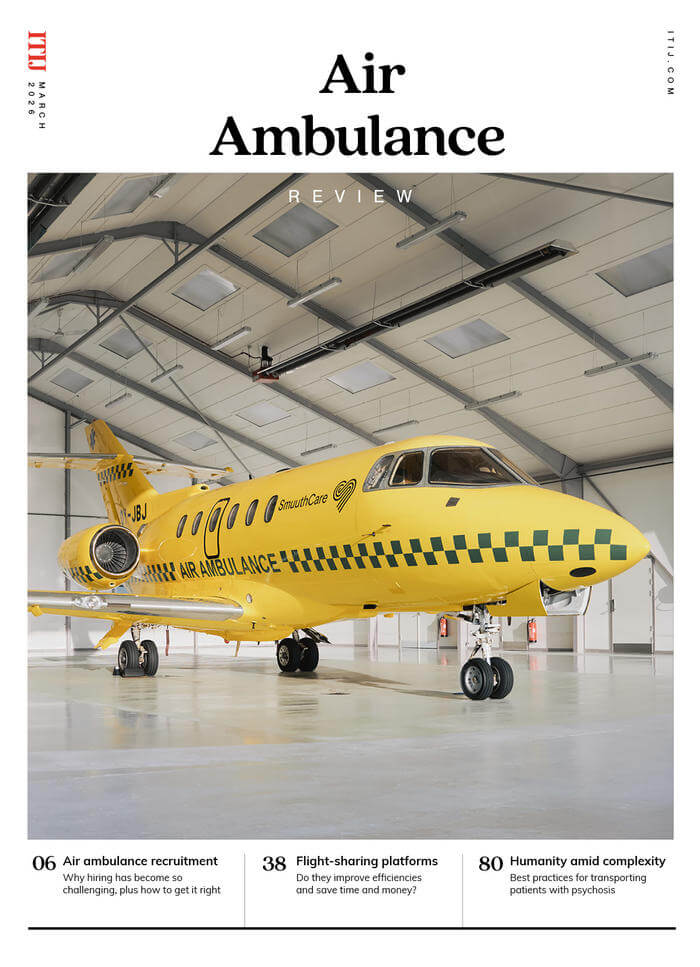
In this issue of Air Ambulance Review we examine the challenges facing air ambulance providers when it comes to recruitment; look at flight-sharing platforms and ask if they can improve efficiencies; and we delve into the latest medications, protocols and best practices for transferring vulnerable patients with psychosis.
Editorial Team
The Editorial Team updates the ITIJ website daily, and works on features for the print edition. With expert industry knowledge and years of experience in writing about complex travel insurance issues, the Editorial Team is ready to investigate and report on the topics that matter most to ITIJ's readers.