
No more malaria in 2050?

According to a new report published by the Lancet, malaria could be eradicated in the next few decades.
With a number of countries battling epidemics, notably in much of Sub-Sharan Africa, Asia and Latin America, this is welcome news. Indeed, according to the World Health Organization (WHO), in 2017, there were an estimated 219 million cases of the disease in 87 countries.
The report, which has been heralded as the first of its kind, lays out the steps required to eradicate the disease within a generation. "For too long, malaria eradication has been a distant dream, but now we have evidence that malaria can and should be eradicated by 2050," said Sir Richard Feachem, an author on the report. "This report shows that eradication is possible within a generation."
we have evidence that malaria can and should be eradicated by 2050
According to the report, if the dream of eradication of the disease is to become a reality, current technologies must be used more effectively and new ways to tackle the disease must be developed. However, this relies on more funding being allocated to malaria. In fact, the report estimates that around US$4.3 billion is spent on malaria every year at the moment, but a further $2 billion is required to eradicate the disease by the year 2050.
Although ambitious, the report states that with a greater financial outlay, stronger malaria programmes and global leadership and accelerated R&D, the disease can be wiped out. “It will require ambition, commitment and partnership like never before, but we know that its return is worth the investment, not only by saving lives in perpetuity, but also improving human welfare, strengthening economies and contributing to a healthier, safer and more equitable world," Dr Fred Binka, from the University of Health and Allied Sciences in Ghana, aptly stated.
with a greater financial outlay, stronger malaria programmes and global leadership and accelerated R&D, the disease can be wiped out
In addition to the new report, in encouraging findings from The Kenya Medical Research Institute (Kemri) and global health partners, scientists used bacteria to kill the parasite that causes malaria. Following extensive lab research, the CDC will now perform human trials using new drugs derived from the bacteria. “Resistance is always a problem and the parasite always finds a way to get away with it. That is why a new line of treatment is a must. It has to be made available soon,” said Dr Simon Kariuki, Head of Kenya’s malaria research programmes at Kemri. “We have discovered [that the] bacterium is highly effective in killing plasmodium falciparum, the parasite that causes malaria, but our research is more focused on pregnant women and children as they are more vulnerable. We are getting very motivating leads.”
With the promise of potential new drugs and all hands on deck to fight the disease, the possibility of eradicating malaria is more in reach than ever before.
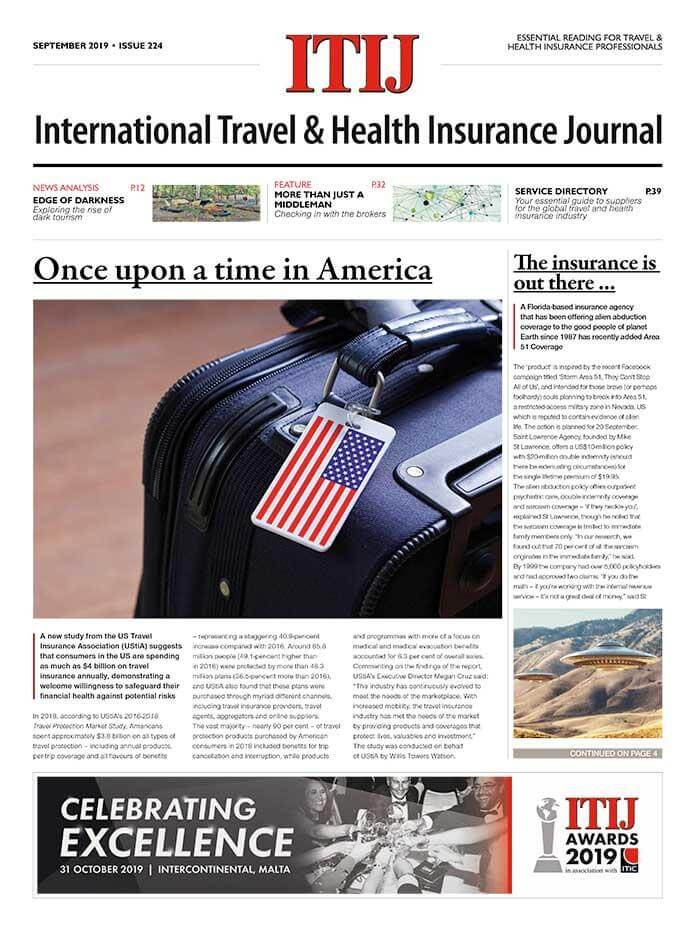
September 2019
Issue
In ITIJ’s September issue, we get to grips with some of the risks involved with the fast-growing trend of ‘dark tourism’; and we explore the enduring relevance of brokers in the global travel and health insurance landscape. We also hear personal insights from an insurtech specialist on how insurers can capitalise on the global tourism boom, a member of the UK’s Chartered Insurance Institute on how policies might evolve to meet the needs of tomorrow’s space travellers, and a global assistance provider CEO on how to better educate customers on hurricane risk.
Editorial Team
The Editorial Team updates the ITIJ website daily, and works on features for the print edition. With expert industry knowledge and years of experience in writing about complex travel insurance issues, the Editorial Team is ready to investigate and report on the topics that matter most to ITIJ's readers.