
Healthcare private equity reached $115 billion in 2024

Global healthcare private equity (PE) soared in 2024 to an estimated US$115 billion, the second-highest deal value total on record
This surge was propelled by an increase in the number of large deals, according to Bain & Company’s Global Healthcare Private Equity Report 2025. In total, five transactions exceeded $5 billion, compared with two deals in 2023 and one in 2022. North America continues to be the largest market, representing 65% of global deal value, with Europe and Asia Pacific accounting for 22% and 12% respectively. Deal volumes remained steady relative to historical levels, with a wave of activity in North America and Europe offsetting a 49% decline in deal volume in Asia-Pacific since 2023.
These are among the findings of Bain’s report.
European dealmaking rebounds to record highs
In Europe, deal volume has surged past its 2021 peak, boosted by a focus on smaller deals in the first half of the year. Biopharma and medtech were two of the leading sectors in 2024, as firms that purchased assets in these sectors can easily scale up across the region. Bain is optimistic about the European market, given the strong growth in buyout volume and a stabilising macroenvironment. The firm anticipates that the uptick in deal activity will continue, with the potential for more ‘megadeals’.
Large deals drive biopharma value
The biopharma sector continues to lead healthcare deals in value, fuelled by several major transactions in 2024. Despite the record buyout deal value in biopharma, overall volume in the biopharma and life sciences tools sectors dropped by 5% and 10% respectively since 2020, in terms of compound annual growth rate (CAGR).
A resurgence of healthcare IT deals
Healthcare IT dealmaking rebounded in 2024 due to several factors, said Bain. First, providers, facing financial pressures and shifting reimbursement models, are investing in core systems to boost efficiency. In response, PE firms are increasingly investing in assets supporting workflow improvements. In addition, payers, looking to improve payment integrity, are investing in advanced analytics.
Four trends reshaping the healthcare PE landscape
- Mid-market funds continue to innovate. Mid-market healthcare-focused funds have historically outperformed the broader market, benefiting from continued innovation and evolution of their investment strategies. They have also been able to maintain buyout deal activity and exits since 2020, even as the broader healthcare buyout market struggled. This performance has translated into strong fundraising. Mid-market funds with healthcare exposure have raised about $59 billion since 2022, exceeding fundraising in the previous three years by about 40%
- Carve-outs open up value in a tight deal market. Despite annual variability in deal activity, healthcare carve-outs have been on an upward trajectory since 2010, propelled by a mix of public companies trying to improve shareholder value and PE firms eager to acquire sizable assets
- Exit value maximisation is a strategic imperative. Healthcare private equity exit deal volume remained low in 2024 – down 41% from its 2021 peak – as high interest rates and misalignment between buyers and sellers prolonged hold periods and strained funds’ ability to return capital to their limited partners (LPs)
- Asia-Pacific investment has evolved. PE firms are expanding their investments beyond China into the broader Asia-Pacific region, where deal value rose at a roughly 21% CAGR since 2016. However, deal volume in the region has declined significantly since 2023, due to a slowdown in dealmaking in China; a shift in volume to India, Japan, and South Korea; and increased competition from strategic players with an appetite to pursue M&A.
Nirad Jain, Partner at Bain & Company and Co-Leader of its Healthcare Private Equity team, commented: “Lower interest rates in the US and stable economic growth in regions like Japan and India indicate favourable investment conditions. Looking ahead, asset build-up in PE portfolios, together with increased pressure from LPs to provide liquidity, suggests an imminent increase in sponsor exits.”
Wendy Sherry recently discussed healthcare programmes, the gender health gap, and embracing new technology with the ITIJ team.
Chloe Fox
Chloe Fox is an Editorial Assistant for Voyageur Group, joining in 2024. She writes for ITIJ and AirMed&Rescue, covering a range of topics including international travel and health insurance, medical assistance provision, and air medical transportation. Chloe holds a BA (Hons) in English and an MA in English Literature from the University of Bristol.











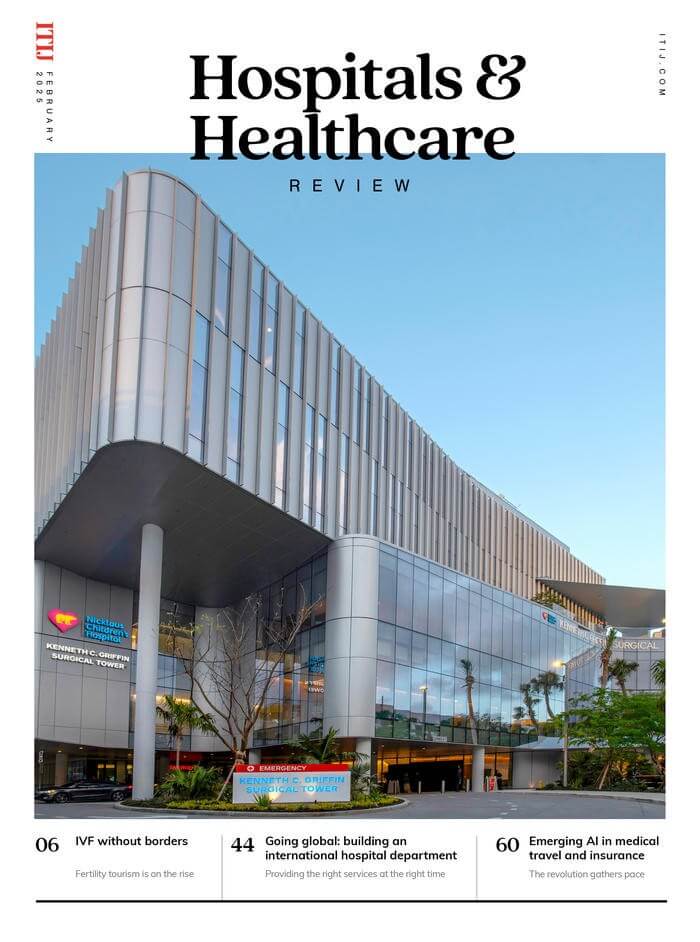
February 2025
Issue
Offering readers a deep dive into the issues facing providers and payers of healthcare services around the world. Cost containment, international patient department development, the role of AI in healthcare delivery and more.