
When a straightforward assistance case takes an unexpected turn

Catherine Njeri, a Registered Nurse, and Tabitha Wanjiku Mwangi, a Critical Care Nurse, from AMREF Flying Doctors, recount how they helped manage a complex assistance case through repeated admissions, changing clinical needs and a repatriation that could not go ahead
What began as a request for a ground ambulance transfer soon developed into a prolonged medical assistance case involving multiple hospital admissions, specialist treatment, changing levels of care and an international repatriation that ultimately had to be cancelled.
The patient, an international traveller, experienced a medical emergency shortly before a planned departure from Kenya. They were initially admitted to a local healthcare facility, but it quickly became apparent that a higher level of care was required.
AMREF Flying Doctors (AFD) was engaged to coordinate a ground ambulance transfer to an appropriate hospital and support the case as the local assistance services partner in Kenya. At that stage, the objective appeared straightforward: ensure the patient reached the right facility and maintain continuity of care.
As the days and weeks unfolded, however, the case evolved into something considerably more complex.
A transfer that was only the beginning
Following the initial transfer, further clinical concerns emerged and additional treatment became necessary. The patient's admission lasted longer than anticipated, and the options available were increasingly influenced by both medical requirements and insurance considerations.
The focus of the case quickly shifted from transport logistics to broader questions of case management.
What treatment would the patient require next? Could the current hospital provide it? Would another facility be more appropriate? What options existed for returning home safely?
Throughout this period, AFD's Medical Assistance Team remained in close communication with the treating facilities, obtaining medical updates, monitoring progress and relaying information to the international assistance and insurance teams.
For organisations managing a case remotely, access to accurate local information is essential. Decisions around transfers, admissions and repatriation depend heavily on understanding what capabilities exist on the ground and how quickly they can be accessed.
Planning the journey home
As the patient's condition stabilised, discussions turned towards repatriation. The proposed plan involved the patient travelling on a commercial flight accompanied by an international medical escort, subject to ongoing medical clearance and fitness to travel.
Preparations were made and the escort travelled to Kenya to accompany the patient on the journey home. For a brief period, it seemed as though the case was approaching a successful conclusion. Then the situation changed.
By the time the escort arrived, the patient's condition had deteriorated.
Following reassessment, the treating team determined that commercial air travel was no longer medically appropriate. The repatriation was cancelled.
It was a disappointing outcome for everyone involved, but it underscored one of the realities of assistance and repatriation work: fitness to travel is not a fixed status. A patient can be considered suitable for travel when planning begins and become unfit before departure.
In this instance, the priority shifted immediately from arranging a journey home to ensuring the patient received the care they now required.
When discharge does not mean resolution
The patient was later discharged, creating cautious optimism that the case might finally be moving towards resolution. That optimism proved short-lived.
The objective appeared straightforward: ensure the patient reached the right facility and maintain continuity of care
A subsequent acute episode resulted in readmission, and what had already become a prolonged assistance case entered another phase.
The patient required further treatment and, as clinical needs continued to evolve, additional hospital transfers became necessary. Specialist intervention was subsequently recommended, prompting coordination between AFD, the international assistance partner and a receiving facility capable of providing the required care.
As part of that process, AFD worked with the relevant parties to facilitate a Guarantee of Payment and support the admission arrangements, helping to ensure that treatment could proceed without unnecessary delay.
The patient remained under specialist care before later requiring transfer to another facility capable of providing a higher level of monitoring and support.
By this point, the original request for a single ambulance transfer had developed into a complex, multi-stage assistance case involving repeated admissions, changing clinical requirements, specialist treatment and an unsuccessful repatriation attempt.
Keeping the case moving
In a case such as this, no single organisation controls every aspect of the process. The treating clinicians determine the patient's medical management.
Insurers and assistance companies make decisions regarding authorisation and coverage. Hospitals assess capacity and clinical suitability. Transportation providers determine what is operationally possible.
Meanwhile, the patient's condition can change at any stage. AFD's role was to help connect those moving parts locally.
Through its Medical Assistance Team and 24/7 Operations and Emergency Control Centre, AFD remained in regular contact with healthcare providers, coordinated transfers, monitored developments and helped identify facilities capable of meeting the patient's evolving needs.
Just as importantly, the team helped facilitate the practical and administrative arrangements required to support continuity of care.
While much of assistance work is often associated with ambulances, aircraft and emergency responses, some of the most important work happens behind the scenes. Someone must obtain the latest clinical information, coordinate between providers, confirm receiving facilities, arrange transport and ensure that the necessary administrative processes are in place.
In prolonged cases, that coordination becomes critical.
Managing the case on the ground
This is where reliable boots-on-the-ground support can make a significant difference.
While strategic decisions may be made elsewhere, many of the practical realities of a case unfold locally. Having experienced personnel in country who can engage directly with hospitals, obtain real-time updates, understand local healthcare pathways and help turn decisions into action becomes increasingly important as complexity grows.
For international insurers and assistance companies managing cases from outside Kenya, local knowledge can make a significant difference. Understanding hospital capabilities, facilitating communication with treating teams, coordinating admissions and arranging transfers all become easier when supported by a trusted local partner with established relationships and operational experience.
Following reassessment, the treating team determined that commercial air travel was no longer medically appropriate
Throughout this case, AFD provided that local support, working alongside the international assistance team as circumstances evolved.
Looking back
There was no single moment when this case became complex.
Instead, complexity accumulated over time. The patient needed a higher level of care. The admission lasted longer than anticipated. A repatriation plan was developed and then abandoned. Discharge was followed by readmission. Specialist treatment became necessary and further transfers followed.
At several stages, those involved were not choosing between clearly right and clearly wrong options. They were balancing patient needs, available resources, operational realities and changing clinical circumstances.
The planned journey home never happened. Yet the case was not ultimately defined by a cancelled repatriation. It was defined by the ability of multiple organisations, working across different healthcare systems and time zones, to continually reassess the situation and respond to the patient's changing needs.
In the end, the most important outcome was not whether the original plan was completed. It was whether the patient continued to receive the most appropriate care as circumstances evolved.
Cases like this serve as a reminder that assistance is rarely a single event. More often, it is a continuous process of assessment, coordination and adaptation, particularly when the expected path forward no longer exists.
And perhaps that is what putting the assist in assistance really means: not simply arranging the first transfer or planning the journey home, but remaining engaged when circumstances change and the next step becomes far less clear.
Catherine Njeri, Registered Nurse, AMREF Flying Doctors Catherine is a registered nurse and healthcare professional specialising in medical assistance, international health insurance and healthcare provider management. At AMREF Flying Doctors, she works across case management, provider networks, claims and healthcare quality. Her professional interests include strengthening cross-border healthcare partnerships and advancing sustainable approaches to healthcare delivery.
Tabitha Wanjiku Mwangi, Registered Nurse, and Critical Care Nurse, AMREF Flying Doctors Tabitha is currently pursuing a Master’s degree in Critical Care Nursing. She specialises in aeromedical patient transfers and international medical assistance coordination. Outside work she is passionate about wellness, preventive health, and promoting holistic wellbeing.
October 2026
Issue
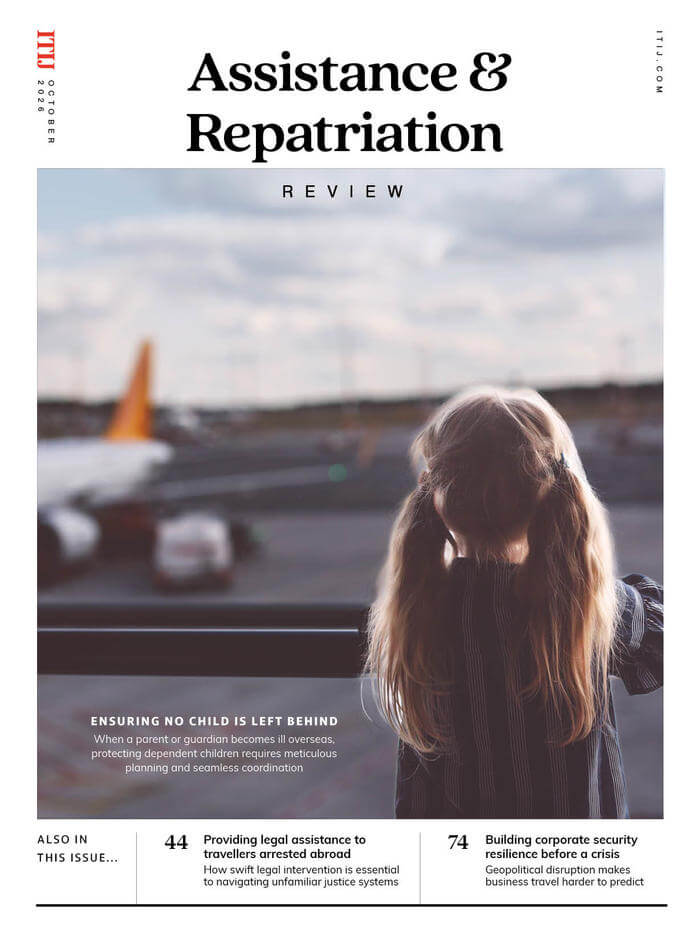
When a parent or guardian becomes seriously ill overseas, assistance providers face a complex challenge that extends well beyond clinical care. Although these cases are relatively rare, in this issue we look at how safeguarding dependent children requires careful planning, legal awareness, and close international coordination.
Editorial Team
The Editorial Team updates the ITIJ website daily, and works on features for the print edition. With expert industry knowledge and years of experience in writing about complex travel insurance issues, the Editorial Team is ready to investigate and report on the topics that matter most to ITIJ's readers.