When reality does not match the medical information received

Dr Eva Wurz, Chief Medical Officer at Tyrol Air Ambulance, tells us about a time when incorrect information caused serious risks for a patient
The initial situation
Tyrol Air Ambulance received a request to transport a patient from Italy to Germany. The medical report described a severely ill but clinically stable patient with the following symptoms: Septic shock due to E. coli caused by:
- Coecum perforation due to ischaemic colitis, post hemicolectomy and ileostomy
Multiorgan failure:
- Microaspiration pneumonia
- Suspected NSTEMI with bradycardia
- Acute on chronic liver failure – Cirrhosis hepatic, CHILD A.
Based on this information, the medical flight team prepared for a critically ill but haemodynamically stable patient breathing spontaneously.
The arrival in Italy – a different reality
Upon arrival at the hospital, the reality was far more serious. The 63-year-old patient was:
- Intubated and ventilated
- Haemodynamically unstable, despite needing multiple catecholamine support.
The ‘stable’ assessed patient had become a highly critical intensive care patient who could suffer life-threatening complications at any moment.
“We always plan for the unexpected, but inaccurate or outdated medical information can jeopardise the safety of the patient and disrupt the entire mission,” explained Manfred Helldoppler, Managing Director of Tyrol Air Ambulance. “Unplanned delays can also have a serious effect on following missions.”
Challenges – medical and logistical
The discrepancy between the preinformation and the actual condition created significant risks:
- Flight preparation: an intubated, ventilated, unstable patient requires additional resources – extra infusion pumps, spare ventilators, specialised medications
- Transport safety: circulatory instability during flight increases the risk of cardiac or respiratory decompensation
- Communication: the unexpected situation made last-minute reorganisation necessary – consulting with the receiving hospital, coordinating with the Operations Control Centre and reassessing the entire mission plan.
Flexibility under pressure
On site the medical team stabilised the patient before departure:
- Optimised ventilation settings
- Adjusted catecholamine doses
- Secured arterial and venous access
- Checked lab values where possible
- Provided a detailed handover at the receiving hospital.
Only after the stabilisation of the patient could the transport begin, after much delay. Continuous invasive monitoring was maintained throughout the flight, with several adjustments to medication and ventilation to keep oxygenation stable.
Lessons learned
This case illustrates the importance of accurate and up-to-date medical information for safe patient transports. Even minor communication gaps can lead to serious risks for the patient during transport.
Preventive strategies
Eva Wurz, Chief Medical Officer at Tyrol Air Ambulance, said: “We always request the most up-to-date medical information possible from our clients, even if it is inconvenient. We use standardised checklists covering vital signs, ventilation status, medication and lab results. We equip our air ambulance jets for unexpected critical situations as standard practice.”
Conclusion
Despite the unexpected challenges, the mission was completed successfully. The case reinforces a vital truth in intensive care transport: accurate communication is just as essential as medical expertise – together, they save lives.
Dr Eva Wurz, Chief Medical Officer at Tyrol Air Ambulance, brings over 15 years of expertise as a Flight Doctor to her role. Her extensive experience in air medical transport ensures the highest standards of patient care, safety, and medical leadership across all TAA missions.
Tyrol Air Ambulance (TAA), based in Austria, delivers worldwide air ambulance services with a strong focus on high medical quality and patient safety. Operating 24/7, they offer medical escort services and case management, and tailored air ambulance services with their dedicated air ambulance jet fleet – from missions within Europe to long-haul flights with a dual-patient capability.
September 2025
Issue
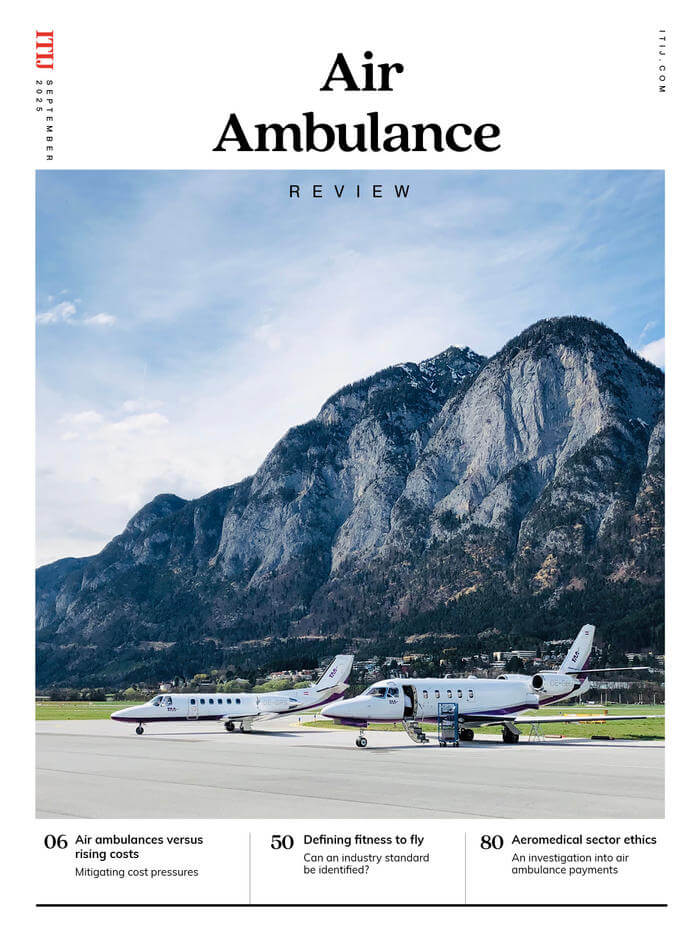
We include an examination on defining ‘fitness to fly’, and ask if an industry standard can be identified, and what that would involve. We also look at capacity in the aeromedical market and experts share their insights. Ethics and transparency in the aeromedical sector is a big issue, and we include an investigation into air ambulance payments.
Editorial Team
The Editorial Team updates the ITIJ website daily, and works on features for the print edition. With expert industry knowledge and years of experience in writing about complex travel insurance issues, the Editorial Team is ready to investigate and report on the topics that matter most to ITIJ's readers.