When every minute counts: rescuing a tourist from Kenya’s Loita Hills

Silas Saitoti from AMREF Flying Doctors recounts a morning hike that took an unexpected turn
A hike through Kenya’s Loita Hills quickly turned into an emergency after a tourist slipped on a rocky outcrop, sustaining deep cuts to his scalp. The accident happened in a remote area that was inaccessible by road and too far from the nearest air strip for a fixedwing evacuation.
The accident
The injured man, a retired medical doctor, was visiting Kenya with his wife on safari. Like many travellers, he had chosen to explore the Loita Hills on foot with local Maasai guides who knew the terrain well.
After more than two hours of hiking, the group paused near a large rock overlooking a valley. As he made his way across the rock surface, he suddenly lost his footing and slid down the rock face.
Sharp ridges cut deeply into his scalp as he fell. Fortunately, he came to a stop just short of the valley below.
His wife watched helplessly as the guides rushed to his aid. They carefully moved him to safety and immediately began administering first aid while trying to control the bleeding. Although he remained conscious and responsive, it was clear he needed urgent medical attention.
The emergency call
Luckily, while planning their holiday, the couple had subscribed to the AMREF Flying Doctors Maisha Tourist Emergency Evacuation Plan through their tour operator.
This mission showed how important teamwork is.The local Maasai guides had already provided first aid and helped identify a safe landing area before we arrived. Everyone played a part in making sure the patient reached hospital safely
The tour operator immediately contacted the AMREF Flying Doctors Operations Centre, triggering the emergency response.
The injured man’s location quickly shaped the rescue plan. Deep inside the Loita Hills, he was several hours from the nearest air strip, making a fixedwing evacuation impractical. A medically configured rescue helicopter offered the quickest and safest way to reach him and transport him to specialist care.
While the helicopter crew prepared for departure, the Operations Centre coordinated with the tour operator and Aga Khan University Hospital in Nairobi to ensure everything would be ready before the helicopter arrived.
Finding a landing site
Reaching the injured man was only part of the mission.
There were no prepared landing sites nearby. Working closely with the local Maasai guides, the crew identified a small clearing that offered enough space for the helicopter to land safely. To make their location easier to identify from the air, the guides spread brightly coloured Maasai shukas across the open ground.
Against the surrounding landscape, the vivid colours stood out clearly, allowing the pilot to identify the landing site and make a safe approach.
The injured man’s location ruled out a fixed-wing evacuation. A rescue helicopter gave us the fastest and safest way to reach him and get him to specialist care
Without the guides, locating a suitable landing area would have taken much longer.
This mission showed how important teamwork is. The local Maasai guides had already provided first aid and helped identify a safe landing area before we arrived. Everyone played a part in making sure the patient reached hospital safely.
Care on the ground
By the time the helicopter landed, the guides had already done an excellent job of providing first aid and helping to control the bleeding.
The initial assessment confirmed extensive scalp lacerations with ongoing bleeding. Scalp injuries can result in significant blood loss if they are not managed quickly, so the medical team’s immediate priority was to control the haemorrhage, assess for any additional injuries and prepare him for transport. Once he had been stabilised, he was carefully transferred into the helicopter for evacuation.
The injured man’s location ruled out a fixed-wing evacuation. A rescue helicopter gave us the fastest and safest way to reach him and get him to specialist care.
The flight to Nairobi
After a rapid turnaround at the landing site, the helicopter departed Loita Hills for Aga Khan University Hospital in Nairobi. The flight took approximately 25 minutes.
Throughout the journey, the injured man remained stable while receiving continuous monitoring and supportive care. On arrival, he was transferred directly to the waiting hospital team for further assessment and treatment.
Outcome
The injured man underwent further assessment and treatment for his injuries. Fortunately, investigations confirmed that he had not sustained any major head injury beyond the deep scalp lacerations.
Following treatment and a short period of observation, he made a good recovery. Within a few days, he was medically cleared to continue his safari.
What began as a routine hike in one of Kenya’s most remote and beautiful landscapes ended with a successful rescue, timely treatment and the opportunity for him to continue enjoying the rest of his holiday.
Looking back
This mission reinforced how preparation, local knowledge and good coordination can make all the difference when an emergency happens far from medical care.
Having emergency evacuation cover already in place meant the rescue could begin immediately. Choosing a helicopter allowed the crew to reach the injured man quickly and avoid a lengthy transfer to the nearest air strip.
From the moment the emergency call came in, to the injured man’s arrival at Aga Khan University Hospital, every stage of the mission depended on people working together towards the same goal: getting him safely to the care he needed.
Silas Saitoti is a Critical Care and Emergency Flight Nurse at AMREF Flying Doctors, with over 10 years’ experience in pre-hospital medicine, emergency care, and critical care patient transport. As part of the AMREF Flying Doctors medical team, Silas cares for critically ill and injured patients from the point of pick-up through to handover at the receiving hospital. His work often takes him into challenging environments where quick clinical decisions, careful patient stabilisation, and safe transport are critical. Silas is particularly passionate about emergency medicine and critical care transport, and the difference timely medical intervention can make for patients when every minute counts.
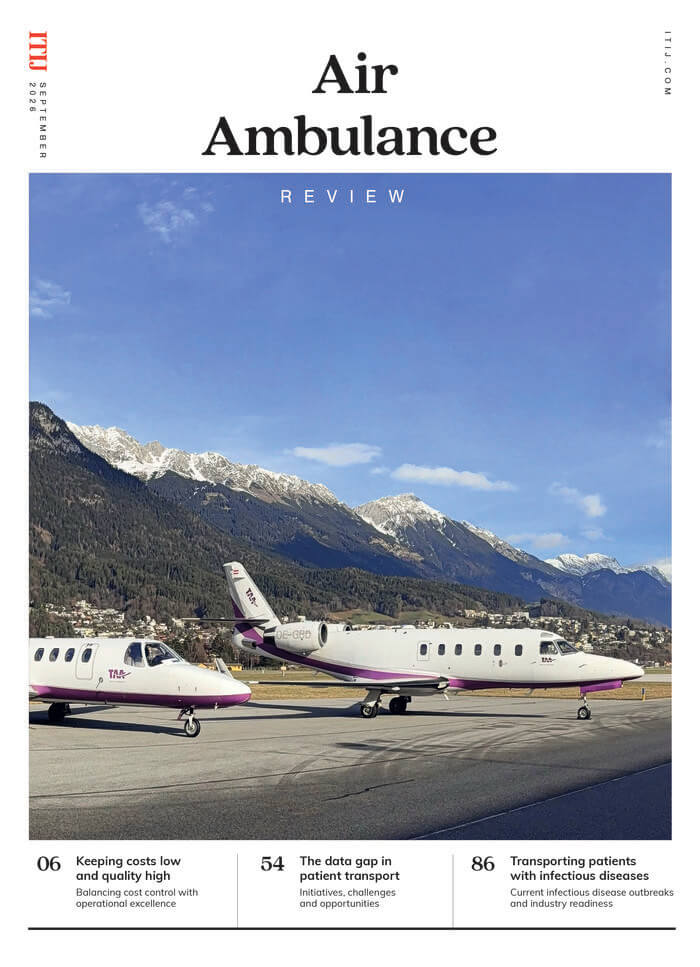
September 2026
Issue
This issue we focus on the problems that rising costs are having on the industry. Air ambulance providers are facing costs across fuel, aircraft maintenance, staffing, insurance, regulatory compliance, and specialist medical equipment. As if that wasn’t enough, delayed payments from insurers are adding further financial pressure. Despite these challenges, providers agree that patient safety and clinical quality must not be compromised.
Editorial Team
The Editorial Team updates the ITIJ website daily, and works on features for the print edition. With expert industry knowledge and years of experience in writing about complex travel insurance issues, the Editorial Team is ready to investigate and report on the topics that matter most to ITIJ's readers.