
When changing the flight plan saves a life and reduces costs

Mustapha Hmoud from Air Ocean Maroc shares lessons from an international air medical evacuation
Medical repatriation often relies on clinical information provided remotely before the medical crew reaches the patient. However, discrepancies between the initial medical reports and the patient’s actual condition may require immediate reassessment of the evacuation strategy. We report the case of an international air medical evacuation that illustrates how multidisciplinary decision making, flexibility, and trust between partners resulted in a better clinical outcome.
Case presentation
A request for an international medical evacuation was received from one of our long-standing insurance partners concerning a patient hospitalised in Cape Verde. The intended destination was Austria, requiring approximately seven hours of flight time with one technical stop. The patient presented with acute abdominal pain, progressive abdominal distension, recurrent episodes of orthostatic hypotension, and a suspected subocclusive syndrome.
Despite the absence of a definitive diagnosis, the available medical documentation suggested that the patient was fit to fly, and the mission was approved. Upon arrival at the referring hospital, our aeromedical team performed an independent bedside assessment before departure. Contrary to the initial reports, the patient exhibited marked abdominal distension associated with respiratory compromise and clinical findings highly suggestive of abdominal compartment syndrome. The severity of the abdominal findings raised immediate concerns regarding the safety of a prolonged international flight.
Operational decision-making
An urgent multidisciplinary discussion was initiated between the flight medical crew and the medical operations centre of our air ambulance company.
Recognising the potential risks, the case was escalated to a collegial discussion involving the insurance company’s medical director. Although changing an already approved mission represents a significant operational and logistical challenge for both the air ambulance provider and the insurer, all parties agreed that patient safety should remain the primary objective. A consensus was reached to interrupt the transfer midway in Morocco rather than continue directly to Austria. This decision allowed urgent diagnostic investigations to be performed before exposing the patient to a prolonged flight.
Clinical outcome
Emergency imaging performed immediately after admission revealed a giant ovarian cyst causing severe compression of the abdominal viscera and mimicking mechanical bowel obstruction. The patient also showed early biological deterioration secondary to persistent vomiting. Emergency laparoscopic surgery was performed the same night, consisting of cyst evacuation and adnexectomy. The postoperative course was favourable. After two days in the intensive care unit, the patient was transferred to a surgical ward and was subsequently repatriated safely to Austria on a scheduled commercial flight four days later.
Discussion
This case highlights one of the major challenges in international aeromedical evacuation: clinical deterioration or inaccurate characterisation of the patient’s condition between the initial referral and bedside assessment.
It also demonstrates the importance of empowering medical crews to reassess transport eligibility at the patient’s bedside and to challenge the original evacuation plan whenever necessary. Such flexibility requires a high level of trust between insurers, medical assistance companies, and air ambulance operators.
Interestingly, the post-mission analysis revealed an additional benefit. The insurance company calculated that the costs of emergency hospitalisation and surgery in Morocco were significantly lower than those that would have been incurred had the patient been transported directly to Austria before requiring urgent intervention.
Conclusion
This case illustrates that modifying an established flight plan should not be viewed as an operational failure but rather as an expression of sound clinical judgement. Effective communication, multidisciplinary collaboration, and mutual trust between all stakeholders remain essential pillars of safe international aeromedical transport. In selected situations, an unexpected change in destination may simultaneously improve patient outcomes, reduce operational risks, and decrease overall healthcare expenditures.
Mustapha Hmoud
is the Sales and Development Manager at Air Ocean Maroc, bringing 18 years of aviation and aeromedical experience. He specialises in international air ambulance operations across EMEA, focusing on strategic partnerships, medical evacuation logistics, and fleet growth, supporting Air Ocean Maroc’s position as a trusted provider of critical care air transport.
September 2026
Issue
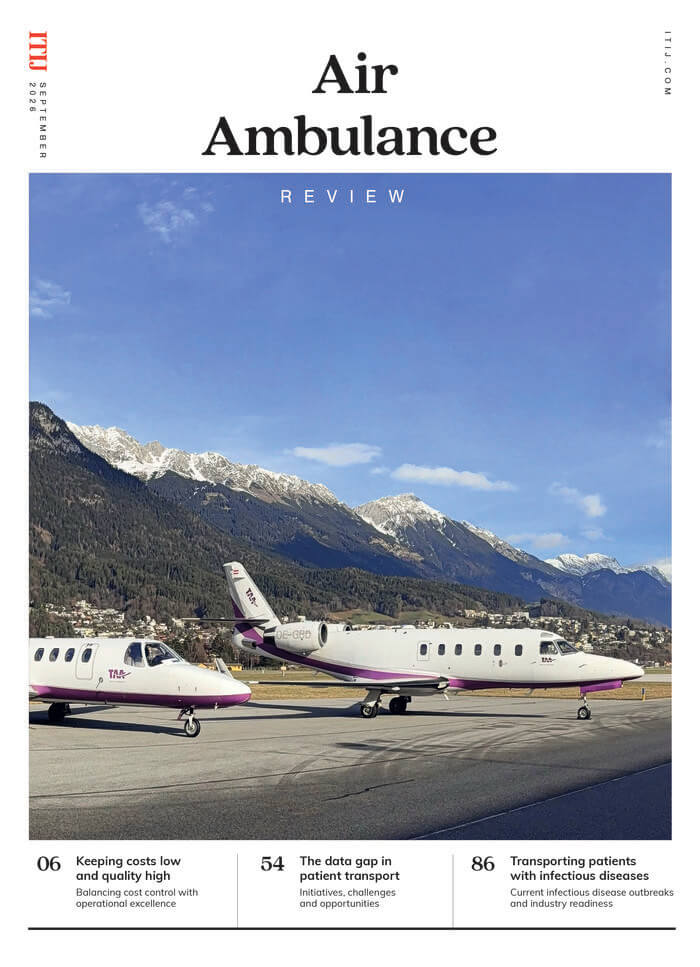
This issue we focus on the problems that rising costs are having on the industry. Air ambulance providers are facing costs across fuel, aircraft maintenance, staffing, insurance, regulatory compliance, and specialist medical equipment. As if that wasn’t enough, delayed payments from insurers are adding further financial pressure. Despite these challenges, providers agree that patient safety and clinical quality must not be compromised.
Editorial Team
The Editorial Team updates the ITIJ website daily, and works on features for the print edition. With expert industry knowledge and years of experience in writing about complex travel insurance issues, the Editorial Team is ready to investigate and report on the topics that matter most to ITIJ's readers.