
Value beyond network discounts

Gitte Bach, from New Frontier Group, talks about when patient advocacy closes the gaps a network can’t see
For international insurers and assistance companies, US provider access often gets reduced to a single question: how big is the discount? A strong preferred provider organisation (PPO) and pharmacy network matter. They lower billed charges and open the door to care. But an open door is not the same as a patient walking through it safely. A recent New Frontier Group (NFG) case showed why the work must expand beyond a network.
The case
An international patient arrived with burning, swelling, red eyes and blurred vision and was treated at an in-network specialty eye hospital. A critical antibiotic was prescribed at discharge. It was out of stock, and the pharmacy told the patient to come back the next day.
On paper, the case looked closed: provider seen, treatment given, prescription pending. In reality, a patient with a serious eye condition was one closed pharmacy away from a dangerous recurrence.
On paper, the case looked closed: provider seen, treatment given, prescription pending
That’s exactly what happened. As part of NFG’s pharmacy support process, the care team called ahead the next morning to confirm the medication had arrived, and discovered the pharmacy had shut its doors for the entire week because of an emergency. If NFG had not checked, the patient would have arrived with no access to the building or critical antibiotic needed.
Instead, the NFG team moved immediately by locating another pharmacy with the antibiotic in stock, transferring the prescription, arranging payment and reaching the patient with new instructions before the delay ever became a crisis.
The risk
That is the difference between a network and a partner. A network can secure access and a contracted rate. It cannot tell an insurer whether the prescription actually got filled, whether the patient understood the next step, or whether a quiet breakdown in the care journey is about to become another visit, another claim or a hospital readmission. For globally mobile patients navigating an unfamiliar system, often across language and cultural barriers, that quiet breakdown is exactly where the risk hides.
This is why NFG builds case and care management around the full arc of care, not just the point of access. We follow patients from treatment, through admission, into transitional care, and through medication sourcing. If a patient needs to get home, we repatriate through our commercial air medical escort team.
Discounts remain the foundation of cost management, but every handoff is a place where cost and outcomes can quickly go sideways. The strongest model pairs network economics with proactive advocacy to catch gaps before they become problems.
Sometimes the greatest value isn’t the discount applied to the claim. It’s the crisis that never had the chance to become one.
Gitte Bach, Founder and CEO of New Frontier Group, launched the independent, woman-owned global cost management firm in 2002 with a bold vision: to bring smarter, more affordable solutions to international healthcare. With more than two decades of experience in international insurance and global assistance, Gitte has built NFG into a trusted partner for insurers, maritime operators, and multinational organisations navigating complex healthcare systems worldwide. She is focused on compassion, transparency, and strategically driven solutions.
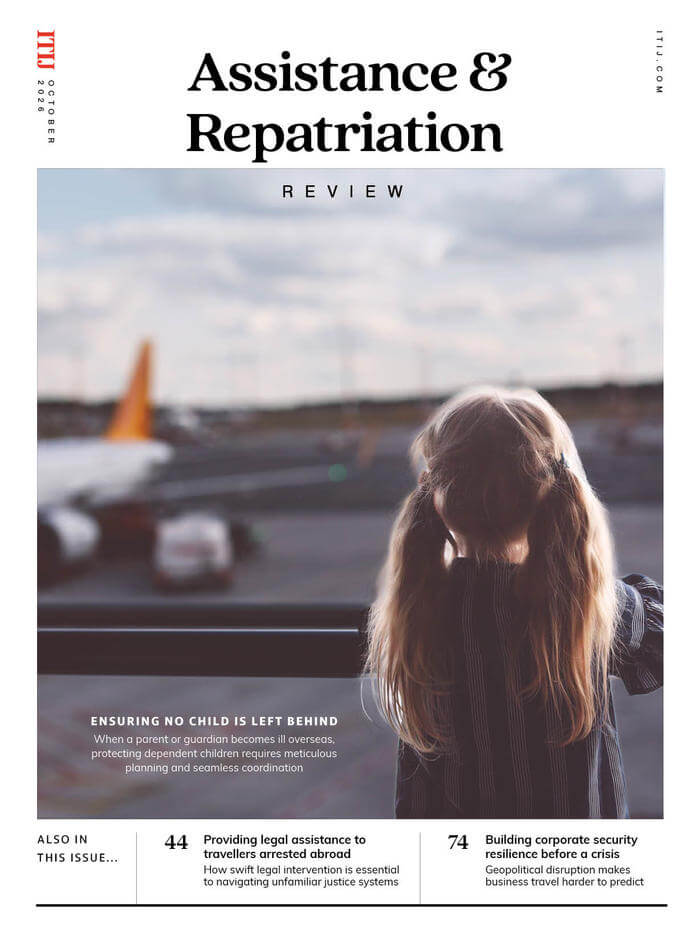
October 2026
Issue
When a parent or guardian becomes seriously ill overseas, assistance providers face a complex challenge that extends well beyond clinical care. Although these cases are relatively rare, in this issue we look at how safeguarding dependent children requires careful planning, legal awareness, and close international coordination.
Editorial Team
The Editorial Team updates the ITIJ website daily, and works on features for the print edition. With expert industry knowledge and years of experience in writing about complex travel insurance issues, the Editorial Team is ready to investigate and report on the topics that matter most to ITIJ's readers.