Using telehealth for cross-border care

Jane Collingwood identifies the challenges and opportunities facing insurers and their telehealth providers when it comes to offering services to customers who are in a different country to their clinicians
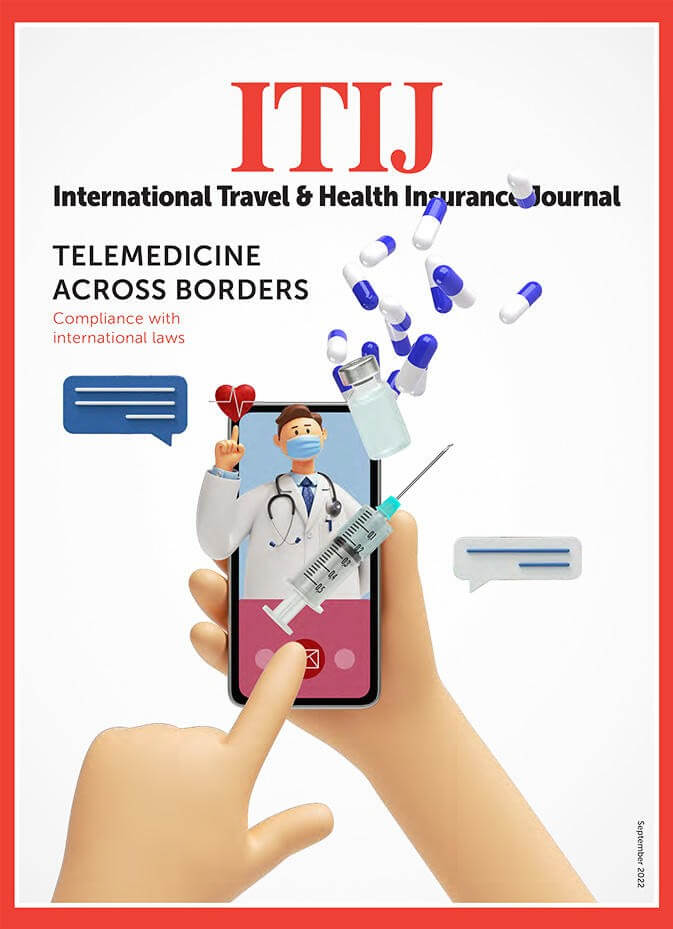
The ongoing globalisation of healthcare is currently reflected in the growing trend for cross-border delivery of health services, and telemedicine in particular. Cross-border telemedicine may include electronic delivery of clinical care such as diagnosis, second opinions, consultations, doctor-to-doctor meetings, and speciality services like telepathology, teleradiology and telepsychiatry.
Countries and providers vary in their use of telemedicine services, but during the Covid-19 pandemic, health insurance companies in many countries broadened their coverage to include aspects of telemedicine to reduce the risks from face-to-face visits.
Many health conditions can be reliably diagnosed, monitored, and treated via cross-border telemedicine. Several connected medical devices already exist, from diabetes management tools for measuring blood sugar levels to wearable blood pressure monitors, and these devices will become more advanced in the next few years.
Smartphones and smartwatches can measure aspects of the wearer’s health, and the more developed these devices become, the more clinical information can be sent directly to a remote doctor. Work is underway on gadgets including hearing aids that monitor heart rhythms, finger rings that measure skin temperature, and clothing with sensors for a range of health metrics.

Laws and regulations overseeing remote healthcare practice were relaxed during the pandemic. However, standards vary widely across the globe, making the practice of telemedicine a complicated business.
Dr Peter Mills, Clinical Director at Cigna, told ITIJ: “For both consultations and pre-op assessments, virtual is very effective. Over the course of the pandemic, we have learnt that many episodic health issues are very well suited to a remote video and audio consultation with a doctor.” At the height of the pandemic telehealth was a crucial tool in assisting individuals with immediate healthcare issues, and now, in the post pandemic world, it is still playing a key part in healthcare delivery.
“I have long been of the opinion that around 50 per cent of patients can be treated virtually, and in fact, data suggests that about 30 per cent of patients who have an initial virtual consultation then don’t go on to access face to face services,” Mills told ITIJ. “For pre-op, it is particularly well suited as much of the pre-op consultation process is about going over medical history, but if samples needed to be taken or tests required, then face to face would be required.
Telehealth is going to be a crucial delivery tool as more providers move to a more blended model of virtual and in person care. The world of healthcare is changing and although the pandemic accelerated this, it was happening already.


In terms of how far the telemedicine process can be taken, clearly it does not allow healthcare professionals to take blood or urine samples, heart rate, blood pressure, or carry out other important medical tests.
What we are striving for through our Whole Health approach, is looking at how we can use this much more and layering telehealth into a patient’s medical journey.
Nevertheless, Greg Bodulovic, Partner at DLA Piper, explained to ITIJ the scope of telemedicine remains significant: “The potential of telehealth solutions is vast, and in my view, we are only at the beginning of a period of significant innovation in remote and virtual healthcare, particularly when it comes to the use of artificial intelligence in this area. After more than two years of the Covid-19 pandemic, there is high demand for convenient access to healthcare and hybrid treatment models, which should support the development of a broad range of telehealth solutions.”
Mills added: “Currently we have a global telehealth solution that’s used on an episodic basis, whether it’s when someone feels unwell or has a non-urgent medical issue. What we are striving for through our Whole Health approach, is looking at how we can use this much more and layering telehealth into a patient’s medical journey.” He continued: “As a doctor, if I have a new patient, I will see them in person to examine them, but once we understand the issue and know the diagnosis, telemedicine is a great way to continue that journey, to follow up and see how they are getting on. For someone with a chronic health condition, telemedicine offers a convenient way for them to have their regular appointments if they are unable to easily travel.”
But, he noted that it’s not always the right solution: “There will be times when virtual is not appropriate such as for severe, acute situations. However, for most cases, we should be able to blend virtual with face to face. It’s not digital care or physical care – it’s digital care and physical care – and I see that as the future for healthcare delivery.”
It is of course vital that cross-border telemedicine services do not compromise patient safety. International cooperation must also tackle issues encompassing cross-border payments and insurance, malpractice liability, and privacy in the provision of telemedicine.
William Ferreira, Partner with the law firm of Hogan Lovells in Washington, DC, outlined the challenges. He told ITIJ: “The interest in cross-border telemedicine has evolved from something of novelty and luxury to a real service line for healthcare providers, with growing revenue. And it’s not just oriented to patient care these days – clinical research and remote data collection are also driving the business.
“What we’re finding is that global medical regulatory regimes are straining to keep pace with the modern practice of virtual medicine. No one doubts how important it is to leverage telemedicine during the pandemic period and beyond. But there is uncertainly in many countries about how to regulate the practice of medicine where the physician and the patient are located in different countries.”
The pandemic has liberalised the regulatory regime for telemedicine around the world, but that has not necessarily translated into flexibility for the cross-border practice of medicine where physicians and patients are not in the same country. Some regions, for example in North America, require doctors to be licensed in the jurisdiction of the patient, while many European regulators tend to require doctors to be licensed in their own jurisdiction. In the US alone, telemedicine regulations are in constant flux as medical bodies, like the American Medical Association, continue to develop basic guidelines for telemedicine practice, and states introduce new telemedicine policies.
What we’re finding is that global medical regulatory regimes are straining to keep pace with the modern practice of virtual medicine. No one doubts how important it is to leverage telemedicine during the pandemic period and beyond. But there is uncertainly in many countries about how to regulate the practice of medicine where the physician and the patient are located in different countries
For all providers in the US, telemedicine must be provided in line with the Health Insurance Portability and Accountability Act, also known as HIPAA – a legislation that provides security provisions to safeguard medical information. It serves several purposes, one of which is to ensure healthcare businesses share patient information securely by whichever avenue is used, including the cross-border transfer of health information.
Ferreira explained: “The location of the patient is critical, as it tends to drive the law applicable to the provider institution, the physician, and the patient. This underscores the need for providers to undertake a country-specific legal review of the spectrum of regulatory challenges that feature in these programmes – ranging from physician licensure to permission to practice medicine, marketing of medical services, and privacy protections.
“The facts and circumstances of any particular provider’s telemedicine programme can greatly affect how the global regulatory issues play out in the real world. Different providers have very different levels of risk tolerance abroad, and that’s something we spend a lot of time measuring with providers as these telemedicine programs roll out.”
Organisations using telemedicine should ensure all data is fully encrypted and uses secure network connections whenever possible.
Bodulovic pointed out: “Compliance with privacy laws is a fundamental consideration when providing telehealth services. Whilst the differences between privacy and data protection laws in each country can be difficult to navigate, generally the high-water mark is the European Union’s General Data Protection Regulation (GDPR).
“Compliance with the GDPR is a good starting point when it comes to privacy and data protection for telehealth providers seeking to expand internationally. However, to ensure full compliance, advice regarding privacy law requirements, including in relation to health information, should be obtained in respect of each country where telehealth services are to be provided.”
For Cigna – as an international organisation with global reach – there are many, often unique, laws and regulations related to data privacy in each of their operational locations and to which they must adhere. “We take this obligation extremely seriously,” said Mills. “Our legal, compliance, data privacy and information protection teams are integral to this commitment. They work collaboratively on an ongoing basis to maintain environmental awareness and to ensure that we understand and adhere to how laws and regulations across different locations apply to our global service offerings, such as our telehealth services. This in turn allows us to maintain a strong focus on high quality service delivery and our aim of continuing to improve the health and security of those we serve.”


Once an operation or treatment has been carried out, telemedicine may serve as a potential method for the remote delivery of rehabilitation and other necessary care.
Mills commented: “When it comes to aftercare, we need to think about what is most convenient for patients, and telemedicine can be very effective in helping with a patient’s recovery. Many patients regularly attend outpatient appointments to manage and review their care. This can be time consuming, often meaning they need time off from work or must juggle childcare around these appointments. Moving forward, I believe that we can triage appropriately on who needs to be seen face to face and who can be seen virtually.”
Overall, telemedicine is clearly a rapidly evolving area of healthcare and, thus, often a challenging one to regulate. Technological progress creates opportunities for more accessible and improved cross-border medical services, but it also brings possible risks such as a reduced standard of care or lack of regulatory oversight and compliance.
The long-term impact of widened cross-border healthcare, boosted by the pandemic, remains to be seen. Around the world, the telemedicine process is destined to become more widely used, with established healthcare services looking it as a cost-effective, secure and safe way to provide care for their clients.
September 2022
Issue
The French healthcare, assistance and travel insurance market; how tech is transforming payments and claims; compliance with medical regulations when performing telemedicine consultations, and data security.
Jane Collingwood
Jane Collingwood is a freelance contributor to ITIJ, specialising in health and and travel news analysis.










February 2025
Issue
Offering readers a deep dive into the issues facing providers and payers of healthcare services around the world. Cost containment, international patient department development, the role of AI in healthcare delivery and more.