Understanding CAMTS accreditation

Jan Eichel from CAMTS talks to us about the benefits of accreditation
Could you talk us through the CAMTS accreditation process and the key benefits for organisations going through it?
The pathway begins with an initial application, a US$1,000 fee, and – for air programmes – proof of aircraft hull and liability insurance. We then send the organisation our Program Information Form (PIF), the heart of the self-study. Programmes have up to a year to complete it, gathering documentation and evidence for each standard. Once the completed PIF is returned, we schedule an on-site visit within four to six weeks. A team of trained surveyors – clinicians and operators who know this work firsthand – spends focused time on the programme, reviews records, and speaks with staff. The accreditation decision rests with our board of directors, which meets four times a year.
We offer a Consultation Program with three tiers, so organisations can choose the level of support that fits their current needs
The benefit organisations describe most consistently is the self-study itself: even before a surveyor arrives, working through the standards line by line exposes gaps in policy, training, or equipment that might otherwise go unnoticed. Beyond that, accreditation is a recognised marker of quality for regulators, referring hospitals, payers, and the public – and for many programmes it’s become a practical prerequisite for contracts and partnerships.
What are some of the key changes coming in the next CAMTS standards, and why are they being introduced?
We’re just finishing the 13th edition of the Transport standards, with input closing in mid-March 2026, alongside draft revisions to the Special Operations and Medical Escort standards. CAMTS standards are typically revised every three years, a deliberate cadence – medical transport is a fast-moving field, and standards written a few years ago can lag behind current clinical evidence, technology, and emerging risks. Every revision undergoes a formal, ANSI-accredited consensus process, so clinicians, operators, and surveyors from across the industry have a voice in what changes and why, rather than revisions being handed down from the top.
How does CAMTS balance consistent standards with the different healthcare systems and operating environments organisations work in?
Our standards are centred on functional outcomes – what a programme must demonstrate about safety and quality – rather than a single rigid path. We describe compliance as ‘substantial compliance’: a programme shows that the essential elements of a standard are met, and our board applies professional judgement to how that looks in a rural ground service, a metropolitan air programme, and an international provider accredited through CAMTS Global. That flexibility lets the same core standards apply meaningfully across very different regulatory and operating contexts without lowering the safety bar.
What consultation services does CAMTS offer, and how can they support organisations preparing for accreditation or strengthening their programmes?
We offer a Consultation Program with three tiers, so organisations can choose the level of support that fits their current needs. A Documentation Review is a remote assessment of policies and procedures against the standards. A Virtual Consultation is a structured, interactive session with a consultant to work through readiness and specific standards questions. An On-Site Visit brings a consultant for a comprehensive, in-person evaluation – essentially a dry run ahead of the real survey. All three help a programme measure itself against the standards and close gaps before a surveyor ever walks through the door.
Jan Eichel, MBA, RN, CFRN, FAASTN, is Executive Director of CAMTS, a role she assumed in 2025 after seven years as Associate Executive Director. With over 30 years in critical care transport management, she has served as a CAMTS site surveyor since 2005.
The Commission on Accreditation of Medical Transport Systems (CAMTS) is a nonprofit dedicated to improving the quality and safety of medical transport worldwide. Since 1990, CAMTS has established rigorous, consensus-based standards for air and ground transport and has accredited programmes across multiple countries and continents – helping organisations demonstrate accountability and elevate patient care globally.
September 2026
Issue
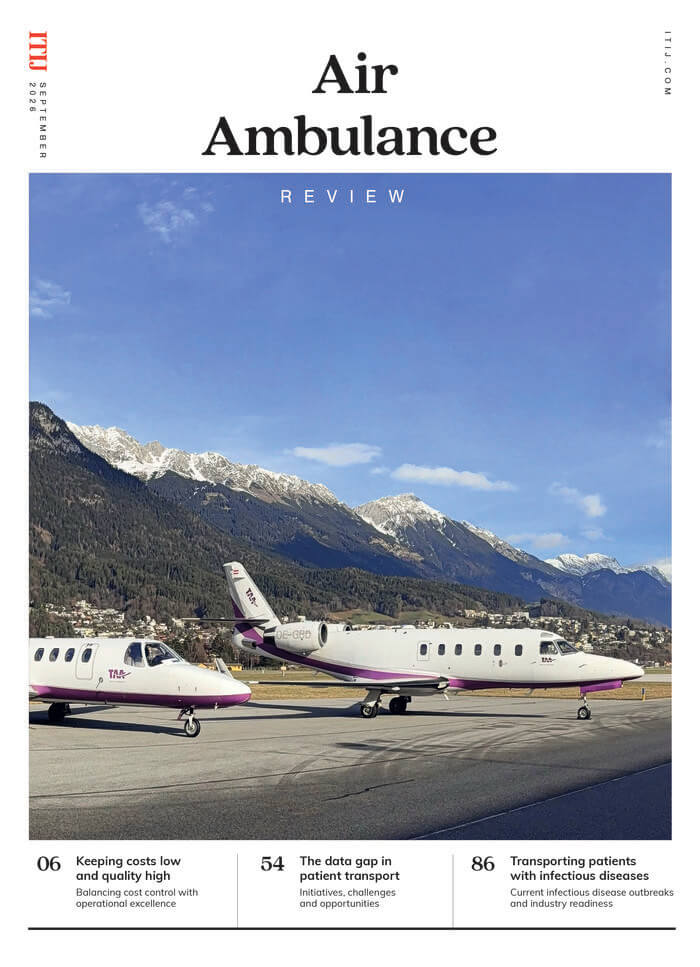
This issue we focus on the problems that rising costs are having on the industry. Air ambulance providers are facing costs across fuel, aircraft maintenance, staffing, insurance, regulatory compliance, and specialist medical equipment. As if that wasn’t enough, delayed payments from insurers are adding further financial pressure. Despite these challenges, providers agree that patient safety and clinical quality must not be compromised.
Editorial Team
The Editorial Team updates the ITIJ website daily, and works on features for the print edition. With expert industry knowledge and years of experience in writing about complex travel insurance issues, the Editorial Team is ready to investigate and report on the topics that matter most to ITIJ's readers.