
Under pressure: medical evacuation strategies for diving accidents in remote locations

Unicair details the challenges of – and its solution for – managing medevacs in the Arctic archipelago of Svalbard
When a professional diver prepares to descend beneath the Arctic waters of Svalbard, Spitzbergen, every part of the mission must be meticulously planned, including what to do if something goes wrong. For Unicair, tasked with developing a Medical Evacuation Plan (MEP) for such a scenario, the challenge is not just clinical. It is a logistical and operational task that combines extreme geographical conditions, unpredictable weather, and limited infrastructure with the need for time-sensitive medical intervention.
Geographic isolation and harsh conditions
Svalbard, an archipelago situated between mainland Norway and the North Pole, is among the world’s most remote inhabited areas. Its main settlement, Longyearbyen, offers a small hospital facility with limited intensive care capacity. In the event of a serious diving injury such as decompression illness (DCI), patients require immediate recompression therapy, advanced airway management and critical care monitoring beyond that which the local hospital can provide.
Compounding the issue is the weather. Arctic conditions routinely delay flights due to low visibility, strong winds, and runway icing. The only available airport, Svalbard Airport, Longyear, is not certified for night operations and lacks alternative nearby diversion options. If the runway is closed, even temporarily, patients and crews may be stranded with little recourse.
Decompression illness
DCI remains one of the most timecritical conditions in diving medicine. The gold standard for treatment is rapid recompression in a hyperbaric chamber. While recompression facilities exist on mainland Norway, they are out of reach within the therapeutic window unless rapid transport is available. In conventional scenarios, airlifting the patient to the nearest hyperbaric unit would be the plan. But in Svalbard, flight time to Tromsø (the nearest facility) is approximately 2.5 hours under optimal conditions – unacceptably long if there is no access to on-scene recompression therapy. Furthermore, transportation in an aircraft would add further injury by exposure to a hypobaric environment, unless conducted with sealevel cabin pressure.
To bridge this gap, Unicair’s MEP includes positioning a portable hyperbaric chamber (Hyperlite 1, SOS Group, London, UK), in Svalbard. The Hyperlite 1 is a lightweight, singlepatient unit, which can be assembled and pressurised in less than 15 minutes. The chamber can be operated with pressures up to 3.3 ATA, enough to meet the minimum pressure requirement of 2.8 ATA as recommended in the US Navy treatment tables for DCI. Maximum certified operational altitude is 17,500 feet. Unicair aircraft (Challenger 604 and Learjet 45) can load and accommodate the Hyperlite chamber (diameter 59.5cm, length 224.5cm), and onboard oxygen systems can be configured to support chamber operation. Unicair medical crew are trained in hyperbaric medicine and inflight chamber monitoring to ensure safe operation under altitude and pressure fluctuations.
Planning for the extreme
Developing an MEP from Svalbard is a test of clinical foresight, operational flexibility, and the ability to bring advanced care to the ends of the Earth. With mobile hyperbaric chambers and high-performance fixed-wing air ambulances, what was once considered impossible – delivering hyperbaric therapy from an Arctic outpost – is now an achievable standard of care.
Andrea Ressler is Head of Sales and Marketing at Unicair with 20 years of operational and mission planning experience in aeromedical evacuation.
Cornelia Rohrbeck is Unicair’s Chief Flight Nurse since 2003 and has a background of more than 30 years of critical care nursing.
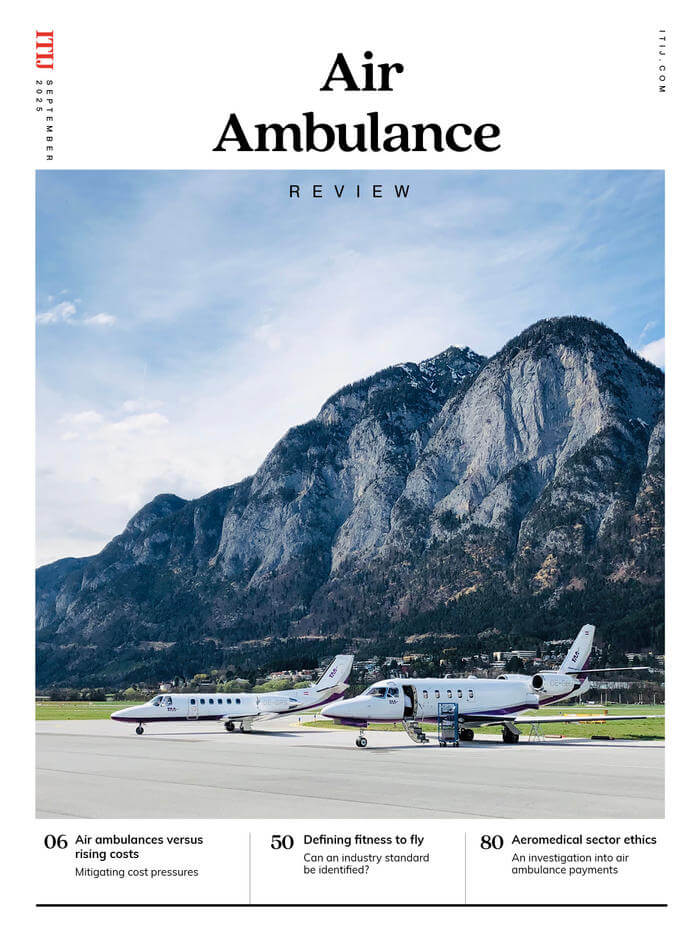
September 2025
Issue
We include an examination on defining ‘fitness to fly’, and ask if an industry standard can be identified, and what that would involve. We also look at capacity in the aeromedical market and experts share their insights. Ethics and transparency in the aeromedical sector is a big issue, and we include an investigation into air ambulance payments.
Editorial Team
The Editorial Team updates the ITIJ website daily, and works on features for the print edition. With expert industry knowledge and years of experience in writing about complex travel insurance issues, the Editorial Team is ready to investigate and report on the topics that matter most to ITIJ's readers.
