
Under pressure

Greg Lawson, Head of Travel Insurance at Collinson, tells us how the pressure on European national healthcare services is affecting air ambulances in Europe, and considers whether insurance and assistance companies are requesting more air ambulance transfers
In 2024 Collinson Insurance saw a steady increase in the need for air ambulances to both repatriate and, in some regions, evacuate patients to other medical facilities due to the demand being placed on public health services throughout Europe. Collinson Insurance observed several factors that contributed to this.
1. Fewer air ambulance companies operating, leading to reduced availability and rising costs
The number of air ambulance providers has dwindled in Europe, either due to financial constraints or regulatory challenges. As fewer companies operate in the field, the demand for air ambulance services has increased, leading to a shortage of available units. This limited availability has driven up the cost of services, as fewer operators are competing for business and prices are adjusted to reflect this. Covid-19 undoubtedly had a major impact, and travel demand remains below 2019 levels, thus offering little incentive to deliver until more recently.
2. Reduced stretcher/oxygen availability on airlines
As commercial airlines reduce the availability of stretchers or the ability to transport patients who require oxygen, air ambulances are playing an increasingly vital part in patient care. Commercial flights are not equipped to manage medical emergencies to the same degree that an air ambulance is, which makes air ambulances the preferred choice for patients needing advanced medical care during transportation.
As fewer companies operate in the field, the demand for air ambulance services has increased, leading to a shortage of available units
Additionally, the reduced availability of medical equipment (such as oxygen tanks or stretcher beds) on regular flights leaves patients with no other option but to rely on an air ambulance for safe, comfortable and reliable transfer. This leads to longer stays in hospital, customer dissatisfaction and increased costs for the insurer.
3. Increasing volumes of bariatric patients
Collinson Insurance has seen a rise in the number of bariatric patients who are clinically obese and require additional support and specialised equipment. The knock-on effect of a decrease in people’s heath is now being seen within the assistance and insurance industry, as even simple conditions can cause additional strain on bariatric patients.
Air ambulances are ideally equipped with larger stretchers, stronger support systems and medical equipment designed to make patients feel at ease. Commercial airlines, by contrast, often lack the necessary infrastructure to transport bariatric patients comfortably or safely, making an air ambulance an ideal transport solution. In some cases, a simple injury to a bariatric patient makes it impossible to manoeuvre them into a seat on a commercial aircraft.

4. Public health services suffering delays and backlogs
Public healthcare systems, particularly in tourist regions where the population increases exponentially during peak times, are constantly under strain from a growing number of emergency cases and delayed response times, and therefore more patients require urgent evacuation via an air ambulance to benefit from timely medical care.
Public health services, including ambulance and hospital beds, are often occupied and in short supply, resulting in longer wait times and the need to expedite transportation to alternative facilities. An air ambulance provides an effective means to circumnavigate these backlogs, ensuring patients receive treatment without unnecessary delays.
Air ambulances are ideally equipped with larger stretchers, stronger support systems and medical equipment designed to make patients feel at ease
Although the Covid-19 pandemic has long since left us, funding and staffing issues continue to impact the healthcare sectors across Europe, particularly in Greece during the summer months, where volumes were overwhelming the facilities, leaving them unable to fully support tourists.
5. Pressure from tourist islands and remote locations
On tourist islands or in remote areas, public hospitals often lack the capacity or appropriate resources to treat severe or complex medical conditions. In these cases, an air ambulance is essential to transport patients to larger hospitals with more advanced medical facilities. These locations may be isolated, and the availability of specific care on-site is limited, making an air ambulance the fastest and safest option for patient transfers.
6. Increase in fuel and maintenance costs.
The aviation industry, including air ambulance services, is affected by rising fuel prices and increased aircraft maintenance costs. The hike in operational costs is absorbed by
the insurer, who ends up paying more for an air ambulance service. Despite the higher cost, an air ambulance remains an essential service due to the critical need for rapid medical transport in emergency situations.
7. Public hospitals struggling and pressure on private hospitals
Public hospitals in Europe are facing financial strain, staff shortages, and capacity issues, leading to longer waiting times for patients. In response, patients who require immediate or intensive care are evacuated via air ambulance to private hospitals where they can receive appropriate and timely care. The strain on public hospitals increases the reliance on air ambulances, particularly for patients who need urgent treatment.
As global travel and tourism increases, more travellers are visiting remote or exotic destinations where the medical infrastructure is minimal or non-existent


8. Conditions needing air ambulance transfers
Many medical conditions, such as severe trauma, strokes, heart attacks, and life threatening infections, require swift transport to facilities with advanced medical equipment and specialists.
An air ambulance is equipped with intensive care units (ICUs) that provide lifesaving treatment during transport. These services are vital for patients who need to be transported quickly to a facility where they can receive immediate medical intervention. The primary driver of air ambulance usage globally is conditions that require critical care during transport.
9. Destinations being more remote/exotic – lack of facilities
As global travel and tourism increases, more travellers are visiting remote or exotic destinations where the medical infrastructure is minimal or non-existent. In such cases, an air ambulance is essential for evacuating patients to more developed regions that are better equipped to deal with ill patients.
Given all these factors, the global demand for air ambulance services has increased and continues to play a more significant role in patient care, making them an indispensable part of today’s healthcare network. The need for quick, specialised, and efficient patient transport continues to grow as the world faces new and more complex medical challenges.
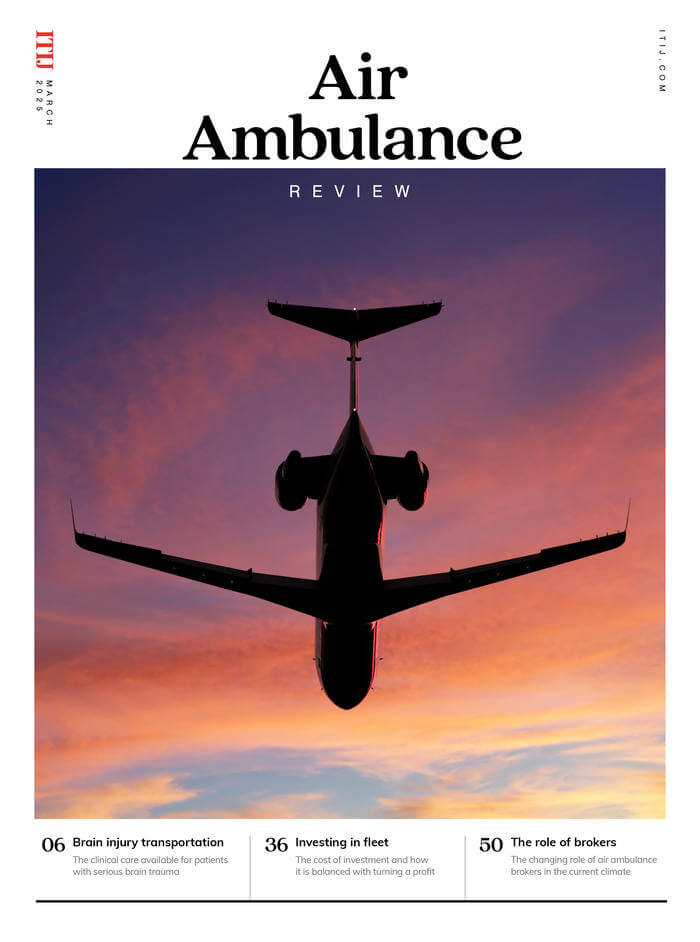
March 2025
Issue
The Air Ambulance Review includes features on clinical care for ABIs; investing in fleet; the role of brokers in the air ambulance industry; and an accreditation update.
Greg Lawson
A highly experienced insurance executive with extensive market knowledge across multiple distribution channels and product lines, Greg has over 25 years of experience within the personal lines sector, with a primary focus on travel insurance. Heading up the travel insurance product line, Greg has responsibility and oversight of all global B2B and B2C travel insurance relationships.