
Uditha Jayaratne interview: A market in motion – why local understanding will define the future of IPMI

Uditha Jayaratne, CEO and Principal Officer, Bupa Global Kenya, speaks to Chloe Fox about Bupa’s African expansion, evolving IPMI demand, and the role of local expertise
Q. Building Bupa’s first licensed African operation from scratch, what have you learned about what it takes to build a successful international private medical insurance (IPMI) business in this market?
The biggest lesson is that global capability only creates value when it is grounded in local understanding. Building a licensed operation in Kenya has required close engagement with regulators, intermediary partners, and healthcare providers, alongside a strong local team that understands the market and the needs of customers.
Being present in the market matters. It allows us to listen more closely, respond faster, and shape our service around local needs, while giving customers access
to Bupa’s global healthcare network and clinical expertise.
Q. Bupa chose Nairobi for its first licensed African operation, describing Kenya as a key market in its international health strategy. What did Bupa see in Kenya that convinced the business this was the right place to start?
Kenya combines a dynamic business environment with growing demand for high-quality, internationally connected healthcare. Nairobi is home to regional businesses, globally mobile professionals, and sophisticated intermediary and provider networks, making it a natural base for us. It gives us the platform to serve Kenyan customers well today and to build responsibly for wider growth across Africa.
Q. You’ve described Africa as ‘a market in motion’. What is changing fastest in the region’s demand for international private medical insurance?
Demand is moving beyond traditional expatriate cover. More African businesses and individuals are looking for healthcare that offers choice, flexibility, and access to specialist expertise, particularly as careers, families, and businesses increasingly span borders. Employers also see high-quality health cover as an important part of attracting and retaining talent.
At the same time, expectations are rising. Customers want a simpler, more connected experience, from virtual consultations and digital servicing through to support navigating complex care across countries.
Q. As African businesses become increasingly regional, how do you see the relationship between IPMI, business travel, and medical assistance evolving?
As businesses expand across the region, the boundaries between IPMI, business travel, and medical assistance will become less distinct. Employers will increasingly want one connected proposition that supports employees before, during, and after travel, rather than separate products that only respond at the point of an incident. IPMI provides the continuity of healthcare cover; travel benefits address shorter-term risks; and medical assistance connects the two by helping people find appropriate care, manage urgent admissions, and coordinate treatment when they are away from home. The opportunity is to create a more seamless journey around the customer, with clear hand-offs, consistent clinical oversight, and support that follows them across borders.

Q. What difference does having Bupa’s own team and local partnerships in Nairobi make when it comes to navigating Kenya’s healthcare system and supporting international customers?
It gives customers the best of both worlds: local accountability and global capability. Our Nairobi team stays close to customers, intermediaries, and healthcare providers, so we can understand local realities and respond quickly. When a case becomes more complex or crosses borders, that local knowledge is backed by Bupa’s global network and clinical expertise. For the customer, the experience feels local, but the capability behind it is international.
Q. Bupa now gives Kenyan customers access to virtual doctors and international second medical opinions. Which of these digital services are changing customer behaviour most meaningfully?
Virtual care is changing day-to-day behaviour most visibly because it lowers the barrier to seeking medical advice. Customers can speak to a doctor wherever they are and can be guided towards the right next step without travelling to a clinic right away. International second medical opinions play a different, but equally important, role. They are used less routinely but can be particularly valuable when a customer faces a serious diagnosis or complex treatment decision. Together, these services are shifting the relationship from insurance that simply pays a claim to healthcare support that helps customers make more informed decisions.
Q. With Kenya positioned as a base for Bupa’s wider African ambitions, what will be the biggest challenge in taking the model into other markets?
The biggest challenge will be avoiding a copy-and-paste approach. Africa is not one market: regulatory frameworks, healthcare systems, distribution models, and customer expectations differ significantly between countries. The discipline is to retain what should be consistent, such as clinical standards, governance, and access to global capability, while adapting the proposition, partnerships, and operating model to each local market. Growth must be paced responsibly, with the right licences, local expertise, and provider and intermediary relationships in place before scale.
Q. Looking ahead, will the biggest competitive advantage in IPMI come from global medical networks, technology, local distribution, or something else?
The advantage will not come from one of these in isolation. It will come from joining them up around the customer. Global medical networks provide access and choice; technology makes the experience easier and more immediate; and local distribution and partnerships create trust and relevance.
The real differentiator will be the ability to turn those components into a coordinated healthcare journey, particularly when care is complex or crosses borders.
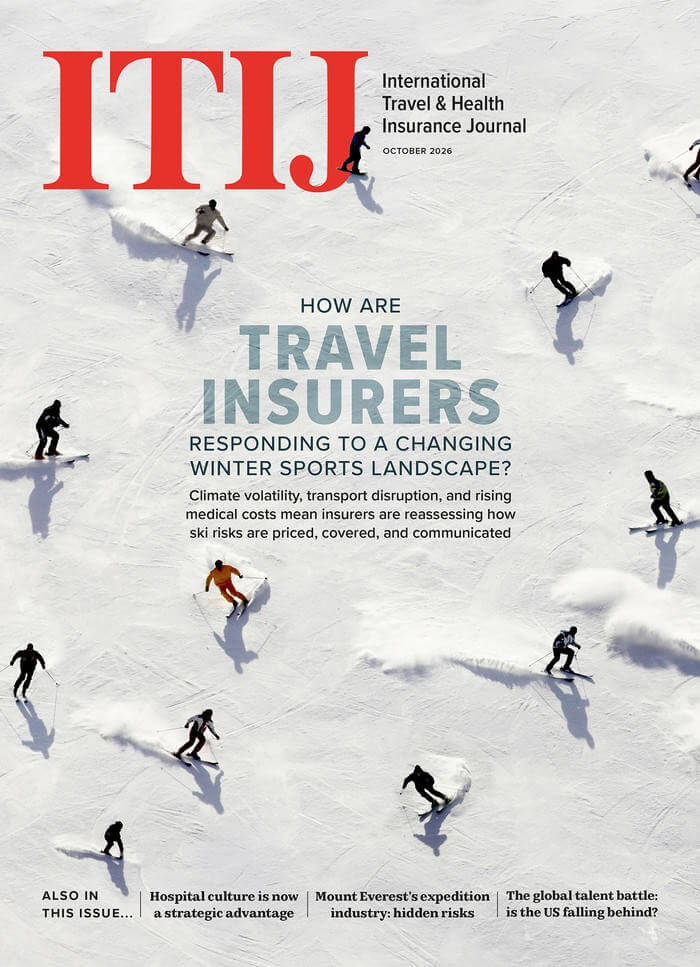
October 2026
Issue
This month in ITIJ we take a close look at how travel insurers are responding to the changes in winter sports risk, and we ask how risk is priced, covered and communicated to policy holders.
How do international hospitals stand out from the crowd, and become the number one choice for insurers and assistance companies? Clinical excellence alone is no longer enough. We look at why hospital culture has become a strategic advantage, and how dedicated international departments are strengthening relationships between hospitals, insurers, and assistance companies.
Chloe Fox
Chloe Fox is an Editorial Assistant for Voyageur Group, joining in 2024. She writes for ITIJ and AirMed&Rescue, covering a range of topics including international travel and health insurance, medical assistance provision, and air medical transportation. Chloe holds a BA (Hons) in English and an MA in English Literature from the University of Bristol.