
The travel experience – from Europe to the US

Robin Gauldie explores the current travel patterns to and from the US and Europe, and asks how insurers can better align their products with the evolving needs of travellers
Five years on from Covid-19, global traveller numbers have crept back up to pre-pandemic levels. There is one outlier, though: Europeans and others have gone cool on the US as a destination for vacation and business travel.
Since October, a new ‘Visa Integrity Fee’ has increased the total cost of a US tourist visa to US$442 for nationals of countries including Mexico, India, China and Brazil, while the Electronic System for Travel Authorization (ESTA) fee for visitors from 41 countries, including European Union (EU) states and the UK, has almost doubled, from $21 to $40. That won’t encourage travel to the US.
Americans, meanwhile, are still keen to visit Europe, but have practical worries about flying within the US. What are the implications for insurers?
Europe’s largest package holiday company, the German travel giant TUI, has seen a “significant decline” in travel to the US from its core markets, which include Germany and the UK, according to TUI Chief Executive Sebastian Ebel. Concerns over US border controls – fed by high-profile cases of European and Canadian nationals being detained by immigration officials – are nudging European travellers towards Canada and other long-haul destinations, Ebel said.
Travel from Canada and Mexico in 2025 has fallen by around 20% compared with last year, according to the US Travel Association, as reported by Reuters. The World Travel & Tourism Council (WTTC) predicts that travel expenditure in the US will fall by 7% this year. “Of 184 countries, the US is the only one that’s seeing an absolute decline in international visitor spending,” WTTC Chief Executive Julia Simpson was quoted as saying.
“We’ve looked at overall outbound trip counts for key countries up to 2023, and updated some to 2024 using preliminary figures,” David Bowles, Manager at Finaccord, part of the Aon Strategy and Technology Group, said. “Across France, Germany, Belgium, the UK, Canada, and the US, the 2023 total was still below 2019, but by 2024 trips had recovered and the total was 3% higher than 2019. France was the only country for which 2024 was still lower than 2019,” he added.
“Our findings broadly confirm the global-level analysis of the UN World Tourism Organization, which has estimated that 2024 arrivals were 99% of the 2019 figure. This indicates that the outbound countries we’ve analysed recovered [from the Covid-19 pandemic] faster than other countries.”

A global outlook
Globally, the outlook is positive, Bowles said. “Given the overall picture of post-pandemic recovery, we’d expect to see still more travel in 2025.”
UN Tourism figures indicate that travel in Q1 2025 was 3% higher than Q1 2019, he pointed out, and Covid-19-related issues have dropped away as a factor affecting international tourism.
“Economic issues and high costs now appear far more significant as factors,” he said.
Christian Bennett, Head of Travel and Mobility in the UK at Cover-More Europe, agreed. “Travel isn’t quite back to pre-Covid levels yet, but it’s getting very close,” he said. “Confidence has returned, and people are planning and booking holidays in ways that feel much more like pre-pandemic habits.”
Other insurers concur.
“Covid coverage is no longer a driving factor in purchase decisions for most customers,” said Jackie Mondelli, Chief Marketing Officer at US insurance marketplace Squaremouth.
Europeans and others have gone cool on the US as a destination for vacation and business travel
Inbound travel figures to the US appear to buck the trend towards overall return to growth, Bowles said. “In contrast to the overall global picture, trips to the US had not yet recovered to their 2019 level by 2024 – they were still 9% below. So far, 2025 appears to show a decline on 2024 levels, rather than a continued recovery,” he added.
Figures for travel to the US for the first five months of 2025 were 2.4% down on the first five months of 2024, he noted: “This includes a 1.8% drop in arrivals from Western Europe, but the fall in arrivals from Canada is much more dramatic, at 17%.”
But while Europeans, Canadians and others seem lukewarm at best about travel to the US, Americans seem less concerned about going the other way. For the fourth year in a row, US summer travel to Europe increased in 2025, according to Allianz Partners USA’s Top Summer European Destinations Report, said Daniel Durazo, Director of External Communications at Allianz Partners USA.
Mondelli cautiously agreed: “We aren’t seeing a significant drop in travel to Europe, despite the current geopolitical climate, but travel to Europe from the US has remained relatively flat in terms of quoted trips.”
Traveller anxiety
Within the US, travellers are more concerned about airline delays and disruptions than they are about global issues, Squaremouth’s recent polling suggests.
“Traveller anxiety has steadily been on the rise, due to concerns over flight delays, airline disruptions, and weather complications,” Mondelli confirmed.
Early in the US summer vacation-buying season, a survey of more than 2,600 Squaremouth customers revealed that almost half of them expected flight delays and disruptions to be worse in 2025 than in previous years, and 49% of travellers taking trips in summer 2025 said flight delays and cancellations were their biggest concern – a major shift in traveller sentiment since 2024, when just 36% of travellers said this was their biggest worry.
“This concern comes at a time when more Americans are opting to stay closer to home and are taking shorter flights for their summer destinations,” said Mondelli.
This has had an impact on what travellers look for when buying travel insurance: Squaremouth has seen a 74% year-on-year increase in the number of travellers searching specifically for policies that cover delays.
As travel patterns change, so do consumer priorities when it comes to buying travel insurance, Mondelli suggested: “While Americans are still taking their vacations, they’re doing so differently than in years past, as they opt for closer destinations and prioritise travel insurance to protect against potential issues like delays and cancellations.”
Squaremouth’s polling reveals a generation gap between US travellers: 35% of travellers under 40 said their plans were directly influenced by recent aviation issues in the US, compared with just 23% of those over 40 – and 37% of younger travellers purchased travel insurance because of flight disruption concerns, compared with 30% of those over 40.
There are outliers, though, among European destinations favoured by US travellers.
“We’re seeing some signs that media coverage of wildfires and extreme heat is affecting travel to parts of the Mediterranean,” said Mondelli. “Insured trips to Spain and Greece are down disproportionately, averaging a decline of 12–13% year over year.”
Spain and Greece are high-end, long-haul destinations for Americans, which may explain their current caution. For Europeans, of course, they’re low-cost, low-risk and on the doorstep, and travel insurers see continued appetite for Mediterranean sun and sand.
“Despite widespread media coverage of wildfires and heatwaves in popular Mediterranean destinations, we’re still seeing strong tourism demand across key markets such as Spain, Greece and Turkey,” Bennett said. “What does seem to be shifting is when people travel. We’re starting to see signs that some travellers are choosing to avoid the very hottest peak summer months and instead booking for the shoulder seasons, when conditions are often more comfortable.”
Mondelli agreed: “More travellers are seeking flexibility in their plans in light of uncertainties, whether political or economic. For example, we saw a 223% increase in travellers selecting Cancel for Work Reasons coverage this past April compared to last year, alongside growing interest in broader flexible options like Cancel For Any Reason or Interruption For Any Reason.”

Activity-based travel
Broader travel trends suggest too that activity-based travel is growing, Mondelli said, albeit slowly. Younger travellers are more likely to book activity-driven vacations such as hiking, snorkelling, or safari trips, but are historically less likely to insure them. Insurers can more effectively align their products with such evolving travel patterns, by adopting a mix of product innovation and consumer engagement.
Bowles also noted a general increase in uptake of ‘non-standard’ policies: “Averaged across eight countries – France, Germany, Italy, Spain, the UK, Australia, Canada, and the US – the percentage of policies that were for winter or extreme sports increased from 0.6% to 0.9%.”
The percentage of ‘backpacker’ policies went up much more dramatically, from 2.8% in 2014 to 10.3% in 2022.
US travellers are taking longer trips and spending more on insurance, assistance company International Medical Group (IMG) stated. It said its autumn 2025 travel trends report showed a 13% increase in average insured trip cost year on year, coupled with a 50% increase in travel plan purchases. For the third year in a row, Mexico was the most popular outbound destination for US travellers, followed by Italy, the UK, Canada, and Spain.
“As travellers plan longer and more expensive trips, we’re seeing a clear shift toward prioritising protection,” said Justin Poehler, IMG Chief Commercial Officer.
Within the US, travellers are more concerned about airline delays and disruptions than they are about global issues
“There’s a clear shift toward experience-driven travel,” added Chris Carnicelli, CEO of Generali Global Assistance. “Whether it’s outdoor adventure, cultural immersion, or wellness activities, travellers want more than just relaxation. This is driving demand for more tailored protection plans that cover specific activities, gear, or even sporting equipment delays.”
Travel production must evolve alongside such developments, Carnicelli said.
“That means delivering flexible, digital-first products and educating travellers on how protection fits into their travel budget. This year, our Holiday Barometer/Summer Travel Snapshot revealed that 41% of Americans said they plan to purchase travel protection, and many are using smart tools, including AI, to help them choose the right coverage.”
Cost, climate, and overtourism are bigger concerns for UK holidaymakers than worries over US border controls. “We are seeing clear signs that British holidaymakers are rethinking how, where, and when they travel,” said Simon McCulloch, Chief Growth Officer at Staysure.
“Our research shows that almost nine in 10 people have considered changing their summer holiday plans, with many pointing to extreme heat, overcrowding in popular resorts, and rising costs as the main reasons. Half of UK travellers now say they would prefer to stay close to home during peak summer months. For insurers, this matters, because it changes both the profile of destinations being visited and the types of risks people are exposed to.”
Medical claims
Staysure is seeing more complex health and financial risks, McCulloch added: “Cosmetic tourism is a growing issue. A 94% rise in people needing NHS treatment following overseas procedures in just three years shows just how quickly this trend has escalated. Many travellers are not insured for these types of trips.”
Even for ordinary leisure travel, the financial stakes are increasing, McCulloch said. The average European medical claim has risen 21% in two years, to more than £3,500, he added.
Staysure has adapted its policies to meet the need for travel cover for holidaymakers awaiting medical treatment in the UK, where more than six million people are on National Health Service waiting lists and many have been unable to secure cover for current medical conditions while awaiting a diagnosis for new symptoms.
“We have updated our policies to ensure our customers can still travel protected for their diagnosed medical conditions when caught up in these delays,” McCulloch said. “Travel will continue to evolve in response to climate, cost, and healthcare realities. Insurers have a responsibility to adapt just as quickly.”
Greg Lawson, Head of Travel Insurance at Collinson, foresees no drastic change in travel patterns that will force insurers to respond in the near future. “There are signs that travellers from the UK and Europe are changing travel behaviours, but nothing that will materially change operating models just yet,” he said.
“The key for all distributors and insurers is that they stay close to the travel sector trends, as well as reviewing their own policy and claims data. The key economic and behaviour influences will always impact the travel sector before we see it in our data – our role is to then decide if it’s a trend or just an acute reaction,” he concluded.
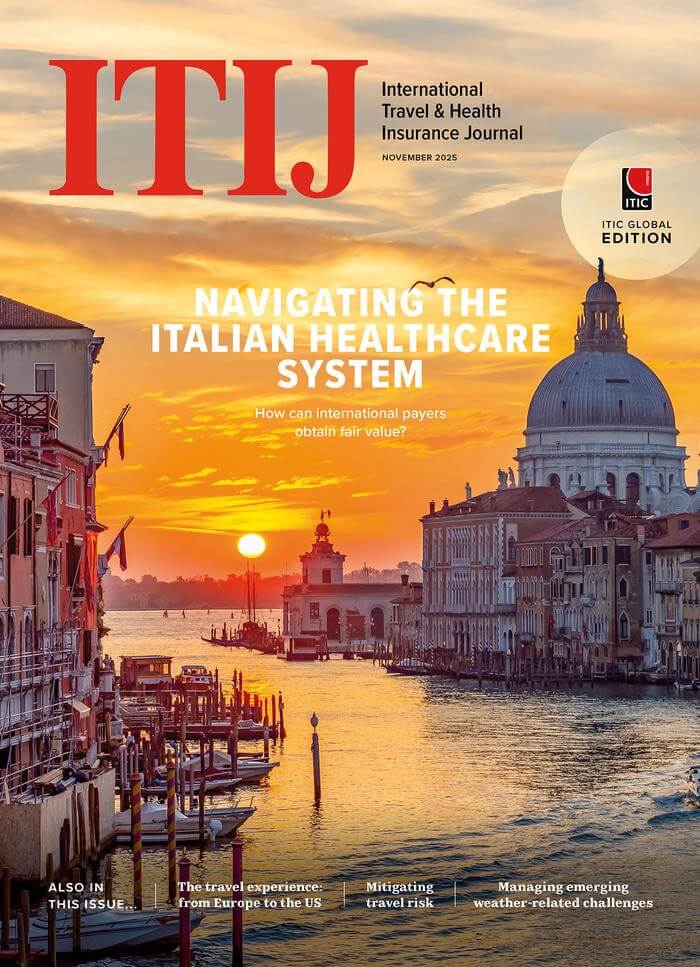
November 2025
Issue
In this issue of ITIJ we look at current travel patterns to and from the US and Europe, take a close look at the Italian healthcare system, and examine how insurers are adapting policies and coverage to manage weather-related challenges.
Robin Gauldie
Robin Gauldie is a freelance journalist and a former editor of a number of travel trade and specialist publications including Travel Trade Gazette Europe, ABTA Magazine, Ireland 2000 and Climate Change - Addressing the Challenge. He contributes to several newspapers and magazines including The Scotsman and Telegraph Travel and is the author of more than 30 travel guidebooks to destinations around the world. He lives in Edinburgh.
Robin has been writing for ITIJ and its Review publications on a freelance basis since 2008, covering a wide range of topics that span the global insurance and assistance sectors.