Transportation challenges in emergency medical care

Dr Eva Wurz, Chief Medical Officer at Tyrol Air Ambulance, talks to ITIJ about changes in the industry, medical clearance, and the importance of good staff
Tyrol Air Ambulance (TAA) has been operating for more than 40 years. What are the biggest changes you feel the company has seen in the industry in that time?
Medical care has generally improved worldwide, especially in tourist countries, but can be cost-intensive. For this reason, economic aspects are more often the focus nowadays, as the expectations of the policy holders of travel or health insurance for care and transport back to the home country in the event of a medical emergency have increased. Quick solutions are required. From a doctor's point of view, it has become more common that medical principles are moved to the background due to the economic aspects for health insurance companies.
Repatriations can sometimes be very challenging. Can you tell us about the core factors involved in medical clearance and deeming when a patient is fit to fly?
Medical clearance gets more challenging when only poor medical information about the patient is available. A minimum requirement of information including measurements of the patient, diagnosis and vital parameters as well as the medication they might be on, is necessary to decide on the patient’s fitness to fly. But there are also other aspects, e.g. the local treatment options must be considered.
Does medical clearance differ between children and adults?
Yes it differs as children are not small adults – neither in their behaviour nor in their physiology.
In order to achieve the best outcome, we have a special pediatric team doing the medical clearance and also the repatriation.
Medical care has generally improved worldwide, especially in tourist countries, but can be cost-intensive
Medical care during a transport is of vital importance. What are the main aspects TAA look at?
Our team consists of a medical doctor and a nurse with a special diploma in intensive care management. This means that we provide a high level of professional care. We also have a checklist in use to cover all individual requirements for the patient to be transported as well as standard procedures for the team to ensure routine processes for their care work on board the air ambulance. This ensures that we are prepared for all possible eventualities during a mission.
Patients with external fixators are challenging for our teams, as space in the air ambulance jet is limited. The team has to be particularly careful here, especially during the embarcation and disembarcation process.
How are your fleet and staff equipped for these situations?
We use special anti-decubitus gel mattresses and special pillows to position the patients during the flight. Our teams also work with checklists and protocols to ensure that the medical care runs smoothly.
Eva Wurz Chief Medical Officer, Tyrol Air Ambulance
After Eva finished her studies in Vienna she trained as a general practitioner and as a doctor in internal medicine with additional qualifications in intensive care medicine in Innsbruck. Eva started as a Flight Doctor at TAA in 2010. Since 2018 she has been Chief Medical Officer and has seen a lot of changes in the flight business.
November 2024
Issue
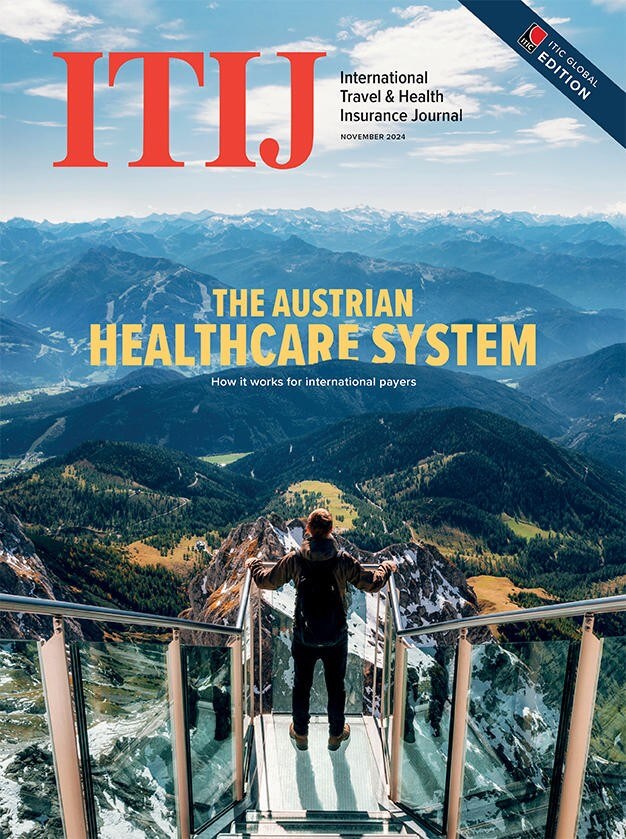
This month we look at affinity partnerships and ask if online travel agencies are the perfect partners for insurers; we cover the trends around cruising in the Mediterranean; we delve into the specifics of the Austrian healthcare system; plus we examine international healthcare and technology, asking how far can technology go.
Editorial Team
The Editorial Team updates the ITIJ website daily, and works on features for the print edition. With expert industry knowledge and years of experience in writing about complex travel insurance issues, the Editorial Team is ready to investigate and report on the topics that matter most to ITIJ's readers.