
Transparency in hospital billing

The practice of providing different price lists for locals and expats is widespread in hospitals around the world, but why does it happen, and is it fair? Tatum Anderson spoke to providers and payers about their contrasting perspectives
Dual price lists have existed for years, said William Cooper, Head of Marketing at William Russell, an expat insurance provider with members from Hong Kong, Singapore and Thailand to Botswana and Zambia. “As an international private medical insurance (IPMI) provider with members in over 160 countries, we have seen dual pricelists in both developed countries and developing countries,” he told ITIJ.
Usual, customary and reasonable – all about perspective
Dual price lists, however, manifest in very different ways. “We have seen hospitals offering fixed/package price for more complex procedures, for example, complete hip replacement to self-pay patients, while billing the insurance companies with an itemised invoice but much higher prices,” he said. That’s why generally speaking, it is necessary to check whether the medical expenses are reasonable and customary before approving a pre-authorisation request for inpatient admission, for example, for surgery or oncology or other complex treatments.
There may even be far more than two price lists. A hospital or a hospital group may have a self-pay package or discounted rate for patients who are paying for treatments on the same day, a standard price list for insurance-funded patients, and possibly an agreed tariff with certain insurers if they have a large volume of cases per year. “We have seen this in all regions really, and you would be surprised to see huge price differences between self-pay price and insurance-funded rate,” said Cooper.
Dual price lists confuse patients, and sometimes delay insurers’ decisions when it comes to finalising the pre-authorisation requests, and often lead to more comprehensive bill auditing when settling the final invoices, he said. Some IPMI providers say they are forced to allocate resources to managing provider network relationships rather than designing better products and improving claims services, with the ultimate goal of enhancing the customer experience.
Price differences, by their nature, depend on the payer. Insurers with a bigger negotiating power in certain countries will be able to cost contain medical expenses and better forecast their claims costs by having agreed tariffs with the main hospital/hospital groups.
Smaller organisations cannot. Many IPMI providers do not have this kind of huge clout, said Stephen Ho, Global Marketing Director at Pacific Prime, another expat insurer. In addition, it’s not always obvious what price is going to be presented. “Pricing for the private medical systems tends to be exceedingly opaque,” he said. “Insurers are somewhat at the mercy of hospitals, based on our observation.”


Global versus local approaches
Price differences are often region- and country-specific. In some countries, like Germany, the healthcare sector is regulated by the Joint Federal Committee and medical costs are transparent. In the US, however, there is a massive difference between medical costs for exactly the same procedure across towns and states. Transparency, therefore, has become a major issue from the US to Hong Kong, leading to new rules and even in some cases, legislation.
Some places are quite open about dual price lists. Hong Kong is home to a large expatriate and high-net-worth population, as well as a rapidly growing middle class. And naturally, there is a strong demand for quality medical services on offer in the territory. So, the Hong Kong Hospital Authority actually publishes dual pricing lists. Expats must carry insurance to cover the costs or be prepared to pay out of pocket at a premium cost as compared to locals.
In late 2016, the Hong Kong government, together with Hong Kong Private Hospitals Association, rolled out a pilot programme to enhance price transparency for private hospitals. “Private hospitals are encouraged to publish budget estimates, fee schedules, and historical bill sizes statistics on their website,” said Lynne Fung, Executive Director of Business Development at Matilda International Hospital. “We made information on a number of total care packages available to the public for enhancing price transparency.”
Price transparency can help patients to be more prepared to focus on their recovery. By empowering patients to make an informed choice, it helps to manage patients’ expectations and have a more satisfactory experience
Prior to this initiative, Matilda Hospital displayed service fees on its website – including maternity packages, health screening programmes, and medical consultations. “Price transparency can help patients to be more prepared to focus on their recovery. By empowering patients to make an informed choice, it helps to manage patients’ expectations and have a more satisfactory experience,” pointed out Fung. For medical procedures not listed, the hospital proactively reaches out to the patients prior to their admission to inform them about charges and their insurers for pre-authorisation.
Interestingly, 70 per cent of Matilda Hospital’s patients are Hong Kong ID cardholders, even though they come from nearly 60 countries. This means they are eligible for the lowest rate at public hospitals; treatments are subsidised by the government. In terms of healthcare, there is no difference in terms of quality. “All patients are equal. We provide quality treatment to patients disregarding their nationalities and backgrounds,” she said.
Same treatment, same rate?
However, points out Pacific Prime’s Ho, prices in other hospitals can vary greatly between a patient receiving treatment in a private room versus in a general ward in a private hospital. “The doctor fees, drugs or even bandages can cost more in a private room setting than a semi-private room setting even though essentially it’s the same medical treatment,” he said.
The picture becomes even more opaque since, according to a recent Pacific Prime report, some medical practitioners in the territory take advantage of the patients’ heightened expectations of healthcare outcomes by recommending a slew of unnecessary tests and procedures. Sometimes it’s the patients themselves who may want to ‘make the most of their insurance plans’ by opting for the latest and most-expensive treatment.
consumers and patients, regardless of their insurance status, can expect to receive accurate price estimates from a reliable source, such as their insurers
US costs can quickly spiral
Understanding healthcare costs in the US, another favourite expat destination, can be even more daunting. With the majority of hospitals privately owned, health services can be expensive, and prices are linked to a bewildering array of parameters from insurance coverage, deductibles, co-payments, co-insurance and insurer, to networks of doctors, hospitals, and other healthcare professionals.
Yet consumers and patients, regardless of their insurance status, can expect to receive accurate price estimates from a reliable source, such as their insurers. So said Richard Gundling, Senior Vice President of the Healthcare Financial Management Association (HFMA), a 83,000-strong organisation of healthcare finance leaders and professionals from hospitals and health systems, provider organisations, physician practices, business partners and payer markets. “That transparency should help people make meaningful price comparisons ahead of service; and that price estimates should be accompanied by other relevant information (e.g., quality, safety, or outcomes) that will help consumers assess the value of a healthcare service,” he said. “If an expat has private insurance, then the insurer is often the best place to obtain what the price is based on a contract or benefit design of the insurance product.”
Transparency laws passed in many countries have not been so successful either. “Many times, when laws are passed, they may not provide meaningful transparency on healthcare prices, so patients and hospitals should clearly discuss any financial obligations,” he added. That said, many hospitals and insurers in the US have been providing increased transparency with online tools for patients.


Almost everyone contacted for this article concedes that expats are generally more expensive to treat, especially when language and logistics are considered.
Elizabeth Boultbee, Managing Director at Boultbee Health, said she has worked for most London hospitals over the last 25 years. “[Expat] cases tend to be more complex, which is one of the main reasons they have come to the UK,” she said. “Often they can’t get the required care in their own country.” In London, international patients tend to account for around 20 to 25 per cent of activity and come from every part of the globe. The vast majority, however, come from the Gulf countries of Kuwait, Qatar and the United Arab Emirates.
Often, prices are charged to compensate for the lack of healthcare infrastructure elsewhere. Supplied medical reports do not always provide all the relevant information, and many countries don’t have a GP network, so sending patients home without medical backup can be difficult. Most patients will need more help. Many need an interpreter, which often doubles the length of a consultation or consent procedure. “You can’t electronically get treatment authorisations, stay extensions or invoice,” she said.
In London, international patients tend to account for around 20 to 25 per cent of activity and come from every part of the globe
Boultbee believes that price differences are often the result of policies from international insurers. Many want an estimate for the treatment, but then only issue a guarantee of payment for the estimate. “The solution is to over-estimate. However, actual treatment is invoiced that could be more or less than the estimate,” she said.
Often, the amount of information international insurers require, when presented with an invoice, is more than that expected by UK-based insurers, she added. Some insurers won’t accept invoices for consultants’ fees, for example, or want justification for every item of expenditure over €200. Preparing invoices for so many items itself costs money to generate. “It often takes longer to get paid, and the network of insurers and TPAs can be very confusing,” she said. “Who are we supposed to invoice?”
That said, there is usually a standard tariff against which discounts can be negotiated according to volume of activity, revenue and how quickly payment is made. Direct settlement agreements are reached with international insurers and are invoiced accordingly. The tariff is usually reviewed annually and insurers notified, said Boultbee.
As for the level of transparency, she reckons hospitals are very happy to provide purchasers with their standard tariff. “Self-paying patients (international and UK) can usually get a fixed price quote after seeing a consultant. However, there may be some exceptions for very complex treatments such as cancer,” she said.
Transparency is still vital, say insurers; it is important for both cost control and the customer experience. “If an insurer declines a claim because a private hospital charges too much, the hospital will just turn around and tell the customer his or her insurer has declined to cover your treatment,” said Cooper of William Russell. “This then puts pressure back on the insurer, hence the insurer actually is at a disadvantageous position.”
More transparency is also required for the benefit of patients, family members, insurers, brokers, hospitals and all other medical service providers. “By having a more transparent billing structure, it will expedite the pre-authorisation process and ultimately provide the patients with a better service, medically and financially,” he said.

June 2022
Issue
In this issue:
Transparency in hospital billing, the nascent travel recovery in Asia, an examination of Malaysian travel and health insurance market dynamics, the considerations of insuring expatriates in Asia, the move from Hong Kong to Singapore by expats, and insurtech in Latin America.
Tatum Anderson
Tatum Anderson is a journalist and has written in-depth features for ITIJ and its supplements for over 12 years. An experienced tech, business and global health specialist, she specialises in writing about all manner of medical travel and technology, from AI and telemedicine to crew health and cost containment. She routinely interviews high-level executives from international hospitals and insurers to assistance companies and air ambulance firms worldwide. Tatum has also written for a range of high-profile publications including The Bulletin of the World Health Organization, BBC News Online and The Guardian. She was a stringer for The Economist and has contributed to The Lancet, BMJ and Nature.












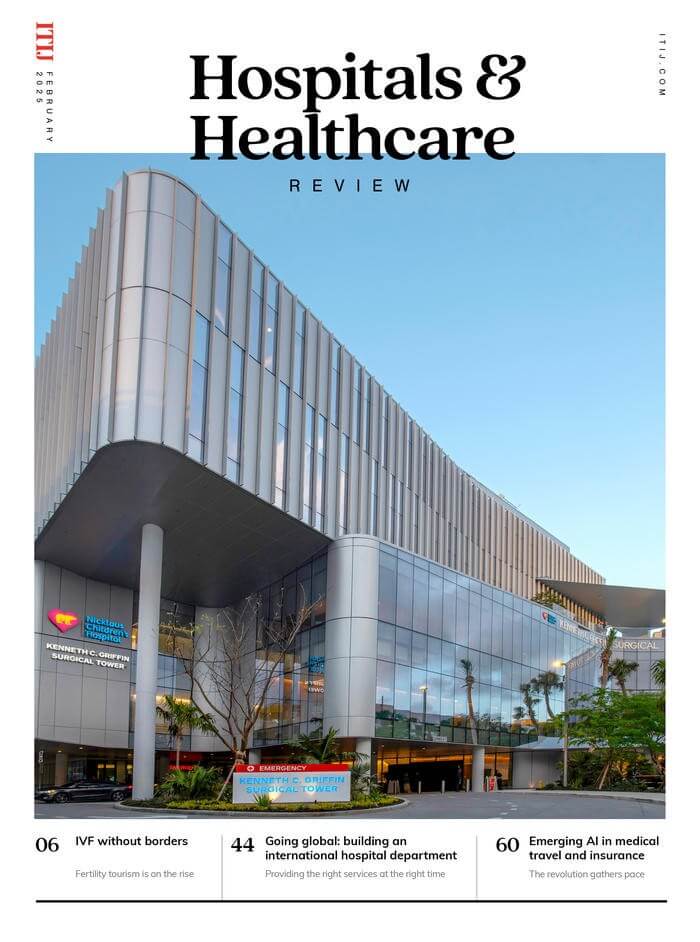
February 2025
Issue
Offering readers a deep dive into the issues facing providers and payers of healthcare services around the world. Cost containment, international patient department development, the role of AI in healthcare delivery and more.