
Too old to come home?

Alex Veldman, Medical Director, and Andrea Ressler, Head of Sales and Marketing, at Unicair, tell ITIJ about a recent case of an elderly man requesting repatriation
When a 102-year-old Dutch citizen fell ill while visiting family in Algeria, his case highlighted the profound dilemmas that fixed-wing air ambulance providers encounter at the interface of medicine, aviation and ethics. Initially admitted to an Algerian hospital for pneumonia, his family requested repatriation to the Netherlands. A highly trained Unicair transport crew deployed with the expectation of transferring him safely home.
Yet, upon closer review after arrival, two obstacles emerged: the patient would require continuation of ICU care on arrival (he was admitted to ICU in Algeria a few hours prior to arrival of the transport team), and the Dutch ICU’s declined admission due to prognosis, age, and shortage of beds. Repatriation became unsafe, leaving the patient to remain in Algeria.
Medical appropriateness
This situation resonates with the framework that we set out before in Veldman A et al. Please get me out of here: The difficult decision making in fit-to-fly assessments for international fixed-wing air ambulance operations. Travel Med Infect Dis. 2023 Jul-Aug:54:102613. The central argument is that technical capability does not equal medical appropriateness. Just because a modern air ambulance jet can sustain an ICU patient across continents does not mean that transport is always in the patient’s best interest. The fit-to-fly decision must weigh risks and benefits in a dynamic context: patient physiology, local treatment options, and what awaits at the destination.
Guidelines on ICU admission in the very elderly provide critical perspective
Weighing up the risks
In this case, the problem was not whether the aircraft and crew could carry him home, but in what would happen after landing. With ICU admission denied in the Netherlands, transfer would not have delivered a higher level of care. Instead, it would have stripped the frail and fragile patient of his Algerian ICU bed, exposed him to physiological instability in flight, and left him at risk of arriving in a country unable to offer an appropriate place of care.
Guidelines on ICU admission in the very elderly provide critical perspective. International criticalcare societies consistently emphasise that chronological age alone must not be the sole criterion for admission. Rather, decisions should be grounded in frailty, comorbidity, reversibility of the acute problem, and the patient’s expressed wishes.
Evidence shows that frailty indices and functional status are stronger predictors of outcome than the number of birthdays. Still, in the centenarian population, the overlap of extreme age, high frailty, and limited organ reserve often translates into minimal expected benefit from invasive intensive care.
Complicated decisions
Overlaying this with resource scarcity makes the decision even more complex. During periods of bed shortage, such as in the recent pandemic, triage frameworks require clinicians to prioritise those patients most likely to benefit. The Dutch refusal in this case reflects both prognostic concerns and the reality of limited ICU capacity. Ethical principles demand transparency: families must understand that denial is not an abandonment but a judgment of proportionality – what care is reasonable, and what may only increase suffering.
For the air ambulance industry, cases such as this reinforce the need for close alignment between transport providers, assistance centres, referring hospitals, and receiving facilities. Fit-to-fly assessments must extend beyond the cabin to include guaranteed acceptance and a realistic treatment plan on arrival. Communication with families must be compassionate yet clear: sometimes staying in place, even far from home, is safer, kinder, and ultimately more dignified.
The sad irony is that this patient was “too old to come home”. Yet, framed properly, the decision was not about denying travel but about preserving comfort, reducing harm, and respecting the realities of both physiology and health system limits. For an industry that thrives on bringing people home from across the world, such restraint can be its most responsible act.
Alex Veldman
Medical Director, Unicair
Alex is a board-certified Paediatrician, Neonatologist, and Paediatric Cardiologist serving as Medical Director of Unicair. Previously, he worked in leadership positions in large university hospitals and in the pharmaceutical industry. Alex has published more than 100 research papers in international, peer reviewed scientific journals, many of those on aeromedical topics.
Andrea Ressler
Head of Sales and Marketing, Unicair
Andrea has more than 20 years of experience in the air ambulance industry. With a background in linguistics, she managed international repatriations in the operations group at Jetcall before moving into project management and consulting. Since 2023 she has led sales and marketing at Unicair, focusing on patient safety, quality, innovation and customer satisfaction.
November 2025
Issue
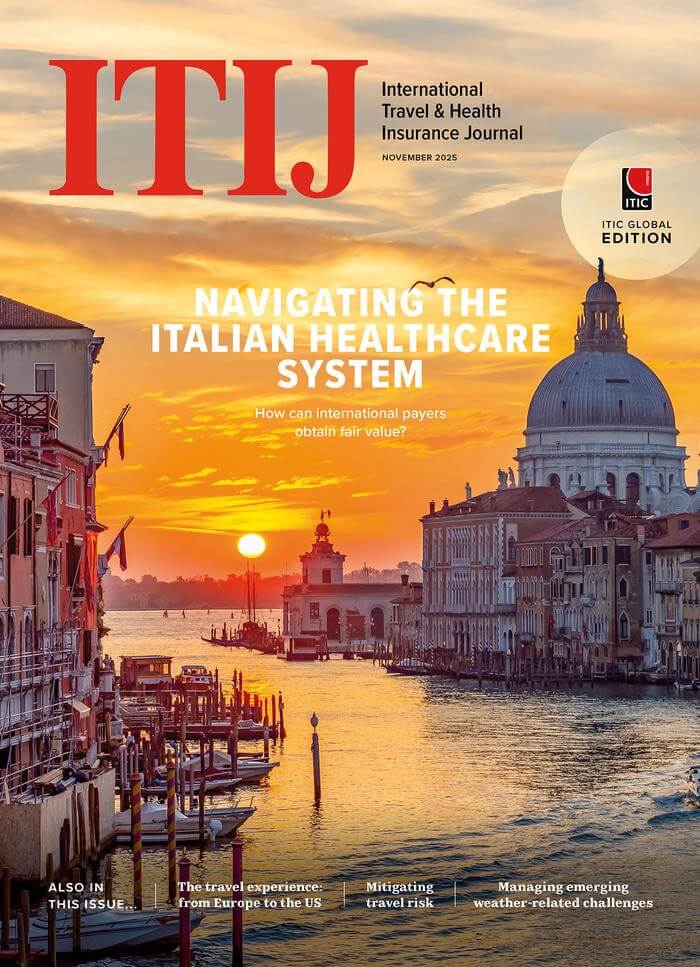
In this issue of ITIJ we look at current travel patterns to and from the US and Europe, take a close look at the Italian healthcare system, and examine how insurers are adapting policies and coverage to manage weather-related challenges.
Editorial Team
The Editorial Team updates the ITIJ website daily, and works on features for the print edition. With expert industry knowledge and years of experience in writing about complex travel insurance issues, the Editorial Team is ready to investigate and report on the topics that matter most to ITIJ's readers.
