
Tara Rose Naccarelli interview: How medical escorts are turning commercial flights into mobile healthcare

Tara Rose Naccarelli, President of Patient Services and Risk Management at Sky Nurses, explains how increasingly complex patients, portable medical technology, and tighter airline requirements are reshaping commercial medical escorting
Q. As President of Patient Services and Risk Management at Sky Nurses, what do your responsibilities involve?
I oversee all our policies, processes, and procedures. Every day something may need to be changed, or may need to be updated, especially our education here at Sky Nurses.
My background is that I worked as an emergency room nurse as well as an intensive care nurse for many years before taking on the task of part ownership in Sky Nurses. I also did a lot of legal nurse consulting.
That experience, along with my hospital experience, has truly helped me in my job today. Sky Nurses has approximately 19 employees now. For a medical escort company, that’s fairly large. I think the average medical escort company probably has maybe four or five people working for them, but we have 19 people here in our office and strategically located in other areas too.
Q. How has the company evolved since it was founded in 2013?
When we started, it was just John Naccarelli and I. John was the finance person; he knew nothing about healthcare. I was the healthcare person. It was a learning curve for me because what happens in a hospital room at sea level is very different to what happens on a commercial airline at 32,000 or 38,000 feet in the air.
When we first started, my manual was about 50 pages long. Today, if you put everything together, it’s about 10,000 pages. There wasn’t really any accessible guidance explaining how to be a medical escort.
One of the things that we are doing here is writing a book called Patient Transport Risk Mitigation and Intervention: Look Beyond the Diagnosis. That’s kind of what my theme is around right now: looking beyond the diagnosis.
The larger trend is that commercial medical transports are evolving from assisted travel into a specialised form of mobile healthcare
We do complex case management here as well, so we have a lot of hospital clients. We were able to survive 2020 without closing our doors, which was a challenge. That gave us an opportunity to say, “Okay, what do we need to do? What do we need to do to prepare for something like this if it were to happen again?”


Q. Are more patients now travelling by commercial airline rather than air ambulance?
A lot more patients are escorted on commercial airlines than by air ambulance. The air ambulance, of course, is still a major player in this industry. But a lot of people are being transported on commercial airlines that probably in 2013 and back in the early 2000s were most likely being transported on an air ambulance versus a commercial airline.
Q. Is that mainly a cost issue, or are there other benefits?
I think it’s cost. When you look at the cost of what it would be to go by commercial stretcher, you may be talking about US$40,000, whereas by air ambulance it may be as high as $140,000.
But in many cases, if you can put a person on a commercial airline with a non-stop flight, that may truly be much better for them. If you’re going from Los Angeles to London, you may get a non-stop flight on a commercial airline, whereas if you go with an air ambulance that you can afford, you may not have that luxury.
It’s about looking at the benefit for the patient, and weighing up travelling by commercial airline versus air ambulance. It’s what is best for that patient.
Q. What trends are you seeing in the sector and in the kinds of patients you transport?
Everybody seems to talk about the ageing population travelling more, but I think it’s not really a trend. The larger trend is that commercial medical transports are evolving from assisted travel into a specialised form of mobile healthcare.
The patients we are transporting today are more medically complex than the patients we transported when we began in 2013. What is changing is the complexity of the traveller and the level of medical support required to keep them travelling safely.
Many of these individuals are travelling with a high level of comorbidities. When you look at their medical history, forget the diagnosis; look beyond the diagnosis. You can have someone who has, let’s say, a femur or a hip fracture. When you quote, you’re quoting based on that fracture. But then when you really start peeling back the onion and looking at everything that is wrong with this patient, there could be a whole new complex situation going on.
When you really start peeling back the onion and looking at everything that is wrong with this patient, there could be a whole new complex situation going on
So, I think it’s not so much that the elderly are travelling more. It’s just that people are travelling more with comorbidities than they did maybe 20 years ago.
Q. What challenges does that create around oxygen and other medical equipment?
There are two types of oxygen. There’s your pulse oxygen, which you get from a portable oxygen concentrator (POC). But if you need continuous flow of oxygen that is greater than what a POC can provide, then you must look at onboard oxygen that is supplied by the airline.
Another challenge that we run into here at Sky Nurses, and I think any medical escort company runs into, is the number of batteries that are required. You must have one-and-a-half times the battery hours.
Let’s say that you have an eight-hour flight. If you have one battery that will last four hours, then you need two batteries for that eight-hour flight. However, the airline says, “No, no, no, you’re going to need one and a half times.” So now you need three batteries. If you’re carrying an Inogen, it’s like carrying a brick. Not as heavy, but it’s the size of a red brick. When you start having to put all those in your bag and you’re having to carry them, they can become quite heavy.
You also need to make sure that you have enough battery time for the flight and the layover, particularly if the patient is non-ambulatory and needs personal care during the layover.
Q. Have improvements in portable oxygen concentrators helped make commercial travel more accessible?
Oh yes, definitely. I would say 98% of our clinicians have Inogen POCs because they’re compact and they are easy to use.
It’s interesting how things have evolved and what equipment we can carry on a commercial airline today versus what you could do 10 years ago. I think that POCs have evolved tremendously, and that has allowed these individuals – it’s not just the elderly population; I’ve seen young people that have respiratory problems utilising a POC.
I think the invention of a POC that is Federal Aviation Administration (FAA) approved has given people that normally couldn’t travel the ability to travel.

Q. How do you prepare clinicians for those cultural differences?
I never want anyone to feel that they must change their beliefs because of the patient, but you do have to learn how to manage those beliefs in that situation.
It’s about the patient and getting them safely to their destination, but also making sure they’re there mentally too. If you’re stressing someone out by going against what they strongly believe, sometimes that isn’t the best approach. So, we do a lot of education around that.
Q. What changes are you seeing from airlines and hospitals?
Commercial airlines are designed to transport healthy people, not sick people. But with the growth of medical escorts, we’re increasingly turning commercial flights into a form of mobile healthcare.
United Airlines has a medical department. If you are injured or ill, you must submit a medical certificate or a fit-to-fly document 48 hours before trying to get on a United Airlines flight. That’s a huge change for us.
It’s about the patient; it’s about getting them safely to their final destination, but also getting them there mentally too
The era of rapid-response medical escorts is likely coming to an end. As airline regulations become stricter, rapid-response services will increasingly be the preserve of air ambulances.
I also think there’s going to be more involvement from US hospitals before they discharge a patient. If a patient is being transferred from a hospital environment to another hospital environment, then it becomes a liability issue for a US hospital. We were getting ready to do a medical escort for a new client, and the first thing that the case manager asked was, “Please make sure that the clinician brings their credentials. No credentials, no discharge of the patient.”
That made me change some things and made me say, “Okay guys, you need to make sure that you carry a copy of your licence and your driver’s licence”. Especially if the patient is being discharged with the intention of going to another hospital. That’s another big challenge that we could potentially face.
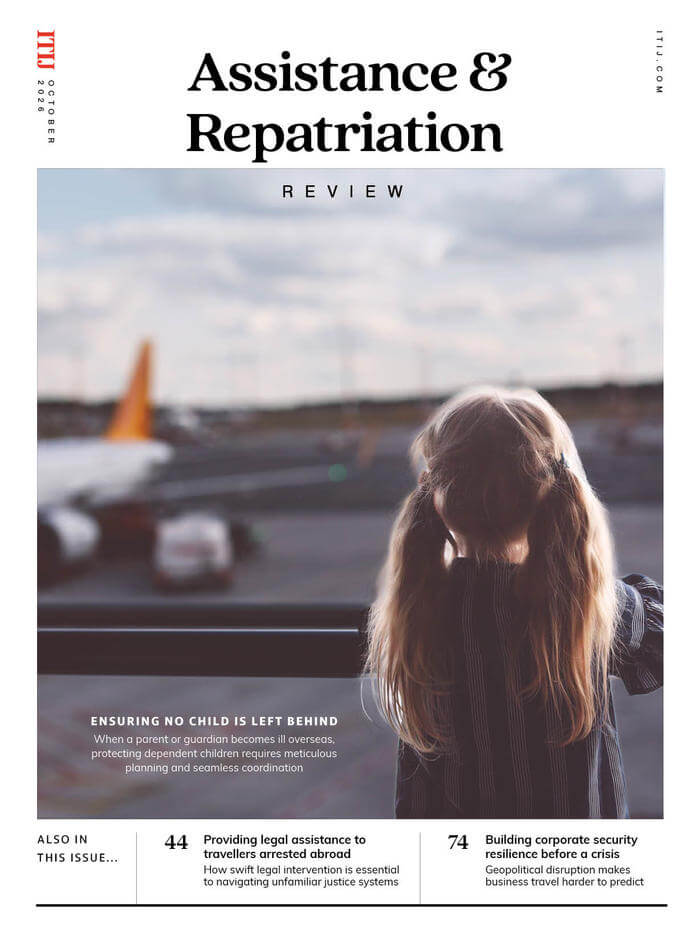
October 2026
Issue
When a parent or guardian becomes seriously ill overseas, assistance providers face a complex challenge that extends well beyond clinical care. Although these cases are relatively rare, in this issue we look at how safeguarding dependent children requires careful planning, legal awareness, and close international coordination.
Editorial Team
The Editorial Team updates the ITIJ website daily, and works on features for the print edition. With expert industry knowledge and years of experience in writing about complex travel insurance issues, the Editorial Team is ready to investigate and report on the topics that matter most to ITIJ's readers.