Stranded in the snow: an emergency rescue near Schotten, Germany

Sabine Radun of BringOff Assistance reports how her company came to the rescue of a client trapped in a snowstorm
On 27 November 2024 at 4:30pm local time, a standard roadside assistance call escalated into an urgent rescue operation. Our client, driving a Citroën Jumper 2.2 near Schotten, Germany, lost control on a snow-covered road. The vehicle skidded, sliding off the road, and came to rest three metres down in a ditch. With a snowstorm intensifying and 15 centimetres of fresh snow already on the ground, the situation quickly turned hazardous.
Initial response
Within half an hour, a towing provider was dispatched to the location. However, upon arrival, the company realised that recovery was more complex than expected. The steep, slippery road, combined with the depth of the ditch, made extraction impossible with a single truck. The provider confirmed that at least two recovery vehicles would be required. But as snowfall worsened, the road itself became inaccessible for heavy equipment.
Compounding the urgency, communication with the client was suddenly lost. His mobile phone battery had died, leaving our coordination centre unable to confirm his safety. With temperatures dropping and visibility reduced by the storm, this raised immediate concerns about hypothermia and exposure.
Escalation and safety priorities
At this point, our operational team reassessed its priorities. Vehicle recovery could be postponed until weather conditions improved, but client evacuation could not. All available resources were mobilised. Local taxis with 4x4 vehicles were contacted, but even experienced drivers reported they could not safely reach the location.
Compounding the urgency, communication with the client was suddenly lost. His mobile phone battery had died
The situation demanded unconventional thinking. Drawing on our strong regional network, we contacted the local fire department. While their standard vehicles could not access the site, the department owned a specialised snow-capable vehicle. This option proved decisive.
The rescue
Despite the blizzard, the firefighter successfully navigated the roads and reached the stranded clients around 6:00pm. Once evacuated from the ditch, the passengers were transported to safety. However, their intended hotel destination was also inaccessible due to snow-blocked roads. Anticipating this, our coordination team had arranged alternative accommodation. The clients were escorted to a nearby location where warmth, food, and shelter were available.
The immediate danger was resolved: although shaken, the clients were safe, comfortable, and relieved after hours of uncertainty.
Vehicle recovery
With the clients secure, focus shifted back to the vehicle. On the following day, weather conditions eased enough to permit a recovery attempt. At approximately 2:00pm local time, the Citroën Jumper was successfully extracted and transported to a local workshop for inspection and repairs.
Outcome and lessons learned
What began as a routine roadside assistance case evolved into a complex rescue operation under extreme weather conditions. Several critical factors contributed to the successful outcome:
• Rapid coordination: the managing team adapted quickly as circumstances deteriorated
• Local expertise: trusted partners on the ground provided knowledge and connections unavailable through standard channels
• Creative problem-solving: engaging a firefighter with specialised equipment ensured client safety when conventional methods failed.
This case underscores the value of professional assistance networks. Vehicles can wait for recovery, but people cannot wait for safety. By prioritising human wellbeing and leveraging local partnerships, we ensured that both the clients and their vehicle were ultimately secure.
In conclusion, this operation demonstrates how swift organisation, trust in regional contacts, and decisive action can transform a potentially life-threatening incident into a successful rescue.
Sabine Radun is the Managing Director and Founder of BringOff Assistance in Austria. With a decade of experience in international medical and travel assistance, she focuses on operational efficiency, patient-centred case management and cross-border healthcare logistics, supported by her background in healthcare management and law.
BringOff Assistance, based near Vienna, delivers 24/7 medical and travel services across the DACH region and the Balkans. With a multilingual coordination centre, a broad network of hospitals, house call doctors and an extensive transport network, the company provides medical and technical services with speed, precision, and compassion.
October 2025
Issue
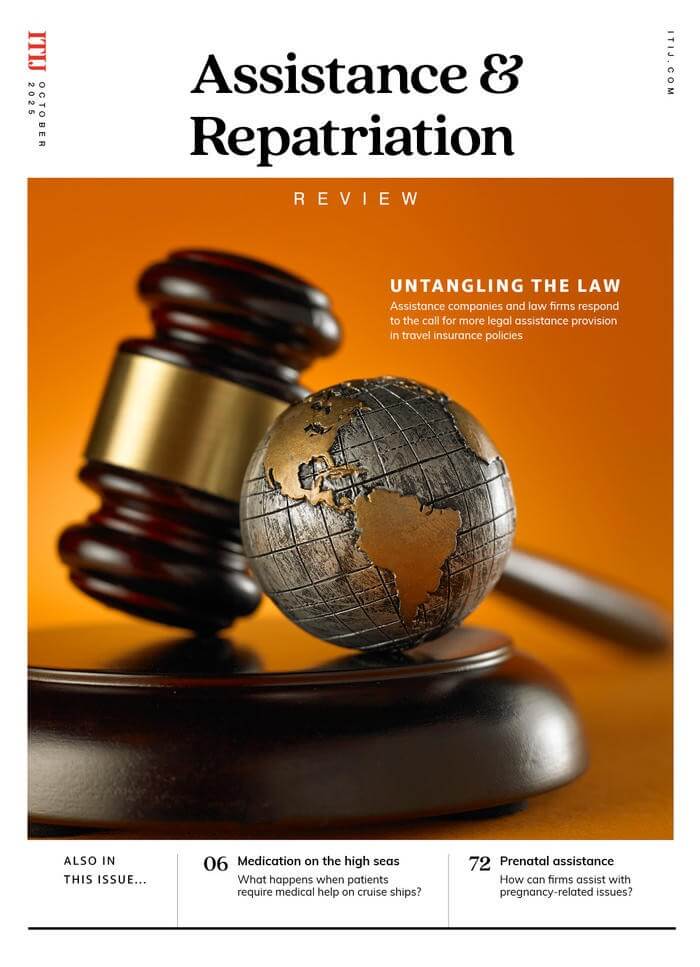
In this latest Assistance & Repatriation Review we explore how legal networks and insurers can help travellers who fall foul of the law while abroad. We look into the intricacies surrounding how medical transfers can be provided to pre-natal and neonatal patients, and examine the provision of medical care to patients who become ill on cruise ships.
Editorial Team
The Editorial Team updates the ITIJ website daily, and works on features for the print edition. With expert industry knowledge and years of experience in writing about complex travel insurance issues, the Editorial Team is ready to investigate and report on the topics that matter most to ITIJ's readers.