
Six days old and thousands of miles from home

AMREF Flying Doctors recalls a six-day-old infant’s journey from Kenya to India that highlights the complexity of intercontinental neonatal transport
At six days old, he had never left the hospital in which he had been born. Yet within a week of his birth, he would travel thousands of kilometres from Kenya’s south coast to India in search of advanced medical care. A complex congenital heart condition posed an immediate and continuous threat to his life. For his parents, the journey was measured not in distance, but in hope.
The baby had been admitted to hospital shortly after birth and required a level of care that could not be accessed locally. As doctors worked to stabilise him, the search for a suitable hospital eventually led to Mumbai, India.
For AMREF Flying Doctors, the mission was about more than distance. It would also be the first medical flight for the organisation’s newest aircraft. As the Citation Sovereign C680 prepared to enter service, its maiden medical mission would take it across continents with a six-day-old infant and his family on board, bound for specialist care in India.
A mission that started long before takeoff
Moving a delicate newborn across continents requires far more than arranging a flight.
Behind the scenes, teams in Kenya and India coordinated medical clearances, travel documentation, ground transportation, flight planning and hospital arrangements. Every detail had to come together quickly to ensure the transfer could proceed safely.
In a hospital, if something changes, you have an entire neonatal unit around you. At altitude, you become that neonatal unit. Every decision matters
Only days after welcoming their son into the world, the family was preparing to accompany him to a country they had never visited, knowing that the next chapter of his care would begin thousands of kilometres from home.
“Families remember these moments for the rest of their lives,” said Margaret Muthoni, Flight Nurse and Aeromedical Coordinator at AMREF Flying Doctors. “Clinical care is only one part of the mission. Families need reassurance, clear communication and confidence that everyone involved is working towards the same goal.”
Once the receiving hospital confirmed acceptance, the transfer plan was activated.
A flying intensive care unit
A transport incubator and specialist neonatal equipment were loaded and checked before departure, while the flight crew worked closely with the medical team throughout the journey.
The Citation Sovereign C680 was selected for the mission because it was well suited to the demands of a long-distance neonatal transfer. Every aspect of the operation was planned around the patient’s needs, from the ground transfer in Kenya to the final handover in India.
“In a hospital, if something changes, you have an entire neonatal unit around you,” Muthoni explained. “At altitude, you become that neonatal unit. Every decision matters.”
Before departure, the infant was carefully transferred into the incubator and prepared for the journey ahead.
Throughout the flight, the medical crew remained focused on one goal: ensuring the baby arrived in the same stable condition in which he had departed. While the pilots managed the route ahead, the medical team continuously monitored the infant and remained ready to respond to any change in condition.
Arrival in Mumbai
After crossing continents, the aircraft touched down in Mumbai, where the infant was transferred directly to the receiving hospital for further treatment.
A detailed handover ensured care could continue without delay, bringing to an end a carefully coordinated journey that had begun thousands of kilometres away on Kenya’s coast.
For the family, it marked the end of an anxious journey and the beginning of the next chapter in their son’s care. “For most people, Mumbai is simply another destination,” Muthoni reflected.
“For this baby, it represented access to care that could change the course of his life.”
More than a transport mission
The successful transfer highlights the role specialist aeromedical services play in connecting patients to care that may be unavailable closer to home.
For one six-day-old baby, the journey opened the door to treatment that might otherwise have remained beyond reach. For the team that accompanied him across continents, it was a reminder that sometimes the shortest lives carry the longest journeys.
July 2026
Issue
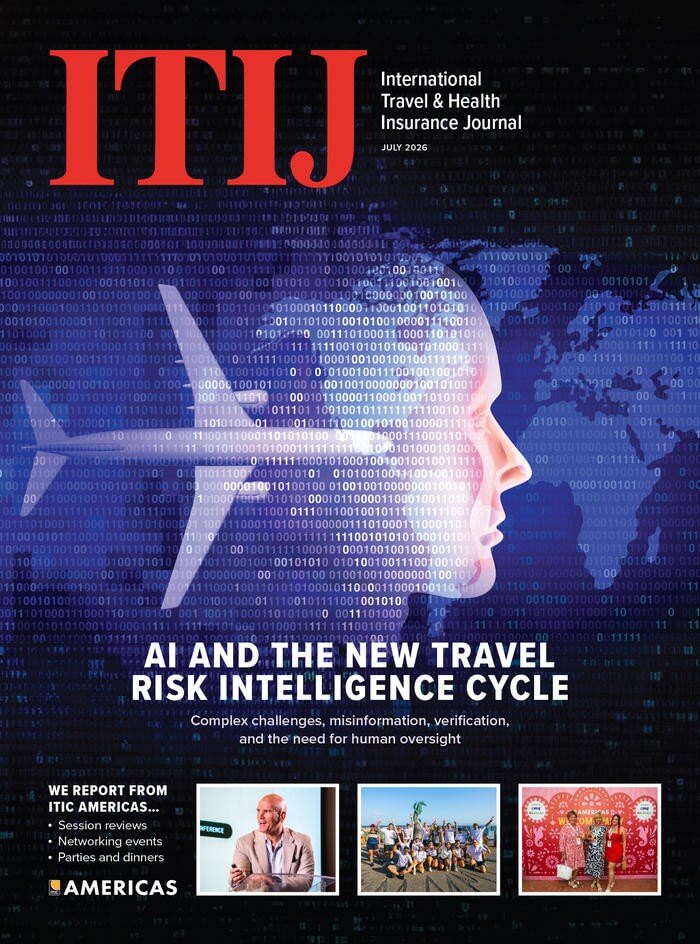
Welcome to your July issue! This month we look at how artificial intelligence solutions are changing the way in which travel risk information is gathered and communicated, plus we ask whether providers should do more to educate their customers, ensuring they understand the products they are buying and using them appropriately.
Editorial Team
The Editorial Team updates the ITIJ website daily, and works on features for the print edition. With expert industry knowledge and years of experience in writing about complex travel insurance issues, the Editorial Team is ready to investigate and report on the topics that matter most to ITIJ's readers.