
Showcasing Latin American medical assistance provision

As the Latin American travel insurance market expands, how can the industry build awareness and engagement among consumers? Medical assistance experts discuss strategies with Lauren Haigh
In Latin America, the travel insurance market is rapidly expanding: it generated US$1.37 billion in revenue in 2024 and this figure is predicted to reach $3.24 billion by 2030, according to Grand View Research. Despite this growth, market research shows that consumer awareness of travel medical insurance is lacking. Globally, only 40% of travellers are aware that standalone travel medical insurance exists and this recognition drops to just 25% in Latin America and Southeast Asia. The disconnect between travellers purchasing travel insurance and their actual understanding of the medical assistance services their policies provide is jarring and a familiar concern for the industry. As such, in Latin America and beyond, the industry is focused on closing this significant knowledge gap.
Essential, not optional
While access to and requirement for travel insurance appears to be growing, it’s clear there is still room for enhanced education. The industry knows that buying insurance isn’t the same as engaging with assistance and it’s crucial that travellers have a solid foundation of understanding.
In order to improve awareness, it’s key to first understand exactly why travellers in Latin America are overlooking the value of medical assistance. Part of the problem is ingrained misconceptions and misunderstandings about travel insurance and medical assistance.
“Many travellers in Latin America still perceive travel assistance as an option rather than a core necessity. This is often due to limited awareness, cultural differences, and the misconception that local healthcare systems will always be accessible and affordable,” Federico Tarling, Chief Service Officer at Assist Card, told ITIJ.
“We see many travellers in LatAm still viewing travel insurance as something expensive, optional or only for long trips, or something they buy only when it’s required for a visa or proof of entry,” said Maximiliano Fausciana, Head of Business Development – Financial Institutions, at AXA Partners US. “There’s also an assumption that nothing may happen, until something actually goes wrong and takes travellers by surprise. As a result, the everyday value of medical assistance is often underestimated. Education, awareness and process simplification become key.”
Huguett Valentina Herrades Lorenzo, Head of Providers at MAWDY, agreed: “Travellers still tend to underestimate medical assistance, largely due to limited awareness of actual costs and the complexity of healthcare systems overseas. There is often a perception that assistance is optional rather than essential, coupled with the mistaken belief that travel insurance covers everything without the need for additional services.”
Tarling said that this was worsened by reliance on credit cards and existing insurance, particularly international medical coverage, which is often limited or not comprehensive. “Many markets have been ‘spoiled’ by the inclusion of limited international medical coverage in credit cards and health insurance, which have made people believe they have comprehensive coverage when they actually do not,” he underlined.
Understanding the true cost
Another hurdle is misconception of how complex, and indeed expensive, navigating healthcare in Latin America can be, as Dr Andrea Rodriguez, Supervisor Case Manager at Logimedex, pointed out. “There is limited awareness of the true cost of private medical care, the variability in pricing structures, and the importance of having coordinated support to avoid unnecessary procedures, overbilling, or poorly suited facilities,” she explained. Research from AllClear in 2025 supports this: 51% of travellers in the UK believe they could personally pay for their medical bills abroad if something went wrong.
Many travellers in Latin America still perceive travel assistance as an option rather than a core necessity
Dr Rodriguez highlighted another issue – that travellers tend to assume that public hospitals across the region operate with the same level of resources and availability as in their home countries. “In reality, public facilities often face shortages of equipment, long wait times, and significant regional disparities, especially in coastal, rural, or high-tourism areas where infrastructure is limited,” she stated. “Because travellers are not usually aware of these constraints, they may view medical assistance as optional until a medical event makes the need for coordinated support immediately evident.”
Effective engagement strategies
Findings from a 2024 survey from the Insurance Council of Australia and the Department of Foreign Affairs and Trade suggest the problem is not necessarily that travellers don’t want to understand their policies. Over half (52%) of respondents said clearer explanations of coverage were the single most beneficial thing
travel insurers could provide to help travellers understand their policies. Furthermore, 64% indicated that better awareness of travel insurers’ emergency assistance services was something they wanted. This indicates that travellers are keen to better understand insurance but require the right tools to do so.
This shines the spotlight on communication as a cornerstone of understanding. “What works best is clear, proactive, and structured communication from the moment the traveller contacts us,” noted Dr Rodriguez.
Tarling agreed: “Clear, fast, and proactive communication has proven most effective. When the customer has access to different contact platforms, with easy interaction and quick responses, everything is much simpler.”
Lacking insurance education in LatAm
There is also a regional awareness gap, highlighted by Thierry Bravo, Senior Assistance Manager at Charles Taylor Assistance. He noted that Latin America didn’t always get the same attention as other popular destinations, such as Europe and the US, when it came to insurance education. “Communicating the medical risks clearly, including limited healthcare facilities outside the biggest cities, poor transport infrastructure (especially in more remote locations), altitude sickness (one of the most common causes of claims in Peru), and the risk of potential conflict and political instability, as well as the ways in which travel insurance can mitigate these risks, is one way of encouraging travellers to Latin America to engage with their insurance coverage,” Bravo told ITIJ.
Social media is an increasingly important tool to facilitate communication, provide guidance, and enhance awareness. “It plays a crucial role. It is one of the fastest ways to provide explanations of how assistance works,” Tarling confirmed. This is particularly the case for new generations of digital-first travellers.

Bridging the gap with digital tools
Digitisation is an invaluable tool for bridging the engagement gap, helping to improve the visibility, accessibility, and immediacy of medical assistance for travellers. The value of telemedicine is being recognised in Latin America, with adoption rising. Indeed, 41% and 48% of travellers said they preferred virtual care for low-complexity and follow-up care, respectively. “Telemedicine and real-time support are the most transformative features,” Tarling stated. “They provide immediate relief and medical guidance without the need to go to a hospital.”
Dr Rodriguez agreed: “Telemedicine is now essential, allowing travellers to receive immediate medical advice and often avoid unnecessary emergency room visits.”
“We’ve found that digital tools are critical to making medical assistance feel real before travel starts,” Fausciana said. “Digital platforms, mobile apps, real-time chat, telemedicine access, and simple claims tracking make the service feel tangible rather than abstract. When travellers, through a simplified process, can see and interact with the support upfront, engagement increases.”
Many markets have been ‘spoiled’ by the inclusion of limited international medical coverage in credit cards and health insurance
Telemedicine is most effective as part of a broader spectrum of digital tools, as Bravo pointed out. “Its effectiveness depends on the severity of the situation. If a telemedicine appointment resolves the issue, it can be the most efficient and cost-effective way of managing a policyholder’s needs,” he noted. “However, where cases require more than telemedicine, wider travel insurance support will be a traveller’s best ally: a call to the insurer’s medical assistance provider will help them find the best course of action.”
Herrades agreed: “Apps with geolocation, alerts, and real-time case management are key, as are push notifications that remind travellers of the services available throughout their journey,” she noted.
Demonstrating value upfront
A key challenge for the industry is demonstrating the value of medical assistance before something goes wrong and the benefit is then recognised in unfortunate circumstances. “The key is to shift communication from reactive to preventative,” said Dr Rodriguez. “Travellers better understand the value of medical assistance when they are informed before travelling about what coordinated care prevents: overbilling, unnecessary interventions, long wait times, language barriers, and confusion when selecting appropriate facilities.”
An important part of this is sharing tangible stories that resonate. “Real stories and cost comparisons help raise awareness, while embedding assistance into the booking process, rather than treating it as an add-on, reinforcing its importance,” said Lorenzo.
Bravo agreed: “Sharing case studies and medical assistance scenarios specific to Latin America is one of the best ways of showcasing how costly a claim can become if a traveller hasn’t purchased travel insurance and how invaluable insurance is; especially if a traveller is stranded in a remote location, or somewhere where the medical speciality or standard of care isn’t the best,” he stated. “Sharing case studies on animal
bites, for example, can help showcase the value of medical assistance. Bites are a common occurrence in Latin America, but a lot of travellers don’t grasp how important it is to carefully monitor them. Medical assistance gives policyholders access to experts who guide them through World Health Organization (WHO) recommendations.”
“We focus on showing how assistance actually works in practice, not just listing benefits,” said Fausciana. “We at AXA Partners deliver digital solutions that teach, engage and simplify the process for travellers. As an example, our platforms allow customers to upload their eligibility requirements before travelling, thus simplifying the claims process. Making assistance visible before it’s needed builds trust and confidence.”
From discussion to action
While the importance of close-knit collaboration across industry stakeholders is often discussed, this is something that is challenging to put into practice. Sharing data insights is a key strategy that ultimately benefits the traveller. “The strongest opportunities lie in data integration and shared platforms,” Tarling stated. “When providers, insurers, and partners collaborate on unified digital ecosystems, travellers experience smoother care pathways and faster resolutions. Joint training initiatives and standardised protocols across networks also ensure consistency, which is critical for building trust across borders.”
Dr Rodriguez highlighted the importance of responsible data sharing, standardised medical auditing, and transparent pricing. “These reduce variability, prevent overbilling, and increase trust,” she asserted. Integrated communication channels are also critical. “Real-time updates between assistance providers, telemedicine platforms and insurers allow clearer coordination and faster decisions during acute cases,” she explained.
For Lorenzo, technology is a key enabler for making collaboration discussions a reality. “Shared platforms and standardised application programming interfaces (APIs) can deliver a unified experience for travellers,” she pointed out.
Delivering impact through change
To establish a clearer understanding of the value of medical assistance and ensure it is seen as essential rather than optional, simplicity is critical. For travellers, trust is built when support is predictable, easy to access, and clearly explained. “The key to building trust lies in offering a simple, predictable experience,” said Herrades. “A single interface for assistance, telemedicine, and claims management, combined with transparent processes and response times, is essential. Communication should focus on prevention and ongoing support, not only on emergencies.”
“We believe simplicity comes from making medical assistance easy to see and easy to use, especially through digital tools,” said Fausciana. “When travellers can quickly access services, understand their benefits, and know exactly where to go for help through an app or digital platform, the value becomes tangible.”
Tarling agreed that progress depended on returning to the fundamentals, particularly around awareness and self-care. “Travellers need to understand the importance of travelling protected, with assistance capable of handling any unforeseen event,” he stated.
Bravo reinforced this mindset shift, stating that medical assistance must be reframed as a travel essential: “Travel insurance should be seen as equally essential as a passport, phone charger, visa or toothbrush. It’s a human service and when travellers know they can speak to someone and feel supported, trust follows.”
Improving customer engagement with medical assistance in Latin America is less about adding new features and more about removing barriers. Clear communication, practical education, digital tools that simplify access, and smooth stakeholder collaboration behind the scenes are all key. By empowering travellers to move from simply knowing that assistance exists to understanding how it works and why it matters, its value becomes clear long before it is ever needed.
March 2026
Issue
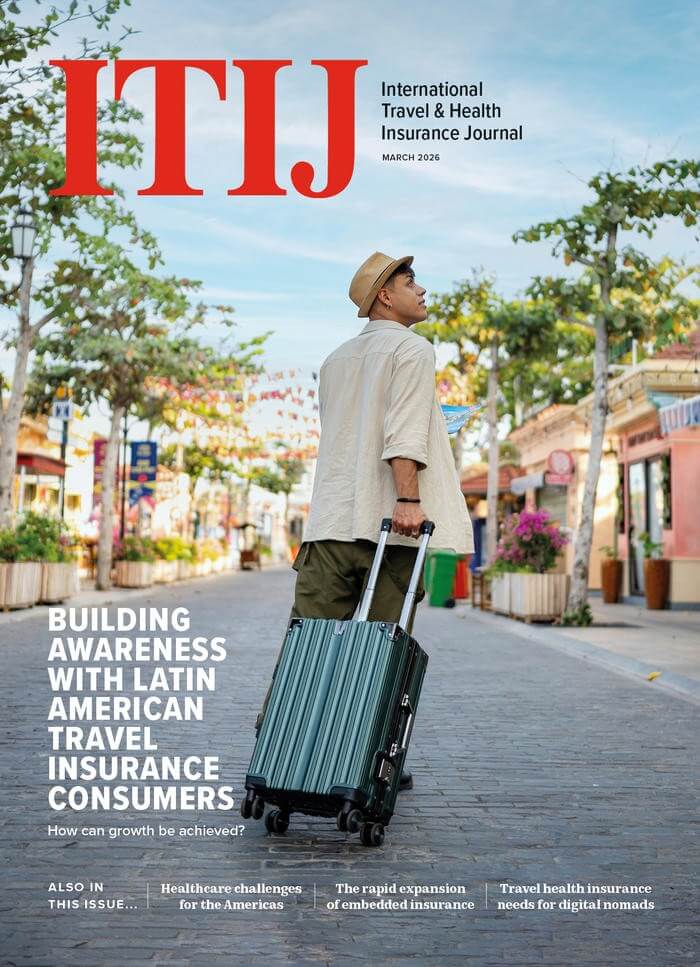
In this month’s ITIJ we examine the digitisation of healthcare across the Americas, plus we look at how embedded insurance is disrupting the traditional insurance market. We also investigate Latin American medical assistance provision and ask how can the industry build awareness and engagement among consumers.
Lauren Haigh
Lauren Haigh is a freelance writer for ITIJ.