Second medical opinion services

A second medical opinion (SMO) has the potential to change the management of medical care drastically, especially for international patients. Clara Bullock explores why SMOs have become more popular while weighing up its shortcomings
Getting a second opinion before deciding on a treatment can be lifesaving. According to the Washington Post, in the US, 12 million people undergo diagnostic errors yearly, but a good SMO programme can assist in confirming diagnosis, identifying additional medical options, clarifying treatment plans, and exposing potential medical errors. At the very least, SMOs bring peace of mind to patients and even insurers about possible treatments. However, they can also be expensive and time-consuming.
Since the pandemic, insurers have adopted SMOs more frequently. Especially as, with new technologies on the rise, it has become easier and less expensive to get a second consultation.
Elena Donina Glukhman, Project Manager at medical assistance firm AP Companies, explained: “Nowadays, with the pandemic, the medical service model is going through big changes. SMO providers may also make a huge step forward, providing online options and solutions.”
Wide use of SMOs still limited in Western countries
SMOs include a wide range of services, whether it be an outpatient visit to get an alternative opinion in the same city, or a telemedical consultation with an SMO from another country for the patient in the ICU (also known as remote SMO). In the case of remote consultations, medical protocols for the same condition differ in every country.
In order to provide a valid conclusion, an SMO should be given by a practising doctor specialised in the appropriate field of medicine. Typically, almost all Western insurance companies include SMOs in the policy benefits – despite this, this service is not widely used. This can sometimes be due to time constraints; highly qualified specialists do not respond immediately, since they are very busy with their assigned patients, and less qualified doctors are not appropriate for the critical situations. Or this could be down to an ethical conflict: if a patient is admitted under the care of a doctor, receiving an SMO that undermines the doctor’s authority can cause tension. Patients are often reluctant to bring about this uneasy situation.
When the patient and/or insurance company disagree, or just do not understand the reason behind the prescribed treatment, it leads to misunderstandings and sometimes dissatisfaction
The ‘biggest challenge’ presented by SMOs
Medical Director at AP Companies Ilya Rapoport explains that insurers and assistance companies are usually faced with the necessity of SMOs when a citizen of one country lives in a different country, and the insurer is located in a third country. In some cases, the mentality of all three parties (including the local doctor) differ dramatically – and this is especially challenging in the case of a clash between Eastern, Western, Middle Eastern, and Former USSR medical cultures. A lot of countries in the world expand the term ‘sovereignty’ to include healthcare, therefore they have their own standards and rules introduced by the states and even municipalities.
Rapoport added: “When the patient and/or insurance company disagree, or just do not understand the reason behind the prescribed treatment, it leads to misunderstandings and sometimes dissatisfaction.
“In this case, an SMO is the best option to ‘bring peace of mind’ to the patient and the insurer (but not always for the treating local doctor). Modern technologies, in many cases, may permit [an SMO service] to get the latest medical data, but the next challenge is who will follow the SMO instructions in case the advice is against or not in line with the local treating doctor. This is normally the biggest challenge behind SMOs.”

SMOs as an option for international patients
However, SMOs can save resources, not only for hospitals, but also other parts of the healthcare ecosystem, such as insurance and the public health services. SMOs can help patients to identify an additional course of treatments, and a sometimes more cost-effective or less-invasive procedure. In turn, this may result in reduced claims, leading to lower insurance premiums, which is cost efficient for clients and companies, according to Stephen Ho, Global Marketing Director at Pacific Prime.
He added: “We believe telemedicine and artificial intelligence (AI) will improve the medical concierge services, these technologies will make SMOs and other health concierge services more accessible and easier to deliver to suitable patients.
“From our experiences, SMO has seen a bigger uptick in adoption in countries such as China and Thailand, which have complex medical systems that are vastly different from what they [foreign patients] are used to back in their home country. Language barriers can also add to the confusion for the clients, so having an SMO can also ensure the client is getting the most suitable treatment plan according to the clients’ needs.”
Are SMOs the solution of the future?
Ho of Pacific Prime says that telemedicine and AI will likely improve medical concierge services, making SMOs and other such services more accessible to patients. And Soraia Arroyo Lynch, Vice-President of Networks, GMMI & GGA, also upholds this view. She tells Hospitals & Healthcare that within the US, health plans are more willing to roll out virtual solutions, and members are more receptive to using them – especially for those more troublesome conditions that traditional telehealth would not cover in a pre-Covid world.
As private health plans look for ways to innovate their service offerings and incorporate value-added services, I see SMOs being more widely adopted,” Lynch adds. “The fact that Covid-19 brought international travel to almost a complete halt, we have seen patients and payers – who would have traditionally not contemplated the service – request for the service in the absence of destination travel and travel for treatment in a Covid-19 era.”
Lynch noted that it is likely that more commercial and self-funded insurance programmes will start covering the service in a post-pandemic era. “The promise that SMOs offer – to reduce waste in healthcare, to avoid treatment costs associated with misdiagnosis, to reduce unnecessary surgeries and even employee absenteeism – makes the service more attractive,” she said.
Typically, almost all Western insurance companies include SMOs in the policy benefits – despite this, this service is not widely used

She extrapolated that SMOs will likely be covered by more insurers, and where SMOs were not included in cover, patients – now being more aware of the availability of SMOs – would likely seek it out, potentially even on a self-pay basis.
Glukham reasoned that telemedical technologies were on the rise, and that all of these – tele-radiology, tele-dermatology, tele-psychiatry, AI use in radiology and neurology – lead to the increase of SMO use. “The coronavirus pandemic, with different approaches to the treatment and diagnostics across the globe, surely lead to the increase of SMO necessity. However, there are serious problems for this market to grow, as was outlined above.
“So, our opinion is that SMO in certain areas of medicine will grow, following the development of modern technologies, as well as improvement of health legislation in the European Union.”
With all of this in mind, it seems SMO services could become even more popular in the future, especially in a post-Covid era. However, in some cases it might not be the best choice – if there are time or financial constraints, for example. With more technological developments and a better routine around SMO, these problems could be solved. ■
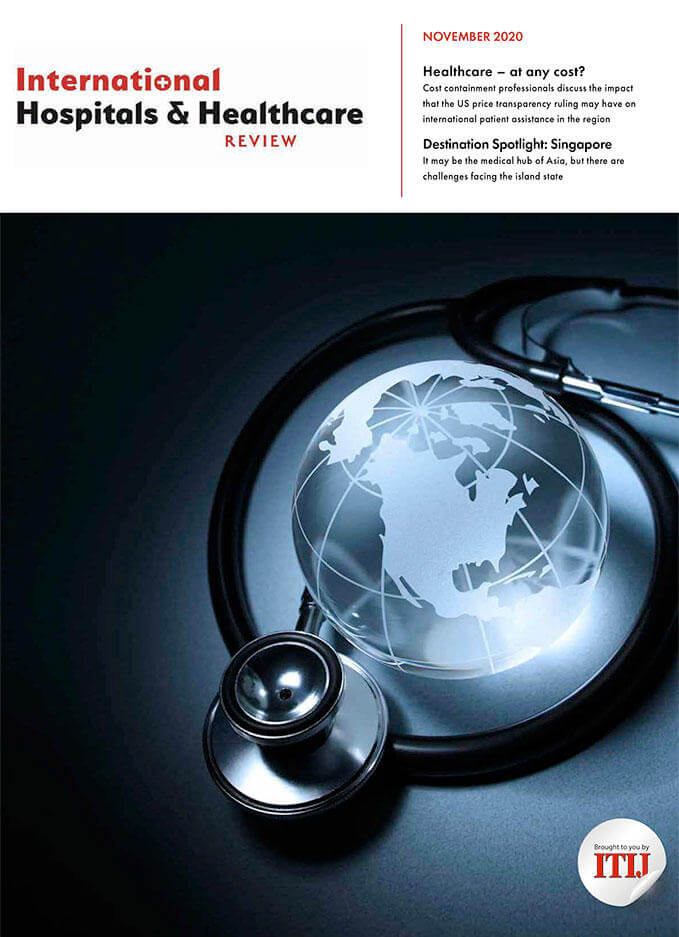
November 2020
Issue
This issue of the International Hospitals & Healthcare Review takes a look at some of the topics likely to play a major role in shaping the landscape of international healthcare in 2021.
We take a look at the new hospital price transparency in the US; assess the provision of healthcare and medical assistance in Singapore; speak to Cigna’s Arjan Toor about the pertinent topic of mental health in our Industry Voice; and weigh up the pros and cons of second medical opinion services.
In the November issue

Protecting employees’ mental health during Covid-19 – no matter where they are in the world

Hospital price transparency in the US and international patient care

Cost Containment born in the USA, now reaching the world: an introduction to Phia International
Sponsored by Phia International













February 2025
Issue
Offering readers a deep dive into the issues facing providers and payers of healthcare services around the world. Cost containment, international patient department development, the role of AI in healthcare delivery and more.