Repatriating highly infectious patients: when preparation becomes the critical factor

Daniela Wilson from Airlec recounts two complex missions involving infectious disease protocols
Aeromedical repatriation is complex even under routine circumstances. When a patient is suspected or confirmed to have an infectious disease, however, the challenge changes fundamentally. Medical crews, pilots, ground staff and airport personnel may all be exposed, while the patient still requires safe and clinically appropriate transport.
Airlec recently faced this challenge during missions involving suspected Hantavirus cases and Ebola virus disease. The operations illustrate how structured risk assessment, specialist training and disciplined procedures can turn an exceptionally high-risk mission into a controlled medical transport.
The Hantavirus mission
The first mission involved five passengers evacuated from a cruise ship in Tenerife following days of uncertainty. Coordination at the airport was difficult, with several repatriation aircraft on the ground and complex patient transfer arrangements.
French health authorities did not require individual isolation chambers and recommended FFP3 masks. Airlec nevertheless followed its established infection-prevention and risk-management procedures.
All five patients appeared stable when boarding. During the flight, however, one patient deteriorated rapidly and required intensive care after arrival in France. The case demonstrated a central reality of aeromedical medicine: a patient who appears stable at departure can change significantly during transport.
After landing in Paris, the aircraft and crew were temporarily held while authorities considered quarantine.
Airlec demonstrated the protective measures followed throughout the mission, and the crew was cleared to return to base. The aircraft then underwent thorough decontamination.
The Ebola patients
Soon afterwards, Airlec prepared for two Ebola repatriations from the Democratic Republic of the Congo region. Unlike the Hantavirus mission, these transports required patient isolation chambers and highly controlled transfer procedures.
Airlec’s medical teams receive annual training in the management of highly infectious diseases, including personal protective equipment, isolation systems, infection control and decontamination. The Ebola crews comprised two critical care nurses and one physician. During patient reception, the physician used high-level protective equipment before placing the patient and personal belongings inside a sealed isolation chamber. The chamber was externally decontaminated before the physician completed the prescribed doffing procedure and boarded the aircraft.
Yet equipment alone does not determine whether a mission should proceed. Before accepting each transport, Airlec conducts a detailed medical and operational risk assessment. Clinical condition, disease stage, likelihood of deterioration and potential exposure to infectious material are evaluated against the expected medical benefit of repatriation. If infectious shedding creates an unacceptable risk, transport may be declined.
Both Ebola missions were completed successfully, with patients transported without unnecessary risk or discomfort and crews remaining protected throughout.
Experience counts
The lesson extends beyond infectious disease transport. Experience matters – Airlec has conducted Ebola repatriation missions since at least 2016 – but experience never replaces preparation. Every mission requires renewed planning, equipment checks, coordination and strict adherence to established procedures.
For insurers, assistance companies and medical partners, these cases highlight the value of choosing an aeromedical provider capable not only of flying complex missions, but of assessing when and how those missions can be performed safely. In high-risk repatriation, preparation is not simply operational discipline. It is part of the treatment strategy.
Daniela Wilson, Chief Commercial Officer, Airlec Ambulance, is a seasoned professional with extensive experience in the fields of aviation assistance and ground ambulances. Over the years, she has risen through the ranks, starting as an assistance worker and advancing to her current role as Chief Commercial Officer at Airlec, thanks to her unwavering dedication, passion, and exceptional skill set.
Airlec, part of DexFly Group, is an air ambulance operator based in Bordeaux and Paris, delivering complex medical missions across Europe and worldwide. With a fleet of seven aircraft and EURAMIaccredited medical operations, Airlec specialises in the most demanding patient transfers, including ECMO, paediatric intensive care and onboard dialysis. Selected aircraft, including Falcon platforms, can accommodate up to four ICU stretchers, with doublestretcher missions also available on smaller aircrafts.
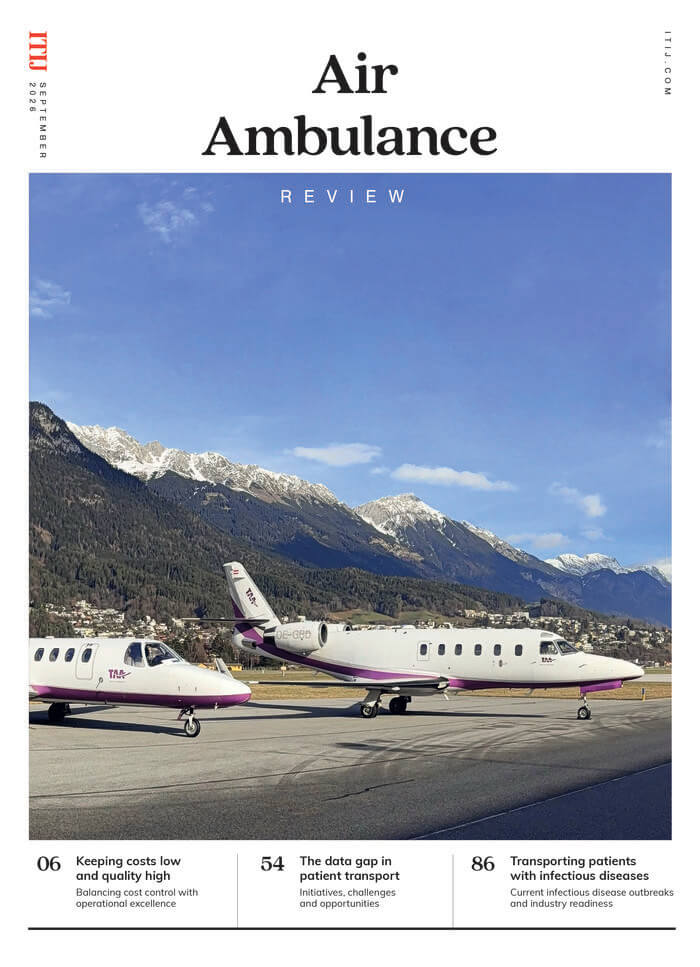
September 2026
Issue
This issue we focus on the problems that rising costs are having on the industry. Air ambulance providers are facing costs across fuel, aircraft maintenance, staffing, insurance, regulatory compliance, and specialist medical equipment. As if that wasn’t enough, delayed payments from insurers are adding further financial pressure. Despite these challenges, providers agree that patient safety and clinical quality must not be compromised.
Editorial Team
The Editorial Team updates the ITIJ website daily, and works on features for the print edition. With expert industry knowledge and years of experience in writing about complex travel insurance issues, the Editorial Team is ready to investigate and report on the topics that matter most to ITIJ's readers.