A remarkable medical transportation from Larnaca to Toronto

SmuuthCare recount a challenging mission with a very ill patient
Our operations team received a request for an air ambulance flight from Larnaca, Cyprus, to Toronto, Canada. While long-distance medical transports demand careful planning under any circumstances, this case posed unique challenges due to the patient’s rare and severe medical condition Our expert teams – from aviation to medical to logistics – collaborated to develop a comprehensive plan that would ensure patient safety and comfort throughout the mission. The patient, a young man vacationing in Cyprus with his family, had been hospitalised due to respiratory distress. He suffered from multiorgan failure and was dependent on a ventilator and beta-blocker infusion to stabilise his blood pressure. Additionally, he required dialysis due to the acute onset of pheochromocytoma with concomitant thyroid adenoma (MEN2). This rare condition, characterised by adrenal gland tumours producing excessive adrenaline, leads to dangerously high blood pressure and systemic complications. The rapid escalation of symptoms necessitated immediate and well-coordinated action.
Mission planning and preparation
Early in the process, every SmuuthCare department was brought into detailed consultations. Our flight operations team navigated regulatory requirements, aircraft limitations, possible refuelling stops, and weather patterns. Meanwhile, the medical team prepared a specialised plan for a patient who was still on high-flow oxygen and beta-blocker infusion.
The team decided to fly to Larnaca a day ahead of departure, allowing the flight crew ample rest, and the medical team conducted an on-site assessment and coordinated with the hospital staff. Both the patient’s wife and father wished to accompany him; however, considering the patient’s fragile condition, flight duration, and space constraints, it was determined that only the patient’s father, a retired nurse, could fly to provide additional assistance if needed.
Upon arrival in Larnaca, the patient had been removed from ventilation and dialysis but remained on high-flow oxygen (15L/min) and beta-blocker infusion. Several logistical challenges had to be addressed, including the flight crew’s duty hours, the need for two fuel stops, and oxygen supply limitations. Typically, the aircraft carries 14,165 L of oxygen on board, but an 18-hour flight at 15 L/min requires approximately 16,200 L. This estimate does not account for ground transport consumption, or the additional 25% reserve needed in case of schedule deviations.
Execution and challenges
Ensuring the patient’s comfort was paramount, as stress, pain, or anxiety could trigger dangerous blood pressure spikes. The medical team preferred non-invasive ventilation to avoid intubation, which is routinely performed in hospitals but significantly more challenging aboard an aircraft.
To optimise risks, the decision was made to stop in Billund, Denmark, SmuuthCare’s home base. There, the flight crew and medical team were swapped with fully rested colleagues, and oxygen tanks were refilled to ensure a sufficient supply in case of delays or diversions. Additionally, if another mission arose on the return trip, the aircraft would already be fully equipped. This plan enabled a safer continuation of the mission, with the final segment flying from Billund to Toronto via a fuel stop in Greenland.
Patient management and in-flight care
Ground ambulances were secured for both departure and arrival locations, with the patient remaining on high-flow oxygen throughout transport. To reduce in-flight movement, a urinary catheter was placed, and beta-blocker infusion was maintained for 24 hours before departure.
Before take-off from Larnaca, the lead doctor briefed the Denmark-based medical team, sharing real-time updates and coordinating additional blood pressure management medications to counteract potential discomfort from the prolonged stretcher-bound flight.
The team ensured the oxygen mask was both comfortable and well-fitted to minimise oxygen loss. The patient was periodically allowed to remove the mask for food and hydration. During the technical stop in Billund, the new medical team was introduced to the patient, fostering trust and continuity of care before the final journey to Canada.
Conclusion
Each air ambulance mission presents unique challenges, requiring a seamless integration of medical, operational, and aviation expertise. At SmuuthCare, our experienced doctors, nurses, pilots, and operations staff collaborate to minimise risks and ensure the highest standards of patient care. This case underscores the importance of meticulous planning, interdepartmental coordination, and adaptability in executing complex long-haul medical transports.
By leveraging our collective expertise, we successfully completed a demanding mission while prioritising patient safety and comfort, reaffirming SmuuthCare’s commitment to excellence in air ambulance services.
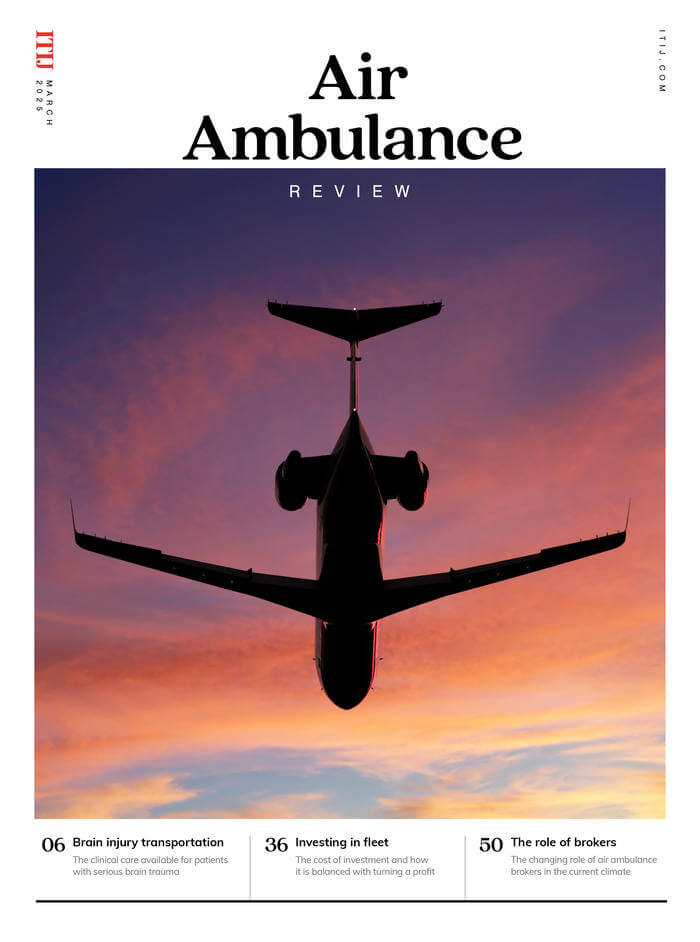
March 2025
Issue
The Air Ambulance Review includes features on clinical care for ABIs; investing in fleet; the role of brokers in the air ambulance industry; and an accreditation update.
Editorial Team
The Editorial Team updates the ITIJ website daily, and works on features for the print edition. With expert industry knowledge and years of experience in writing about complex travel insurance issues, the Editorial Team is ready to investigate and report on the topics that matter most to ITIJ's readers.