
Recovery from Mount Everest

Manfred Helldoppler of Tyrol Air Ambulance recounts efforts by his company to recover the body of a mountain climber who lost his life in the Himalayas
In 2019, a member of an expedition on Mount Everest’s Northeast Ridge tragically lost his life due to a medical emergency during the descent. At an altitude of approximately 8,600m, accompanying Sherpas placed the body in a secure location for a later recovery.
Immediate retrieval was not possible due to the altitude and hazardous conditions. The Covid-19 pandemic then halted all expeditions to Mount Everest for an extended period, further delaying recovery.
In 2024, the same expedition company organised a new Everest climb and offered to attempt the recovery during this mission. The family of the deceased notified their insurance provider, which appointed Tyrol Air Ambulance (TAA) to manage the case.
The initial phase involved obtaining cost estimates for both the recovery operation and the subsequent funeral arrangements, as well as assessing the overall feasibility of such a complex high-altitude mission. Following review, the insurance company approved the proposed budget and authorised the operation.
First attempt (2024)
The expedition team travelled to China in April for acclimatisation, with the summit push scheduled for mid-May. However, a complication arose when permits for climbing from the Tibetan (north) side were not granted. As the weather window was rapidly closing due to the coming monsoon season, the team relocated to Nepal to attempt the ascent from the southern route. The recovery from the original location on the Northeast Ridge became impossible under these changed circumstances.
Second attempt (2024)
During this time, the family heard of an Austrian expedition team that had remained in China and successfully secured climbing permits. The insurance company declined this option, citing uncertainty about whether a recovery could realistically be carried out on such short notice. Furthermore, advance payments and financial guarantees had already been issued to the Swiss expedition company.
The family therefore pursued this second option privately. This attempt also failed, as local authorities denied permission to remove the body from the mountain.
Both expedition companies expressed willingness to make another attempt in 2025. After reassessing the projected costs and consulting with both the insurance company and the family, the Austrian expedition company was officially commissioned for a renewed recovery mission. All actual expenses incurred by the Swiss company were settled, and advance payments were adjusted accordingly.
Third attempt (2025)
A new recovery operation was carefully prepared for 2025. All logistical and administrative measures were undertaken; however, final authorisation was to be granted on site at base camp by the responsible Chinese liaison officer. TAA reorganised the funeral arrangements for repatriation from Kathmandu to Austria in anticipation of a successful mission.
Upon arrival at base camp, the expedition submitted the recovery request as instructed, but unexpectedly, the Chinese authorities rejected it, citing unspecified safety concerns. Even diplomatic engagement by the Austrian Embassy did not result in approval. Consequently, the third recovery attempt was unsuccessful.
Another rescue attempt is not currently foreseeable, and the deceased climber remains on the highest mountain in the world. The insurance company has also turned down a further rescue attempt, citing the high costs and uncertainties.
Challenges of missions in high alpine regions:
• International rescue companies often assure prompt rescue without adequately addressing the external factors that can impede the operation
• Many relatives and insurance companies are unaware of the complexities and requirements involved in conducting a rescue mission in such an environment
• Rescue operations are often offered as part of expeditions organised by the same companies, which can create potential conflicts of interest
• There is no guarantee of success, despite mission costs mostly being paid upfront, regardless of outcome
• External factors can impact the success of a rescue mission, including weather, authorities imposing restrictions, climbing permits being revoked, or the body of the deceased being relocated.
Manfred Helldoppler, Managing Director of TAA, is a long-time aviation leader with extensive experience, having successfully led the company for many years. Under his guidance, TAA has significantly expanded its assistance services, establishing itself as a key regional partner in Austria.
Tyrol Air Ambulance (TAA), known as a reliable partner for international ambulance flights with its own ambulance jet fleet, is also a Core Partner of the International Assistance Group and a regional provider of travel assistance services and roadside assistance in Austria.
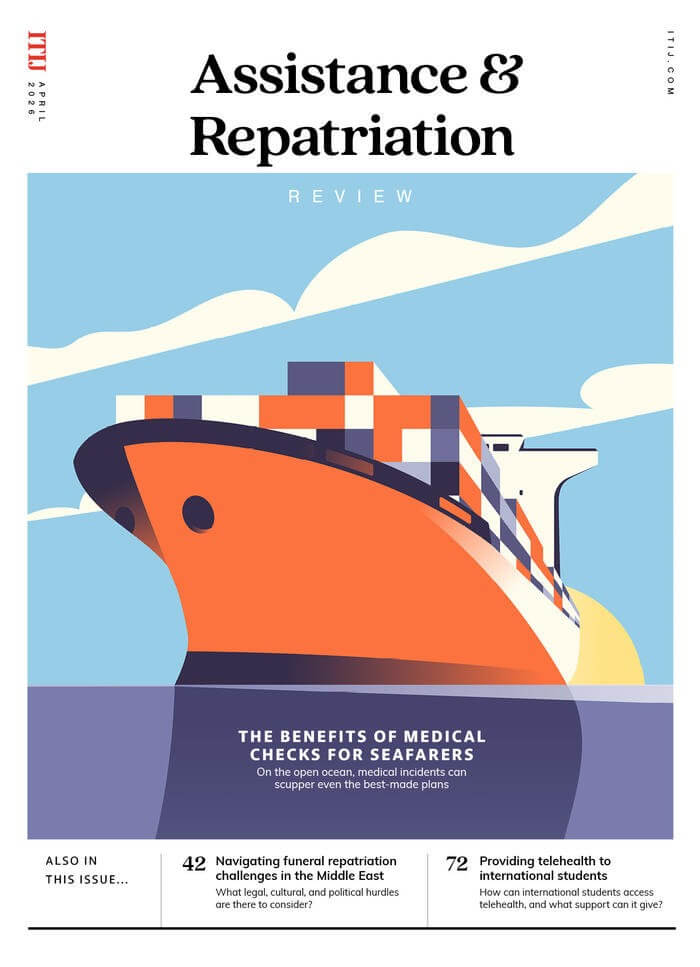
April 2026
Issue
In the first Assistance & Repatriation Review of 2026, we explore the cultural, legal, and logistical intricacies of funeral repatriation in, around, and out of the Middle East. We also consider how pre-deployment medical assessments can save lives and sea voyages. The burgeoning demand for telehealth among students is covered in our third feature, plus we look at how companies are delivering services that meet that need.
Editorial Team
The Editorial Team updates the ITIJ website daily, and works on features for the print edition. With expert industry knowledge and years of experience in writing about complex travel insurance issues, the Editorial Team is ready to investigate and report on the topics that matter most to ITIJ's readers.