Raising the bar: European Air Ambulance delivers gold standard analgesia at 37,000 feet

European Air Ambulance (EAA) continues to set benchmarks in patient care, recently showcasing advanced pain management during a long-distance medical repatriation. Dr David Sinclair talks to ITIJ
While air ambulance services are widely recognised for delivering quality care, providing hospital-level treatment in-flight remains a challenge. In the realm of pain control, however, EAA is proving that gold-standard care is achievable – even at 37,000 feet.
Regional anaesthesia: a superior approach
Clinical research consistently shows that regional anaesthesia offers superior pain relief for trauma patients compared to systemic options like intravenous or oral medications. Once limited to operating theatres, regional blocks are now used in emergency departments for procedures such as fracture management and joint reductions.
Ground and helicopter EMS services are increasingly incorporating regional anaesthesia techniques. However, their use in fixed-wing air ambulances is still rare, due to the complexity and skills required. EAA is breaking new ground by successfully implementing this advanced intervention mid-flight.
Case study: advanced in-flight analgesia
In August 2025, European Air Ambulance was tasked with repatriating a 30-year-old female trauma patient from Jamaica back to the UK. Four weeks earlier, she had sustained multiple injuries in a car accident, including an untreated displaced femoral fracture and bilateral haemopneumothoraxes (successfully drained). Her haemoglobin was 9.6 g/dL at the time of transport.
Following the ground transfer to EAA’s Bombardier Challenger 605, the medical team performed an initial assessment. The patient was alert, oriented, and reported a pain level of 5/10. The circulation and sensitivity of the affected limb were unimpaired. Only mobility was significantly reduced due to pain. After informed consent, the team planned to perform a femoral nerve block. The patient – a trauma nurse herself – had previously requested this block during her hospital stay, but was declined.
Due to security concerns at the local hospital and limited hygiene conditions in the ground ambulance, the team decided to delay the procedure until airborne. Intravenous narcotics were given for comfort during boarding the patient, and the nerve block was scheduled for post-take-off to avoid crew duty time violations.
In-flight procedure
Roughly 20 minutes after take-off, with the aircraft stable at cruising altitude, a sterile field was set up on the secondary stretcher. By then, the patient’s pain had worsened to 7/10 due to traction and repositioning.
Under full aseptic technique, the team prepped the right thigh and administered 3ml of 1% lidocaine subcutaneously. Using ultrasound and a nerve stimulator, a lateral approach was used to visualise the femoral nerve. Once motor response ceased at 0.35mA, 15ml of 0.75% ropivacaine was injected. A catheter was then placed and secured, connected to a syringe pump delivering 0.2% ropivacaine at 6ml/h.
Within 10 minutes, the patient's pain reduced to 2/10, eventually reaching 0/10. She remained pain-free for the remainder of the flight, with only minor discomfort (up to 3/10) during post-landing ground transfers.
Why use regional anaesthesia in flight?
This case underscores the value of regional anaesthesia in air ambulance care:
• Reduced opioid use: minimises sedation and respiratory depression
• Improved respiratory safety: vital in hypobaric environments, especially for patients with anaemia or lung issues
• Stable in-flight condition: effective analgesia ensured a smooth, complication free journey.
Conclusion
European Air Ambulance is redefining airborne critical care by successfully integrating regional anaesthesia into fixed-wing operations. This case proves that hospitalgrade analgesia is not only feasible in flight but also highly beneficial in selected cases.
Through innovation and clinical excellence, EAA continues to raise the standard for air medical services worldwide.
Dr David Sinclair
Consultant Anaesthetist, European Air Ambulance
Dr Sinclair is a consultant anaesthetist, continued specialisation in critical care, emergency and aviation medicine. He joined European Air Ambulance in 2002 and can look back on more than 20 years of experience in rotor wing and fixed wing missions. He has a special interest in regional anaesthesia and strives to promote this technique in the field of pre-hospital care.
November 2025
Issue
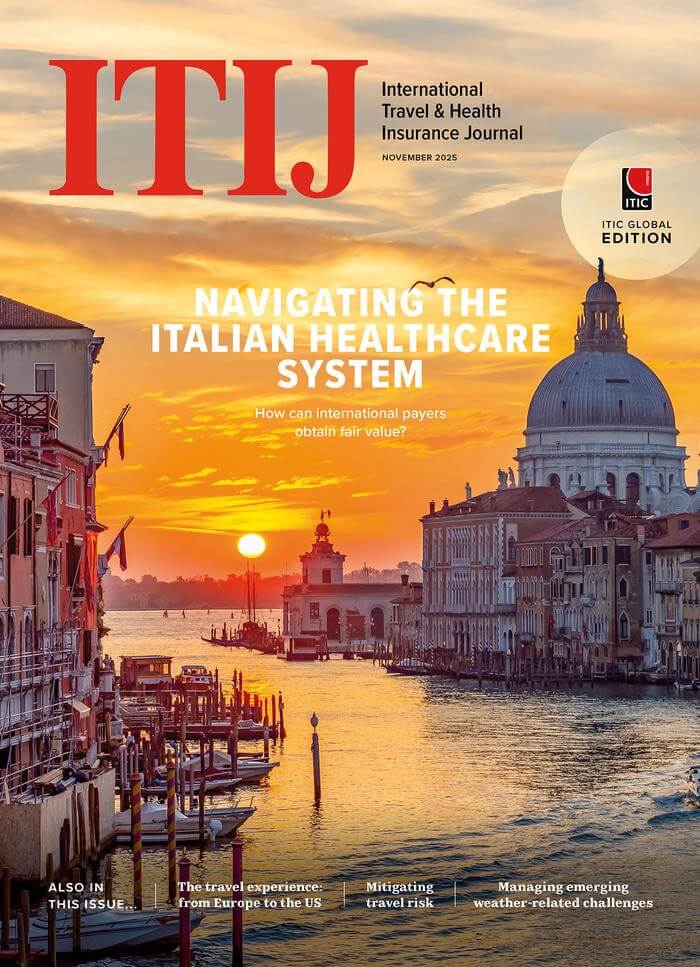
In this issue of ITIJ we look at current travel patterns to and from the US and Europe, take a close look at the Italian healthcare system, and examine how insurers are adapting policies and coverage to manage weather-related challenges.
Editorial Team
The Editorial Team updates the ITIJ website daily, and works on features for the print edition. With expert industry knowledge and years of experience in writing about complex travel insurance issues, the Editorial Team is ready to investigate and report on the topics that matter most to ITIJ's readers.