
A race against time: saving a baby’s life across borders

Airlec Ambulance shares a report on a mission that involved a sea-level flight from Tunisia to France for a critically ill baby
We were contacted by an assistance company with an urgent request: a 12-month-old French infant in Tunisia was fighting for his life. Just two months earlier, he had been hospitalised with severe Covid-19 pneumonia. Now, after another infection, his condition had rapidly worsened.
Baby’s condition deteriorating fast
The baby had been admitted to a local hospital with a cough and breathing difficulties. Within days, he needed high levels of oxygen. Despite intensive care, his oxygen levels kept falling. By the time our paediatric intensive care team arrived, he was critically ill: struggling to breathe, turning blue, and with dangerous air trapped under his skin from his head to his legs. Two intravenous lines had already failed, and time was running out.
Our operations team and the assistance company coordinated a special sealevel flight to Marseille, home to the nearest paediatric ECMO centre, and arranged for a specialised ambulance with inhaled nitric oxide to help his oxygen levels upon arrival
Together with his parents, we decided to take all possible lifesaving measures before the transport took place. We placed an emergency bone-access line, intubated him, and connected him to a ventilator. Meanwhile, our operations team and the assistance company coordinated a special sea-level flight to Marseille, home to the nearest paediatric ECMO centre, and arranged for a specialised ambulance with inhaled nitric oxide to help his oxygen levels upon arrival.
Transport from Tunisia to France
After takeoff, his oxygen levels slowly stabilised. On the ground in France, with additional support, they finally reached safer levels. He was admitted directly to the paediatric intensive care unit, where he remained critically ill for two days.
Against all odds, the baby began to recover without needing ECMO. Twentyfive days later, he was breathing on his own, and a month after his arrival in France, he was strong enough to be transferred to his hometown hospital in Paris.
This case was a powerful reminder that saving a life sometimes means mobilising not just medical skills, but teamwork, speed, and seamless coordination across countries.
Daniela Wilson, Director of Aviation, Airlec Ambulance, is a seasoned professional with extensive experience in the fields of aviation assistance and ground ambulances. Over the years, she has risen through the ranks, starting as an assistance worker and advancing to her current role as Director of Aviation at Airlec, thanks to her unwavering dedication, passion, and exceptional skill set.
September 2025
Issue
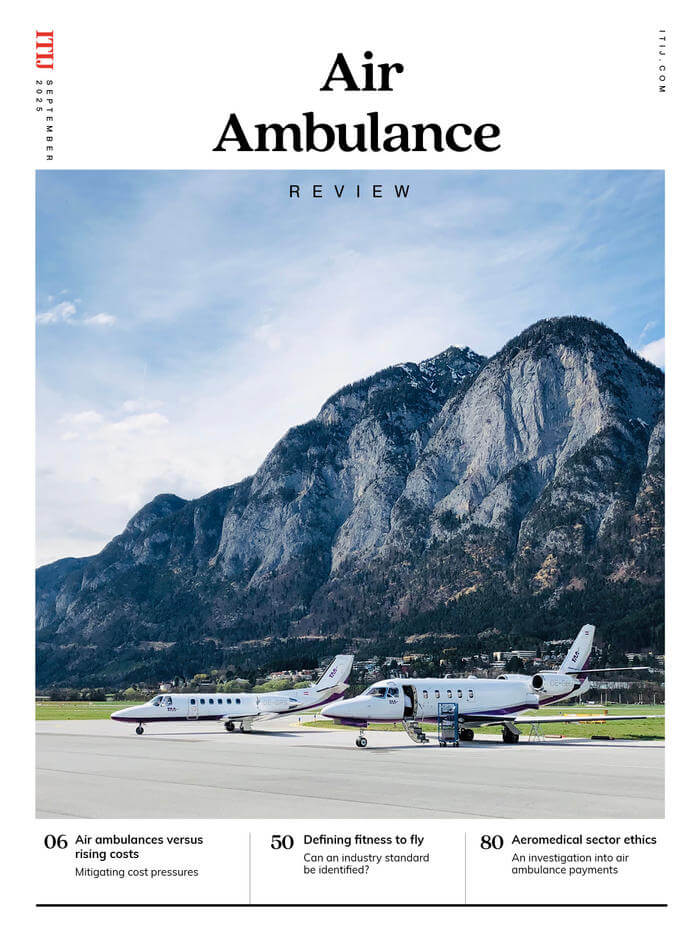
We include an examination on defining ‘fitness to fly’, and ask if an industry standard can be identified, and what that would involve. We also look at capacity in the aeromedical market and experts share their insights. Ethics and transparency in the aeromedical sector is a big issue, and we include an investigation into air ambulance payments.
Editorial Team
The Editorial Team updates the ITIJ website daily, and works on features for the print edition. With expert industry knowledge and years of experience in writing about complex travel insurance issues, the Editorial Team is ready to investigate and report on the topics that matter most to ITIJ's readers.