A purpose-built cabin

Louis-Philippe Loiselle Fortier, Vice-President of Strategic Initiatives and Business Development at Airmedic, talks to ITIJ about their new medical cabin, and the benefits it brings
What motivated Airmedic’s decision to invest in a new medical cabin, and how does it support your long-term vision?
This investment comes from a mindset of continuous improvement shaped by real experience and ongoing discussions with our clinical teams, flight crews, and clients. By reviewing how missions actually unfold and understanding what matters most to the people using the cabin, we developed a purposeconfigured medical cabin tailored to our operational requirements.
Rather than adopting a standard layout, the configuration was developed internally in close collaboration with certified engineering partners and guided by input from the teams and clients who rely on it. Each element was deliberately positioned to support efficient clinical care, anticipate potential in-flight emergencies, and help crews act quickly and safely.
Why was it important to go beyond the previous configuration, and what problems were you aiming to solve?
While the previous setup was functional, it was not designed as a fully dedicated air ambulance cabin. We chose to move beyond that by investing nearly one million Canadian dollars in a permanent medical configuration, reinforcing this aircraft’s long-term clinical role within our fleet.
Engineered with certified specialists and approved by Transport Canada and the US Federal Aviation Administration (FAA) through a supplemental type certificate, the project allowed us to redesign the cabin around real operational requirements. Every characteristic, from equipment placement to the medical team clearance around the patient, was evaluated to create a structured clinical layout aligned with the realities of in-flight care.
These design choices go beyond a traditional retrofit. They reflect a deliberate effort to engineer a cabin around clinical access, workflow continuity, and medical efficiency, ultimately supporting safer care.
The project allowed us to redesign the cabin around real operational requirements
What changes will crews and patients actually feel during a mission?
Crews will notice a more intuitive and controlled clinical workspace. Equipment is mounted on tracks using custom attachment systems that keep critical devices secure, visible, and immediately accessible while preserving a clear care zone around the patient. This improves access and allows teams to intervene efficiently during time-sensitive situations.
For patients, this translates into safer handling and greater comfort throughout the transport. The privacy curtain supports dignity, while the optimised layout and expanded clearance through the baggage pit enable crews to load and manage stretcher patients with better control, including bariatric and incubator cases.
Together, these design choices support a calmer, more controlled care environment.
What are the key upgrades you’re most proud of, and why do they matter operationally?
We are particularly proud of the upgrades that strengthen clinical reliability and support crews in delivering uninterrupted care. The addition of a SKYTRAC satcom enables hands-free communication, allowing teams to consult a physician while continuing patient care, a critical advantage during complex transports.
The aircraft was also configured with utility flooring and stainless medical walls to support thorough cleaning and efficient decontamination. This helps reduce operational risk, protects patients and crews, and prepares the aircraft for its next mission without unnecessary delay.
A custom full-depth cabinet keeps essential equipment organised, visible, and immediately accessible, enabling faster response times when timing is critical.
When you say “investment”, what does that mean in concrete terms, and what does it reveal about Airmedic’s priorities?
In concrete terms, this investment required significant engineering time, specialised expertise, and capital to permanently configure the aircraft for medical operations. It reflects a deliberate long-term decision to dedicate the aircraft exclusively to patient transport and speaks directly to our priorities: operational readiness, clinical reliability, and supporting our crews with an environment built for the realities of care in-flight.
A second Learjet is already scheduled to receive a similar medical configuration in the months ahead, representing a total of CA$2 million. Expanding the fleet strengthens our ability to support patients and crews with a dependable clinical environment and reinforces our commitment to the partners and clients who entrust us with their transport.
About Airmedic
Airmedic, based in Montreal, Canada, provides trusted air ambulance services and medical escorts worldwide. With a fleet of eight aircraft, including two Bombardier Learjet 45XRs and six Pilatus PC-12s, we ensure rapid medical evacuations, neonatal care, seamless coordination, and global repatriation with expert critical care and ground transport solutions.
Louis-Philippe Loiselle Fortier
Vice-President of Strategic Initiatives and Business Development, Airmedic
Louis-Philippe (LP) has more than 15 years’ experience in the critical care medical field and has been with Airmedic for more than 11 years. As Vice-President of Strategic Initiatives and Business Development, he plays a pivotal role in driving the company’s growth, bringing strategic vision, strong leadership, and a patient-centred approach.
March 2026
Issue
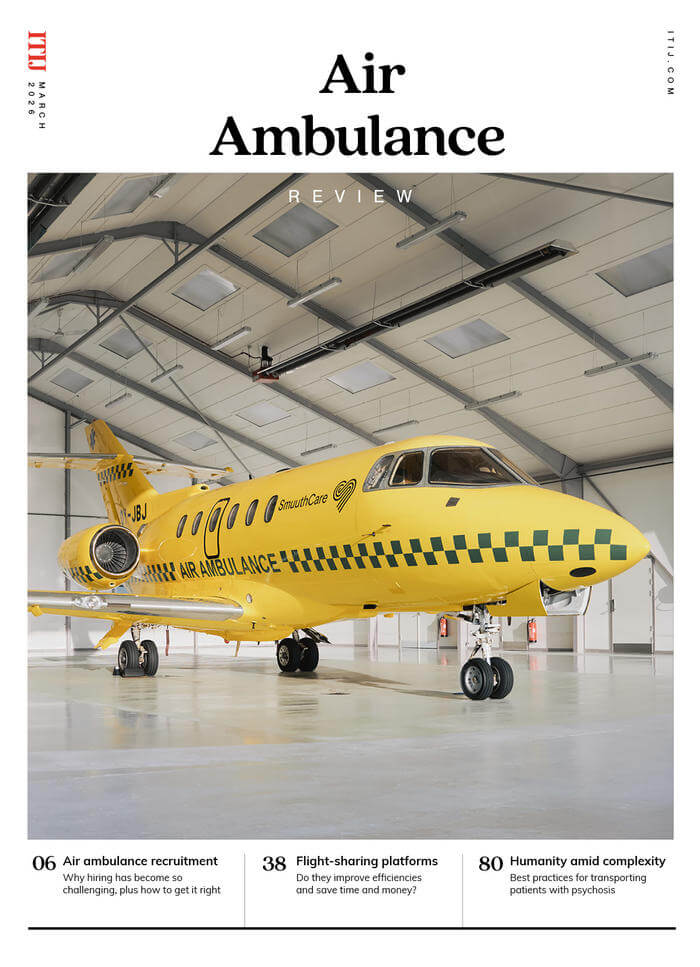
In this issue of Air Ambulance Review we examine the challenges facing air ambulance providers when it comes to recruitment; look at flight-sharing platforms and ask if they can improve efficiencies; and we delve into the latest medications, protocols and best practices for transferring vulnerable patients with psychosis.
Editorial Team
The Editorial Team updates the ITIJ website daily, and works on features for the print edition. With expert industry knowledge and years of experience in writing about complex travel insurance issues, the Editorial Team is ready to investigate and report on the topics that matter most to ITIJ's readers.