Providing time-critical emergency airlifts in Zimbabwe

The introduction of a subscription service is bringing emergency air medical services to more people in a country lacking ground transport infrastructure
Zimbabwe faces challenges in providing pre-hospital care and emergency transport. The country is three times the size of England at 390,760km2. With an estimated 3,600km of the tarred road network being in reasonable condition, it does not compare with the 422,100km of well-maintained English roads.
The only solution to the problem of providing effective pre-hospital care in these remote areas is through the use of air ambulances
Zimbabwe has no national ambulance service. Hospital facilities are based in the two largest cities, and outside these cities there are no hospitals providing comprehensive emergency care. The rural areas rely on private ambulances coming from these cities, which are far from the main safari areas. These are – unsurprisingly – located in remote uninhabited areas where the wildlife thrives. It may take many hours to reach safari camps by road. The only solution to the problem of providing effective pre-hospital care in these remote areas is through the use of air ambulances, as most safari camps have air strips or are accessible by helicopter.
Time-sensitive approval
Another challenge in time-critical medical emergencies is obtaining immediate approval to activate from travel insurance companies – issues that do not normally arise in countries with a national ambulance service. To address this, HAC Medical introduced a prehospital medical evacuation package. Subscribers can expect an immediate response in the event of a medical emergency, avoiding any delay. By pressing the emergency button on the HAC app, our call centre is immediately alerted to who the subscriber is and their exact location.
A case in point
One of our subscribers, a male in his 50s, was fishing on the lower Zambezi River, eight hours’ drive by 4x4 from Harare. He reported experiencing sudden onset of “terrible chest pain radiating to his back and jaw”. He was a non-smoker with no relevant previous medical history. Before dispatching our HEMS team, including a doctor and ITU nurse, we obtained tenecteplase from the receiving hospital. This is a thrombolytic and its administration is time critical. After a flight of one hour, the team was with the patient within 90 minutes of receiving the call.
The findings were a blood pressure 156/94, pulse 88SR, oxygen saturation of 95% and a pain score of 8/10. A 12- lead ECG confirmed an anterior infarct. Our team followed our pre-hospital thrombolytic check list, which requires the medical director’s confirmation of the ECG changes, before tenecteplase, aspirin, clopidogrel, heparin, GTN and morphine were administered. There was an immediate reduction in pain score to 2/10 and a small reduction in the ST elevation seen on the ECG. The patient’s condition remained stable throughout the return flight. The following day after authorisation from his medical insurers, we airlifted him by fixed-wing air ambulance to South Africa for coronary angiography.
In a second case a male, “off-road” motorcyclist contacted us reporting right-sided chest pain and shortness of breath following an accident. He initially requested a road ambulance be sent. His location was 2.5 hours northeast of Harare. In view of his symptoms, it was decided that the use of a helicopter was necessary. Our team was with the patient within 40 minutes and identified a tension pneumothorax.
By pressing the emergency button on the HAC app, our call centre is immediately alerted to who the subscriber is and their exact location
After inserting the chest drain and stabilising him, it took us just 30 minutes to have him at a hospital in Harare.
These are two examples of timecritical illnesses where any delay would have had the potential of jeopardising the outcome. Complications arising from delays are known to result in longer hospital stays, poorer recovery for the patient and worse long-term outcomes. Speed is of the essence, and HAC Medical provides high-quality care at the fastest-possible pace.
For the last 10 years Charles Crawshaw has worked for Halsted Aviation Corporation, initially as Medical Director and more recently as Medical Consultant. Raised in Zimbabwe, he undertook his medical training in the UK, where he spent 40-plus years as a trauma and orthopaedic surgeon before returning to Zimbabwe.
HAC Medical provides professional air and ground medical evacuations across Southern Africa. Our EURAMI-certified King Air fleet meets international medical standards and operates in remote areas, including short and unpaved runways. We offer rapid, expert emergency response unmatched in the region.
September 2025
Issue
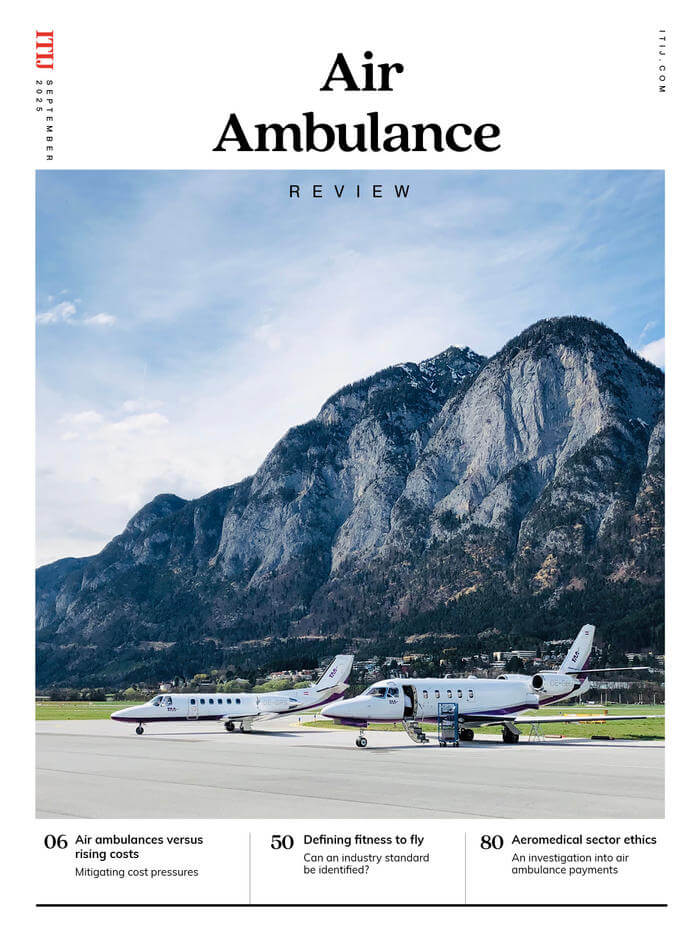
We include an examination on defining ‘fitness to fly’, and ask if an industry standard can be identified, and what that would involve. We also look at capacity in the aeromedical market and experts share their insights. Ethics and transparency in the aeromedical sector is a big issue, and we include an investigation into air ambulance payments.
Editorial Team
The Editorial Team updates the ITIJ website daily, and works on features for the print edition. With expert industry knowledge and years of experience in writing about complex travel insurance issues, the Editorial Team is ready to investigate and report on the topics that matter most to ITIJ's readers.