Precision assistance for a tourism related accident

Logimedex describes how they handled a case involving a car accident in southwestern Mexico which left one person dead and another critically injured
Accidents in tourist settings present a high degree of complexity, where timing, accuracy, and coordination among multiple parties is critical. The challenge goes beyond providing clinical care – it also involves managing medical and logistical processes under conditions of uncertainty, often compounded by cultural, language, and operational barriers.
This case illustrates how a structured response – built on clear protocols, effective communication, and empathetic assistance – can transform a crisis into an orderly, reliable process focused on safeguarding the patient’s wellbeing, while fostering cooperation among all stakeholders.
The accident and initial response
Earlier this year, we were activated for a case involving a car accident in southwestern Mexico. Two individuals were critically injured and admitted to a public hospital as unknown persons without official identification, as their initial care had been provided by local emergency services.
Communication with the public hospital proved challenging, as their protocols prohibit sharing patient information with third parties
Once notified, the insurer requested our intervention. Communication with the public hospital proved challenging, as their protocols prohibit sharing patient information with third parties or accepting letters of guarantee. Our immediate action was to deploy one of our physicians on-site to obtain direct information and assess the situation.
Our physician confirmed that one patient had sustained multiple traumas, fractures, and a severe splenic injury, requiring admission to the intensive care unit. Tragically, the second individual had passed away, and their remains had been transferred to the local forensic service.
Identification and initial management
With no documents and no close relatives in Mexico, we were tasked with locating and identifying the deceased individual, while simultaneously arranging the transfer of the critical patient to a hospital with greater treatment capabilities.
Through coordination with the insurer, the family, and the foreign embassy, we obtained official identification, preventing the deceased from being classified as unknown and buried in a common grave. It was later confirmed that the deceased had separate insurance coverage, concluding our involvement in that matter and allowing us to focus entirely on safeguarding the life of the surviving patient.
The administrative challenge
In the public hospital, every hour counted. Discharge authorisation required an in person, cash payment. After exhausting all available payment options – wire transfers, credit card payments, and thirdparty deposits – and through persistent, on-site efforts by our physician, the hospital ultimately accepted our payment terms, enabling the insured’s discharge.
Transfer and specialised care
With the discharge approved, the transfer was swiftly carried out through the coordination of a specialised ambulance. Accompanied by our physician, the insured was taken to a private tertiary care hospital. The initial diagnosis confirmed the severity: polytrauma, bilateral pleural effusion, and multiple fractures. Comprehensive care was initiated, including laparotomy, blood transfusions, thoracoscopy, and pulmonary physiotherapy, among other procedures.
The initial diagnosis confirmed the severity: polytrauma, bilateral pleural effusion, and multiple fractures
After a delicate and closely monitored period, the patient was moved to a regular hospital ward, showing stable vital signs and steady improvement. Ultimately, their continued recovery allowed the primary insurer to arrange repatriation to their home country to complete treatment in a familiar environment.
Conclusion
This case confirms that effective care relies not only on clinical expertise but also on the combination of a global vision with seamless local operations. It requires an integrated approach in which both medical assistance and administrative management are most effective when supported by in-depth knowledge of local geography, government regulations, and sociocultural factors that shape critical routes and timelines.
Support in these scenarios demands clear protocols, effective communication, and empathetic assistance – along with the ability to understand, adapt to, and address on-the-ground realities to safeguard the patient, build trust among stakeholders, and provide clarity even in the most challenging circumstances.
Logimedex provides access to quality medical care in Mexico and Latin America. We eliminate unnecessary costs and delays through a certified network of providers and an integrated model that ensures prehospital, hospital, and post-hospital care with the highest standards of quality, transparency, and trust, delivering effective solutions for insurers and businesses.
October 2025
Issue
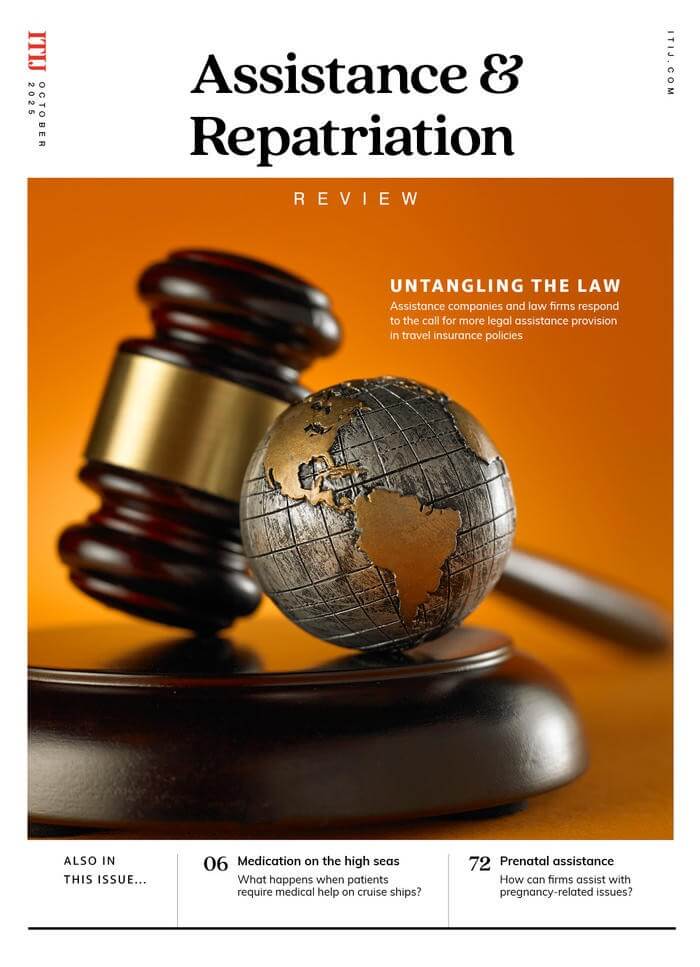
In this latest Assistance & Repatriation Review we explore how legal networks and insurers can help travellers who fall foul of the law while abroad. We look into the intricacies surrounding how medical transfers can be provided to pre-natal and neonatal patients, and examine the provision of medical care to patients who become ill on cruise ships.
Editorial Team
The Editorial Team updates the ITIJ website daily, and works on features for the print edition. With expert industry knowledge and years of experience in writing about complex travel insurance issues, the Editorial Team is ready to investigate and report on the topics that matter most to ITIJ's readers.