
The power of customisation: IPMI in the MEA region

In the third of our series on IPMI worldwide, experts discuss the state of play of IPMI in the MEA region, explaining the need to balance navigating regulations, harnessing innovation and delivering on the needs of varied customer profiles. By Lauren Haigh
In the Middle East and Africa (MEA) region, healthcare costs are rising, regulatory frameworks are evolving, and the number of remote workers and expatriates is growing. According to estimates, the health insurance market in the Middle East and North Africa (MENA) will grow at a compound annual growth rate (CAGR) of 6.78%, reaching US$25.64 billion by 2030. In the Gulf Cooperation Council (GCC) countries, healthcare expenditure is predicted to reach $135.5 billion by 2027. Disparities in healthcare across the region are pushing forward a preference for private care.
For example, in the United Arab Emirates (UAE), digital health is thriving and the country was ranked 19th in the 2022 World Index of Healthcare Innovation. However, in stark contrast to this, there are countries where healthcare supplies are dwindling, and the situation is worse still for countries in conflict, where hospitals have been destroyed and health systems are barely functioning.
The MEA region presents diverse healthcare landscapes, from world-class facilities in the UAE and Saudi Arabia to underserved rural areas in Sub-Saharan Africa
“The MEA region presents diverse healthcare landscapes, from world-class facilities in the UAE and Saudi Arabia to underserved rural areas in Sub-Saharan Africa,” stated Eugenia Guskova, Head of Network at AP Companies Global Solutions. Demand for private healthcare is driven largely by expatriates and wealthy locals, and effective international private medical insurance (IPMI) is essential to meet the needs of the employees of multinational companies.
Meeting demand
ITIJ asked Amber Musson-Thorp, Group Commercial Director – MEA at Lifecare International, about the specific benefits and coverage options that are most in demand among expatriates and corporate clients in the Middle East. “We are definitely seeing demand for strong maternity benefits, and access to support for IVF is also common. Wellness, and a desired annual check-up, is more common than I’ve seen in Europe. Vitamin deficiencies can be common here, particularly vitamin D, ironically enough – so we see that these benefits are being tailored by IPMI providers to fall in line with local demands,” she stated.
Guskova shed light on contrasting demands: “In the GCC, high-net-worth individuals expect VIP medical services and access to internationally accredited hospitals, while in African markets, affordability and emergency evacuation capabilities are priorities. We’ve also seen a growing demand for digital healthcare solutions, and the rising prevalence of lifestyle diseases, such as diabetes and hypertension, in the MEA region has also driven demand for chronic disease management programmes.”
Indeed, according to 2019 research, the MENA region had the highest global prevalence of diabetes, necessitating a robust approach to managing this disease.
Customisation is crucial
To meet such a diverse array of needs, customisation is key to ensuring customers receive appropriate healthcare coverage in line with their specific circumstances and are, ultimately, satisfied. This also helps ensure that policies are compliant with local regulations and reflect the healthcare standards and expectations in different countries.
Guskova commented that she has spotted a trend towards this. “We have noticed that bringing a tailored approach to IPMI policies is essential. The benefits and limits must be customised to suit the unique needs of expatriates, high-net-worth individuals and remote workers in this region,” she explained. “Telemedicine services have become critical in regions where healthcare infrastructure is limited or distant.”
She said that AP Companies’ on-the-ground presence in key MEA countries facilitates the provision of localised services: “Our localised approach includes aligning healthcare solutions with local customs, such as gender-sensitive medical services in conservative societies. This enables us to offer localised solutions tailored to regional healthcare standards and regulatory frameworks.”
Musson-Thorp reported that customising IPMI policies is becoming increasingly difficult across the Middle East in particular. “The largest brands have become rigid in their decision-making and there is a lack of desire to tailor policies in the IPMI space (bar one or two),” she said. “We see that tier two offshore insurers and managing general agents (MGAs) are more agile and more interested in finding a solution to cover all company designations, but this is effectively non-admitted business. In some locations that’s okay, but [it] will not work in others.”
For the worker population, Musson-Thorp asserted, it is very location dependent. “Worker populations that are based offshore and in remote locations are easily insured, but the network is the key here and, in some places like Algeria, getting to the closest hospital can take many hours by road, and some form of evacuation will need to be readily available,” she outlined. “In Qatar, HMC (Hamad Medical Corporation) is available and the worker population will not be insured at all; they will usually have a $25-a-year health card which serves as access to the state healthcare system, whereas in the UAE and Kingdom of Saudi Arabia (KSA), they will be required to have an insurance policy, and for low-salary-level workers, the average premium is around 600–1,000 dirham ($160–$270). This is why IPMI players don’t want to compete in this space.”
Indeed, for IPMI providers who offer comprehensive, high-end plans for expatriates and high-income individuals, the low-cost mandatory segment in the UAE and KSA is not profitable for them.
Navigating region-specific challenges
For insurers providing international health coverage in MEA, there are challenges to circumvent, such as navigating local regulations and healthcare infrastructure.
William Cooper, Marketing Director at William Russell, spoke with ITIJ about this: “Across most of the MEA, we offer our standard offshore IPMI product. Obviously, the UAE is different and is quite prescriptive on the benefits a product must include. Therein lies the biggest challenge. One of the main issues is the prohibition on excluding pre-existing medical conditions, which turns the concept of insurance (i.e. managing risk) on its head,” he stated.
In African markets, affordability and emergency evacuation capabilities are priorities
“Unlike our offshore product, our telemedicine and virtual medical services are central to our product in the UAE. However, much like other insurance providers are experiencing, the demand for such services by brokers is not matched by utilisation by our members. Also key to customer experience in MEA is the use of third-party administrators, who – through their networks of hospitals and clinics – manage the members’ experience of private healthcare. As with the pre-existing medical condition requirements, outsourcing such an important part of the insurance experience to a third party is contrary to the William Russell ethos. But it is necessary in many countries in MEA,” he said.
Guskova also highlighted the challenges faced by insurance providers. “Hurdles include regulatory complexity, varying healthcare standards and provider availability. MEA countries each have distinct regulatory frameworks, with stringent licensing requirements in the GCC, evolving insurance mandates in Egypt and Nigeria, and fragmented healthcare systems in Sub-Saharan Africa. AP Companies mitigates these challenges by leveraging its deep expertise in local compliance, ensuring seamless navigation of MEA’s diverse regulatory environments, licensing requirements, and mandatory insurance frameworks.”
Guskova said that these difficulties can be overcome through the use of advanced cost control measures and fraud prevention strategies. “AP Companies implements automated systems that prevent overbilling and fraud, enhancing financial sustainability,” she highlighted. “Additionally, by continuously expanding its provider network and forming strategic partnerships with accredited hospitals and clinics, AP Companies guarantees access to high-quality, cost-effective medical care for policyholders across the region. We also ensure compliance with region-specific requirements, such as Saudi Arabia’s CCHI regulations and the DHA’s mandatory insurance policies in Dubai.”
Musson-Thorp said that although the MEA region is an ever-changing landscape when it comes to regulation, the biggest challenges now are centred around sustainability, cost management and managing fraud waste and abuse.
“In markets like the UAE, where the regulation has been around for some time, we are beginning to see regulatory measures being introduced to protect the industry. But in other territories such as Oman and Qatar, where the insurance concept is still not fully understood, the biggest challenge is the market competition, which is driving underfunding and tightening of the guidelines for approvals,” she said. “Even data isn’t regulated, which also causes issues with sustainable pricing – and the cost of treatment in the Middle East is high anyway due to many factors, including the standard of the facilities, overtreatment of patients and the pure availability of the healthcare itself.”

Enhancing accessibility
Telemedicine is critical for allowing people in remote areas to access medical care, and the integration of these services into IPMI has been crucial to enhancing accessibility. The use of telemedicine in the MEA region is rising, with the telehealth market projected to exceed $22.2 billion by 2030.
The benefits and limits must be customised to suit the unique needs of expatriates, high-net-worth individuals and remote workers
“Virtual consultations are particularly impactful in countries with underdeveloped healthcare infrastructure, such as Sudan and Somalia, where telemedicine bridges the gap between patients and specialists,” highlighted Guskova. Indeed, research from 2023 found that digital health solutions have the potential to help address health needs in fragile and conflict-affected areas in the MENA region.
Musson-Thorp said that telehealth is recognised in the UAE but is still a fairly new concept in some countries, such as Qatar. “However, I know that governments will be utilising telehealth and other innovative healthtech available to improve population health management across the entire region. Digital transformation is one of the biggest focus areas,” she underlined.
Flexible and customised IPMI policies are key to meeting the needs of the MEA region’s diverse demographic. Healthcare provision and customer satisfaction can be elevated with the use of telemedicine and, to ensure ongoing success, IPMI providers and third-party administrators (TPAs) must continue to provide access to customised, efficient and accessible healthcare solutions.
May 2025
Issue
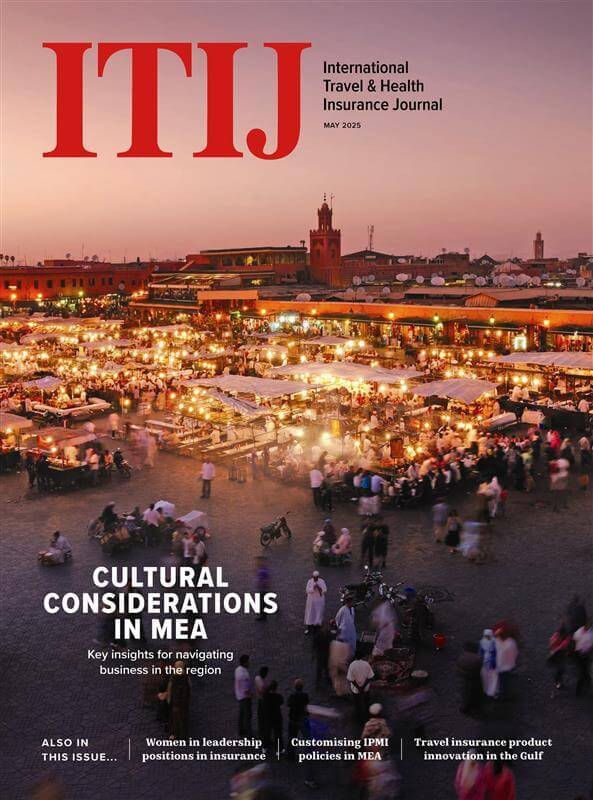
In this issue of ITIJ we consider cultural considerations and understanding in the Middle East and Africa; look at IPMI in the MEA region and the customisation of policies; and gain insights from woman in leadership positions who share the obstacles and opportunities they have encountered.
Lauren Haigh
Lauren Haigh is a freelance writer for ITIJ.