A personalised approach

Louis-Philippe Loiselle Fortier, Vice-President of Strategic Initiatives and Business Development at Airmedic, talks to ITIJ about their tailored services
Airmedic is widely recognised for its personalised approach to medical transport. How has your experience shaped the way you deliver tailored services today?
Over the past decade, Airmedic has earned its reputation by operating in some of the most demanding environments. That experience has been instrumental in shaping how we deliver personalised care. Whether routine or critical, each mission has helped refine our approach and ensure that every client receives a solution tailored to their unique needs.
A key example came in 2018, when we supported the G7 Summit in Charlevoix, Québec, by deploying two dedicated medical helicopters and specialised teams. This event required exceptional planning, coordination, and adaptability – capabilities that are now embedded in our day-to-day operations.
Beyond summits, we’re regularly mobilised for provincial emergency responses, such as wildfires and floods. These high-pressure scenarios have strengthened our agility and responsiveness while upholding the highest standards of care.
We also play a key role in large-scale public events like the Canadian Formula 1 Grand Prix, where we deploy two helicopters and a 10-person team. Our operations are closely aligned with event organisers, FIA regulations, and established safety protocols to ensure seamless medical coverage. Our clients, ranging from government agencies and corporate partners to international patients, bring diverse and complex requirements. This operational versatility is at the heart of Airmedic’s personalised approach to medical transport.
As you mentioned, Airmedic has provided air medical transport for the Canadian Formula 1 for the past six years. How do you adapt your operations for such large-scale events?
Supporting the Canadian Formula 1 Grand Prix demands precision, speed, and flawless coordination. Our preparation begins months in advance, involving close collaboration with race organisers, hospitals, and emergency services to align on logistics and medical protocols.
Every detail, from aircraft configuration to crew assignments, is tailored to meet the unique risks of the event, including trauma, medical emergencies, and high-impact injuries. Joint simulations and pre-event briefings ensure full integration with all stakeholders.
During the event, two dedicated medical helicopters and a 10-person team are stationed on-site, ready to respond within minutes. All operations are choreographed to meet strict timing and security requirements. Our adaptability, deep planning, and commitment to clinical excellence allow us to deliver high-level care in a fast-paced, high-profile setting.
The logistics behind personalised air medical services are often extremely complex and vary case by case. How does Airmedic manage these challenges while maintaining consistency in care and coordination?
Airmedic meets the complexity of personalised air medical services with a blend of agility, expertise, and structured coordination. Every mission presents its own challenges, ranging from medical urgency, location and geography to weather and timing, and we manage these through a multidisciplinary team that works in real time.
Flight planners, medical staff, pilots, and logistics coordinators collaborate to tailor every detail. Whether responding to wildfires, repatriation, or major public events, we customise our approach to each scenario.
Standardised communication protocols and thorough pre-mission planning ensure consistency and safety, even when conditions change unexpectedly. Our 24/7 in-house dispatch centre and diverse fleet give us the flexibility to pivot quickly. At every step, we’re focused on delivering seamless, high-quality care – regardless of the mission’s complexity.
How does Airmedic’s commitment to personalised service translate to other areas like international patient repatriation?
Our approach reflects the same principles that guide our domestic operations: precision, adaptability, and patient-centered care. These missions often involve navigating time-sensitive medical conditions, complex logistics, and crossborder regulations.
Drawing on our extensive experience in critical operations, we take a proactive, solutionsfocused approach. We coordinate directly with international providers, embassies, and insurers to manage everything from medical clearances to customs procedures. Each repatriation is fully customised: aircraft configuration, medical crew, and in-flight support are adapted to the patient’s condition and requirements. Strong communication is key – we build trusted relationships with our clients and tailor our processes to their expectations. With a growing fleet, seasoned teams, and a commitment to innovation, Airmedic is poised to meet the industry’s shifting demands while staying true to its core mission: delivering personalised, highquality medical transport without compromise.
Louis-Philippe Loiselle Fortier
Vice-President of Strategic Initiatives and Business Development, Airmedic
Louis-Philippe (LP) has more than 15 years’ experience in the critical care medical field and has been with Airmedic for more than 11 years. As Vice-President of Strategic Initiatives and Business Development, he plays a pivotal role in driving the company’s growth, bringing strategic vision, strong leadership, and a patient-centered approach.
June 2025
Issue
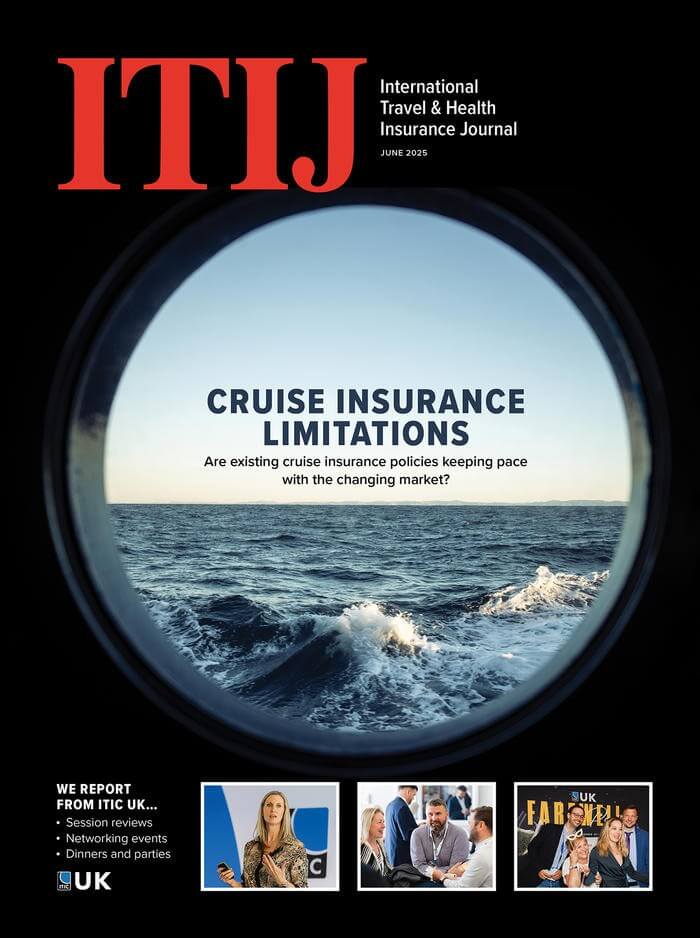
In this issue of ITIJ we examine the repatriation of mortal remains, and look at the trends, challenges and local expertise required. We also consider cruise insurance limits and exclusions and ask whether the latest cruise insurance policies are keeping up with what the travel market is offering.
Editorial Team
The Editorial Team updates the ITIJ website daily, and works on features for the print edition. With expert industry knowledge and years of experience in writing about complex travel insurance issues, the Editorial Team is ready to investigate and report on the topics that matter most to ITIJ's readers.