Optimising healthcare costs in East Africa

Jane Munyua explains how AMREF Flying Doctors helps patients, assistance providers, and insurance firms navigate healthcare costs in Africa
East Africa’s healthcare systems face numerous challenges, including a high burden of infectious diseases such as malaria, HIV/AIDS, and tuberculosis, as well as trauma resulting from accidents and regional conflicts. These challenges are further compounded by inadequate infrastructure, limited access to healthcare particularly in rural areas, shortages of medical professionals, and disparities in the quality of care.
Despite these constraints, the region is experiencing a positive shift toward more accessible and higher-quality healthcare. Increased investment in the sector has led to advancements such as digital health innovations, including telemedicine, hospital upgrades to teaching and referral status, and a growing role for private healthcare providers in expanding access to services.
However, this growth has also contributed to a sharp rise in healthcare costs, exacerbated by geopolitical and economic pressures. As a result, demand for cost-effective, high-quality medical solutions continues to increase. Managing healthcare expenditure while ensuring optimal patient outcomes remains an evolving challenge across the region.
AMREF Flying Doctors: a leader in medical assistance solutions
As a trusted partner to hundreds of international medical assistance companies and travel insurance providers, AMREF Flying Doctors (AFD) coordinates medical assistance cases across Kenya and the broader East African region.
This service is built on nearly 70 years of operational experience in Africa, delivering medical solutions in often challenging environments.
AFD is Africa’s largest fixed-wing air ambulance provider and is currently in its 19th year of accreditation with the European Aero-Medical Institute (EURAMI). This accreditation covers both Fixed Wing Air Ambulance (FW) and Commercial Airline Medical Escort (CAME) operations, with specialised endorsements including:
• Critical care transport
• Paediatric critical care transport
• High-consequence infectious diseases (HCIDs) transport.
Comprehensive assistance solutions for international clients
AFD’s assistance services primarily support leisure and business travellers, expatriates, and insured individuals requiring medical care while in Africa. Our assistance network extends beyond East Africa, enabling coordinated support for international clients across the continent.
Key services include:
• Hospital admissions and placement of guarantees of payment (GOPs)
• Follow-up and monitoring of medical reports
• Flight ticket arrangements and ground transfers
• House calls and bedside assessments for fit-to-fly evaluations
• Medication dispatch and home care assistance
• Medical escorts for patient transfers
• Cost control and medical bill verification
• Repatriation of mortal remains and funeral arrangements
• Fraud investigation
• Legal assistance
• Concierge services.
Healthcare costs across many parts of Africa have been increasing steadily
The rising cost of healthcare in Africa
Healthcare costs across many parts of Africa have been increasing steadily, partly due to limited regulatory oversight by medical boards and professional councils.
Patients with medical insurance are sometimes subjected to unnecessary procedures, diagnostic tests, and high-cost medications, as some healthcare providers assume insurers will cover the expenses. In addition, certain private practitioners contribute to cost inflation by imposing higher charges on insured patients.
While maintaining high-quality healthcare services in the region inevitably carries legitimate costs, opportunistic practices – such as price inflation, charging foreign or insured patients higher fees, and fraudulent billing – can significantly increase the financial burden on insurers and assistance providers.
As a result, there is a growing demand for cost-effective, high-quality medical solutions that ensure both financial sustainability and appropriate patient care.
There is a growing demand for cost-effective, high-quality medical solutions that ensure both financial sustainability and appropriate patient care
Cost containment: ensuring quality healthcare at sustainable costs
Cost containment involves implementing strategies that control medical expenses without compromising patient outcomes. AMREF Flying Doctors has established several key measures to effectively manage healthcare costs:
1. Fraud detection and investigation – identifying and challenging fraudulent or inflated claims submitted to insurers
2. Control of unnecessary procedures and tests – preventing unwarranted medical interventions often imposed on insured patients
3. Negotiated discounts on medical bills – leveraging AFD’s network of more than 80 medical providers across East Africa to secure cost reductions on bed fees, medications, and final hospital bills
4. Pre-negotiated care bundles – working with selected private hospitals to develop fixed-price packages for surgeries and inpatient care, offering cost savings compared to individual practitioner fees
5. Telemedicine for remote consultations – utilising virtual consultations through platforms such as WhatsApp, Zoom, and other telehealth tools to reduce unnecessary hospital visits and enable early medical intervention
6. Promoting preventive healthcare – encouraging medication adherence, vaccinations, and regional health advisories to reduce preventable illnesses and associated costs.
Enhancing cost containment services
Building on these initiatives, AFD continues to expand its cost containment capabilities to help international partners manage healthcare expenditure in Africa.
AFD has recently secured preferential rates with a leading private hospital, allowing these cost savings to be extended to its international clients. This initiative enables partners to better control medical costs while maintaining high standards of care for their policyholders.
Jane Munyua is Medical Assistance and Networking Manager at AMREF Flying Doctors (AFD). She oversees the day-today operations of AFD’s assistance management services and plays a key role in onboarding new clients and maintaining relationships with international insurance and assistance partners. Jane is also a professional critical care nurse with more than 25 years of experience and is a certified BLS and ACLS instructor.
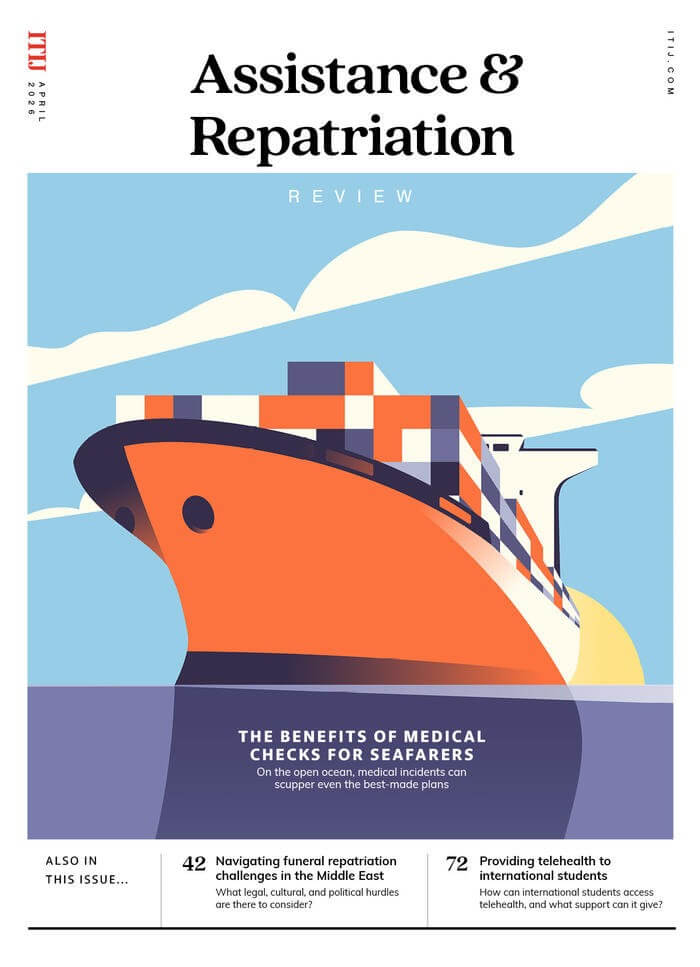
April 2026
Issue
In the first Assistance & Repatriation Review of 2026, we explore the cultural, legal, and logistical intricacies of funeral repatriation in, around, and out of the Middle East. We also consider how pre-deployment medical assessments can save lives and sea voyages. The burgeoning demand for telehealth among students is covered in our third feature, plus we look at how companies are delivering services that meet that need.
Editorial Team
The Editorial Team updates the ITIJ website daily, and works on features for the print edition. With expert industry knowledge and years of experience in writing about complex travel insurance issues, the Editorial Team is ready to investigate and report on the topics that matter most to ITIJ's readers.