No limits: the heaviest ECMO patient ever transported

Stanley Yoder of Phoenix Air on the heaviest ECMO patient transport ever recorded – 324kg
Five hospitals had already declined the transfer. Not because the patient wasn’t an ECMO candidate, but because the mission itself was considered impossible.
The mission
In Mississippi, a young man’s life hung in the balance. At 26 years old, the patient weighed 324kg (714lb) and had a BMI of 84.7. Initially admitted with sepsis, his condition had rapidly deteriorated. He was now profoundly hypoxic with severe acute respiratory distress syndrome (ARDS) and mechanically ventilated with peak airway pressures approaching 70cmH₂O. Proning wasn’t possible, conventional transport wasn’t feasible, and time was running out. Without extracorporeal membrane oxygenation (ECMO) support, he was unlikely to survive the nearly 400-mile journey to the nearest specialty hospital for definitive care.
There is only one air ambulance provider in the world with the aircraft, specialised equipment, and multidisciplinary expertise capable of executing a transport of this magnitude.
Phoenix Air accepted the mission. Two hours until wheels-up.
Engineering the impossible
Phoenix Air’s 24/7 Dispatch Center immediately began coordinating bariatric ground emergency medical services (EMS), specialised loading equipment, and landing permits while the clinical team prepared their state-of-the-art equipment for the record-breaking transport.
At the centre of the operation was one of Phoenix Air’s modified Gulfstream III aircraft, call sign Gray Bird. Unlike a conventional air ambulance, the G-III’s large cargo door and open-cabin configuration provide ample space to support longdistance ECMO transports without compromising patient access, clinical workflow, or passenger comfort.
Equally critical was Phoenix Air’s specialised bariatric stretcher system, engineered for patients weighing up to 454kg (1,000lb). Combined, the aircraft and stretcher created a transport platform capable of moving the heaviest patient ever transported on ECMO.
The 13-member retrieval team included physicians, perfusionists, critical care nurses and paramedics, pilots, logistics specialists, and a certified loadmaster. Each discipline brought a unique set of skills, but throughout the mission they functioned as one unit.
Movement becomes medicine
At the bedside in Mississippi, successful veno-venous (VV) ECMO cannulation was only the beginning.
The greater challenge was transitioning a fragile 324kg patient on ECMO through multiple care environments: ICU bed to stretcher, stretcher to ambulance, and finally into the aircraft.
Even with a purpose-built aircraft, the margin for error was narrow. The bariatric stretcher measured 205cm. The cargo-door opening measured 206cm. #
Less than one centimetre separated success from failure.
Spotters positioned inside and outside the aircraft coordinated the final loading sequence. The patient was secured.
The cargo door closed.
Wheels-up.
Another chapter
The remainder of the flight was remarkably uneventful. In critical care transport, that is often the greatest measure of success.
The patient arrived safely in Atlanta, Georgia, was decannulated from ECMO 15 days later, and ultimately returned home in stable condition shortly thereafter.
This mission now joins the long list of remarkable operations that have shaped Phoenix Air’s legacy. Many of those stories are chronicled in the newly released book No One’s Coming: The Rogue Heroes Our Government Turns to When There’s Nowhere Else to Turn by award-winning author Kevin Hazzard, which explores the extraordinary missions that have built Phoenix Air’s reputation as a leader in the global air ambulance industry.
Stanley Yoder, Director of the Air Ambulance Division at Phoenix Air Group, is a Flight Nurse and board-certified Emergency Nurse Practitioner based in Atlanta, Georgia. He leads a dedicated team of flight clinicians providing complex medical evacuation and critical care transport services worldwide, with particular expertise in non-traditional, austere, and resource-limited environments.
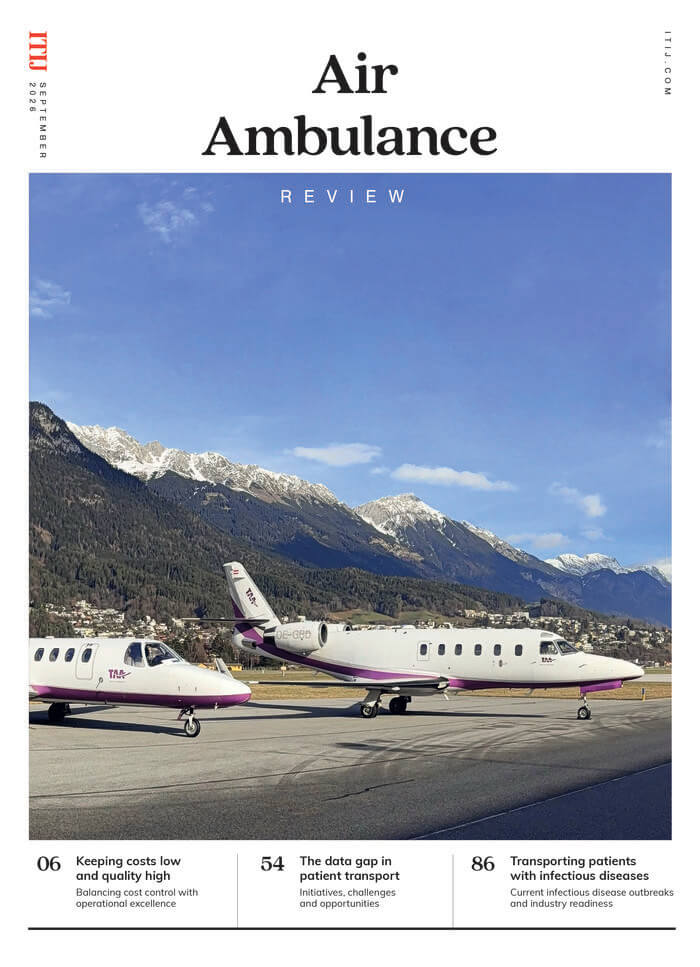
September 2026
Issue
This issue we focus on the problems that rising costs are having on the industry. Air ambulance providers are facing costs across fuel, aircraft maintenance, staffing, insurance, regulatory compliance, and specialist medical equipment. As if that wasn’t enough, delayed payments from insurers are adding further financial pressure. Despite these challenges, providers agree that patient safety and clinical quality must not be compromised.
Editorial Team
The Editorial Team updates the ITIJ website daily, and works on features for the print edition. With expert industry knowledge and years of experience in writing about complex travel insurance issues, the Editorial Team is ready to investigate and report on the topics that matter most to ITIJ's readers.