
News Analysis: Tracking brains across borders

As Washington debates who gets to work in America, rival nations are moving quickly to attract the world’s brightest minds. Milan Korcok investigates
A legal tug of war over US President Trump’s proposed US$100,000-plus fee levy for highly skilled foreign workers seeking H-1B immigration status to work in America continues to churn its way through the courts (after several defeats), while international student-applicants and highly skilled workers (mostly from India) wait and worry about their immigration status and future work prospects.
The proclamation
The H-1B proclamation by the Trump administration, issued in September 2025, asserted that abuse of the programme had disadvantaged and displaced US workers by catapulting in non-immigrant aliens as workers in occupations that required highly specialised knowledge and at least a bachelor’s degree or its equivalent.
The programme also established certain standards to protect similarly employed US workers from being adversely affected by the employment of foreign workers, and also protect the H-1B immigrant workers from being underpaid or being taken advantage of – as was apparent by existing payment rates. The proclamation specified that employers must attest to the Department of Labor that they would pay wages to the H-1B non-immigrant workers that were at least equal to the actual wage paid to other workers with similar experience and qualifications for the job in question.
However, in June 2026, a federal district court struck down the proposal as an unconstitutional tax, but days later, that same fee was temporarily put back in place through a court-ordered stay. The White House clarified that the proposed levy was a one-time payment, not an annual tax, and didn’t apply to existing H-1B holders or renewals of individuals already working and resident in the country. It was intended only for new H-1B applicants.
But as happens so often in America’s judicial game plan, a lower court ordered the fee protocol off-limits, and the administration had to back off and justify itself through more appeals.
Then on 24 August, President Trump proposed a new fee of $103,265 for all H-1B visa applications, using a more established federal process beginning with a 30-day consultation period.
So again, the world waits while courts and government departments dodge and weave.
The visa
For purposes of clarity (and this story needs clarity), the H-1B
visa is a non-immigrant classification that permits US employers to hire foreign workers in specialty occupations – roles that require highly specialised knowledge and at least a bachelor’s degree (or equivalent) level in specific fields such as computer science, engineering, mathematics or medicine.
Common positions include software developers, analysts, electrical engineers, accountants, and university researchers in many industries besides those represented by Amazon, Microsoft, Meta, Apple and so on, including the embattled healthcare industry, which is bleeding primary physicians, specialists, various levels of nursing and ancillary healthcare personnel, and more.
The programme also established certain standardsto protect similarly employed US workers from being adversely affected by the employment of foreign workers
Keep on reading

News Analysis: North America’s travel youth insurance markets strengthen, despite global ‘quakes’

AI and the new travel risk intelligence cycle
In the 60 years since the US government began allowing immigrant physicians into the country to solve the growing shortage, foreign doctors have become the invisible foundation of American medicine. Nearly one quarter of the physicians in the country now are international medical graduates, according to a 2023 study by the AAMC (formerly the Association of American Medical Colleges).
But there are more players in the field
Access to US universities and industrial locations (as well as to Canadian and Australian institutions) is prized among foreign pools of well-prepared and well-endowed candidates wanting assurance that after they pay steep fees, their sons and daughters will not end up in ‘no man’s land’ without that treasured degree or job. There is no shortage of qualified applicants. It’s channelling them to the right place that is the challenge.
According to data from US Citizenship and Immigration Services (USCIS), 406,348 H-1B petitions in 2025 – of which nearly 72% were for continuing employment positions – citizens of India accounted for 226,359, or 77.6% of all H-1B extensions. And according to the American Immigration Council, immigrants from India formed the largest country-of-birth group among immigrant STEM workers – 28.9%. There were also significant numbers of STEM workers who were born in China (273,000), Mexico (119,000), and Vietnam (100,000).
It has become clearer year after year that citizens of India provide the most consistent and plentiful manpower resource for professional-level careers. And for them, the H-1B visa is the single most important pathway to a career in the US. Each year, roughly 65–75% of all H-1B visas are awarded to Indian nationals – making the H-1B the most consequential immigration mechanism for the Indian diaspora. And India’s grip on H-1Bs isn’t loosening anytime soon.
Among foreign professionals already working in the US, Indians accounted for 50.3% of approvals for initial employment, while they made up 77.6% of continuing employment approvals, indicating that Indian professionals form a significant share of workers who stay in the US on renewed H-1B status. Overall citizens of India accounted for 71% of H-1B acquisitions, China 11.7%, the Philippines 1.3%, Canada 1.1%, and South Korea 1%.
Among foreign professionals already working in the US, Indians accounted for 50.3% of H-1B approvals for initial employment
In referring to the Trump proposal for levying $100,000 per H-1B application, India’s Pime Minister, Narendra Modi, came in for heat from his political cohorts for not being more demonstrative with the President about singling out the huge advantage America gains from having access to India’s youth. But he deferred and emphasised the need for India to become self-reliant, saying that the real enemy of the country was dependence on others. “We have no major enemy in the world. Our only real enemy is our dependence on other countries. This is our biggest enemy, and together we must defeat this enemy of India, the enemy of dependence.”
Canada plays the game as well
Interestingly, Canada is not only a beneficiary of its neighbour’s H-1B pathway, but is launching a similar channel of its own to induce not just tech specialists, but also medical professionals (which it needs direly) to join its ranks. It even offers American applicants trapped by the uncertainty of America’s responses to foreign applicants, including H-1B visa holders currently in the US, to look north. As the Government of Canada declares on its website: “To strengthen Canada’s innovation ecosystem, address labour shortages and attract top talent in healthcare, research, advanced industries and other key sectors, in the coming months IRCC [Immigration, Refugees and Citizenship Canada] will develop and launch an accelerated pathway for H1-B visa holders.”
The Aussies compete too
Similarly, another member of the Anglosphere, Australia, has very effectively opened up to these top tiers of talent, and is not reticent about competing with the best for the best. As per its Postgraduatefutures.com.au site: “Information and Communication Technology (ICT) professionals are projected to soon become Australia’s largest group of STEM workers. In the projections, ICT professionals are estimated at 419,700 workers in May 2025, rising to 481,900 by May 2030 and 526,400 by May 2035. The ever-expanding role of information technology, including the harnessing of big data, explains growing demand...”
Quite clearly, when it comes to harvesting brains, borders don’t matter very much.
October 2026
Issue
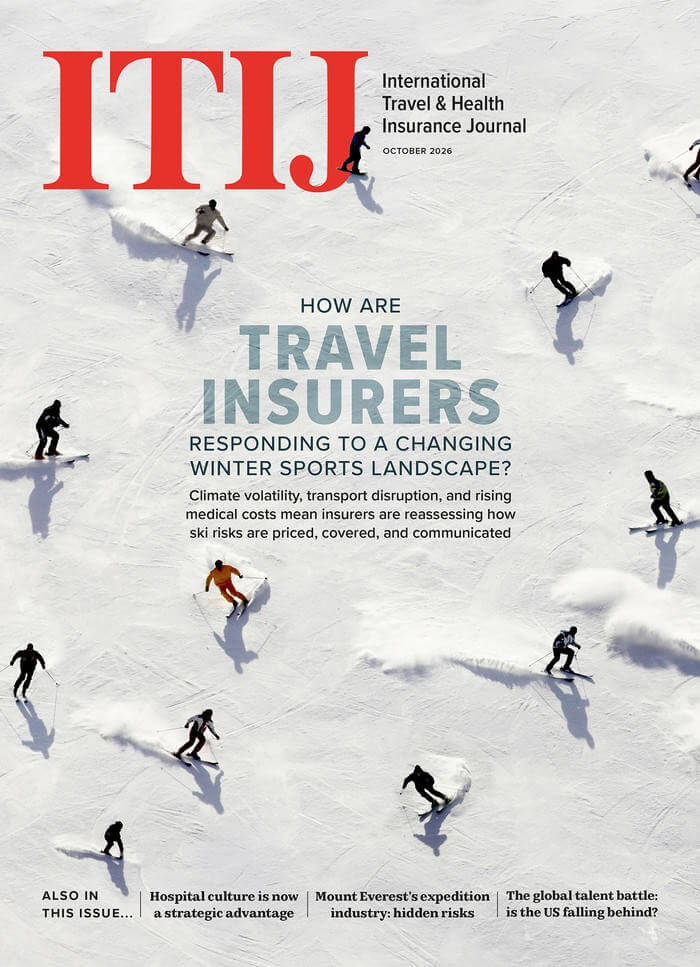
This month in ITIJ we take a close look at how travel insurers are responding to the changes in winter sports risk, and we ask how risk is priced, covered and communicated to policy holders.
How do international hospitals stand out from the crowd, and become the number one choice for insurers and assistance companies? Clinical excellence alone is no longer enough. We look at why hospital culture has become a strategic advantage, and how dedicated international departments are strengthening relationships between hospitals, insurers, and assistance companies.
Milan Korcok
Milan Korcok is a national award-wining medical writer who has been covering international healthcare activities and trends in Canada, the US and abroad for many years. He has long served as contributing editor to the Canadian Medical Association Journal and the Journal of the American Medical Association. He is a founder of – and has served as editor of – the US Journal of Drug and Alcohol Dependence; a founder of the Travel Health Insurance Association of Canada, and currently serves as contributor to ITIJ.