
News analysis: Cape Verde medevac pressures test insurers

Rising medical evacuations and healthcare limitations in Cape Verde are prompting insurers to rethink coverage, costs, and client guidance
Cape Verde, the island nation off West Africa, has grown rapidly as a tourist destination. Visitor numbers have climbed from 115,000 in 2000 to nearly a million in 2024, with UK travellers now making up just over a third of arrivals. But alongside this growth, the islands’ healthcare limitations are becoming more transparent, particularly following outbreaks of gastric illness that have affected hundreds of visitors and, in a few cases, proved fatal.
Reports from the UK Health Security Agency show that since October 2025, 112 Britons contracted shigella and 32 salmonella after trips to Cape Verde. In early 2026, media coverage revealed that four UK tourists died in 2025 after falling ill at various resorts across the islands.
The UK government has formally acknowledged the issue. In its travel advice, the Foreign, Commonwealth & Development Office (FCDO) states: “The UK Health Security Agency is investigating an increase in reports of Shigella sonnei and Salmonella infection in travellers returning from Cape Verde. If you have an underlying health condition, speak to a healthcare professional before travelling.”
ITIJ contacted the FCDO, which declined to provide further comment but urged travellers to follow its current online travel guidelines.
How insurers might be rethinking risk
Medical assistance providers describe Cape Verde as a textbook case of “cost versus frequency”. According to AXA, “the primary driver of medical expenses is not the volume of cases but the extreme cost of individual evacuations”. In other words, claims volumes may be manageable, but a single serious case can generate a disproportionate financial burden.
AXA characterises the country’s healthcare system as “basic and limited”, noting that specialised care is largely concentrated in the urban centres of Praia and Mindelo and that “the country’s healthcare system relies on external support for severe cases”.
Geography compounds the issue. For tourists visiting more remote islands such as Brava or Santo Antão, which lack functional airports, “any serious medical condition necessitates a multi-modal transfer involving maritime transport followed by international air ambulance services”. This “logistical complexity”, combined with the need for long-haul transfers to suitable medical hubs, means “even a single case can represent a substantial financial charge”.
This helps explain why insurers may be examining territorial limits, underwriting criteria and pricing assumptions, even in the absence of a dramatic spike in overall claim frequency. High-severity, low-frequency risk requires a different modelling approach.
The primary driver of medical expenses is not the volume of cases but the extreme cost of individual evacuations
Sustainability of travel insurance coverage
For assistance companies, AXA told ITIJ that sustainability in Cape Verde depended on moving “from reactive measures to a proactive, standardised strategy” built around rigorous medical triage, a strong local provider network, and carefully selected evacuation hubs.
Selecting an appropriate evacuation hub involves carefully balancing medical necessity, logistical feasibility, and cost, with the choice strongly influenced by the severity of the patient’s condition. Two factors are particularly important: proximity to the patient, and the clinical capabilities available at the hub.
Dakar, Senegal, is often seen as a practical option, offering both close geographic access and emergency medical teams certified to World Health Organization (WHO) standards. In contrast, Morocco stands out for its extensive private clinic network and strong air ambulance capacity, providing flexible options for a range of medical needs. Meanwhile, the Canary Islands combine European Union (EU)-regulated healthcare with a stable logistical environment, making them an attractive choice for patients requiring reliable infrastructure near the archipelago.
Overall, the selection of a hub is a nuanced decision, weighing the urgency of the medical situation against the quality, accessibility, and reliability of care available.
AXA also stressed that evacuation planning could not be separated from detailed local knowledge. Understanding the medical facilities available across the islands and their capacity “to treat life-threatening cases” is as critical as aircraft availability. The insurer has indicated it will conduct a comprehensive on-site audit to further refine and optimise its strategy.
AXA stated that “a proactive air ambulance strategy is essential”, involving pre-identified providers that meet strict safety and clinical criteria, negotiated pricing structures, and real-time aircraft visibility to select the most efficient partner. It further argued that complex cases should be overseen by a medical director to ensure clinical decisions are medically driven while maintaining cost control.
Protecting clients in practice
Beyond evacuation logistics, prevention and case management are increasingly important. The recent gastrointestinal outbreaks have sharpened the relevance of official travel guidance and pre-travel screening.
Stronger partnerships with selected local hospitals may help establish a baseline quality of care and facilitate communication with European receiving hospitals if evacuation becomes necessary. Advising travellers on hygiene, food, and water precautions, and encouraging prompt reporting of symptoms could reduce escalation rates and therefore evacuation frequency.
Policy design may also evolve. Some insurers could differentiate between islands, introduce clearer pre-authorisation requirements for high-cost interventions, or apply adjusted deductibles in areas with limited infrastructure. Such steps would not eliminate exposure but could make it more predictable and financially sustainable.
Broader context
The healthcare constraints in Cape Verde are intertwined with wider infrastructure realities. Even on larger islands, facilities may face equipment shortages, limited specialist capacity, and intermittent electricity or water supply. Transport links between islands can be weather-dependent, and road conditions vary.
At the same time, Cape Verde remains politically stable and continues to attract both short-term tourists and longer-term expatriates, particularly in Sal, Boa Vista, and Praia. For insurers providing international health or expat cover, medical risk sits alongside contractual, property, and logistical considerations that require careful planning and communication.
The pattern is not unique. As emerging destinations grow in popularity, tourism often outpaces healthcare infrastructure development. The result is a familiar equation: rising visitor numbers, uneven local capacity, sporadic outbreaks of infectious disease, and high-cost evacuation exposure.
Looking ahead
The Cape Verde experience illustrates that sustainability in travel insurance is not simply a matter of raising premiums. It involves detailed local knowledge, structured evacuation planning, medical oversight, and proactive case management.
As AXA’s analysis suggests, the core challenge is structural rather than statistical: a market defined less by high claim frequency and more by the severity and complexity of individual cases. When “even a single case can represent a substantial financial charge”, operational efficiency and clinical governance become as important as actuarial pricing.
For travellers, awareness remains critical. Understanding which islands have stronger facilities, recognising symptoms early, and following hygiene advice may materially affect outcomes. For insurers and assistance providers, Cape Verde serves as a reminder that in geographically fragmented destinations with limited specialist care, preparedness, not just coverage, determines outcomes
April 2026
Issue
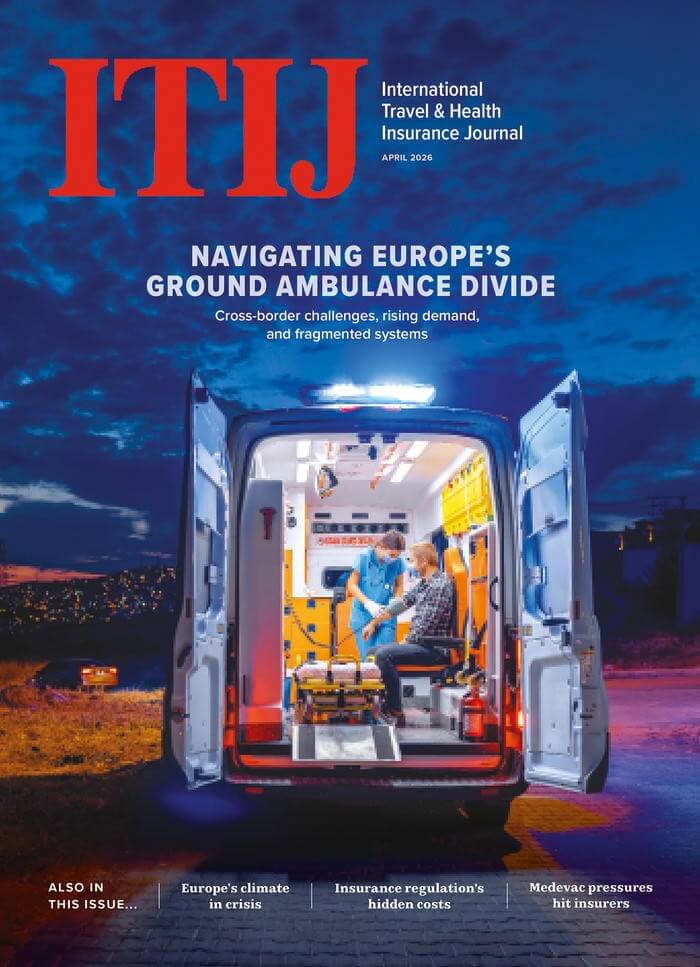
Across Europe, demand for ground ambulance services is rising, while capacity, workforce availability, regulatory limits and inflationary cost pressures intensify. We look at the evolving landscape, highlight major market stress points, and assess how stakeholders are responding. We also have anassessment of the latest regulations in different jurisdictions that are hindering insurance development and growth. We cover the most important regulatory frictions across major and emerging jurisdictions, explain how they impede growth, and propose actionable mitigations for industry stakeholders.
Chloe Fox
Chloe Fox is an Editorial Assistant for Voyageur Group, joining in 2024. She writes for ITIJ and AirMed&Rescue, covering a range of topics including international travel and health insurance, medical assistance provision, and air medical transportation. Chloe holds a BA (Hons) in English and an MA in English Literature from the University of Bristol.